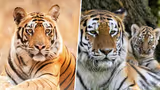
Billy Arjan Singh, once a hunter, turned into one of India's most respected conservationists. His work at Dudhwa National Park saved tigers and leopards, creating a powerful legacy of wildlife protection in India.
KNOW
On International Tiger Day, the world celebrates efforts to protect one of nature's most majestic animals, the tiger. In India, one name stands out in this mission and that is Billy Arjan Singh. Once a hunter, Billy spent over four decades protecting wildlife, especially tigers, in the forests of Uttar Pradesh. His life’s journey, from pulling the trigger to saving lives, changed the face of Indian conservation of tigers forever.
Billy Arjan Singh: From hunter to protector
Billy Arjan Singh was born on August 15, 1917, in Gorakhpur, Uttar Pradesh. He grew up in the princely state of Balrampur, where his father Jasbir Singh was a royal manager. As a child, Billy was surrounded by royal life and hunting, which was a common activity among the elite.
In his early years, Billy loved hunting. But his life changed completely one night when he shot a young leopard. Seeing the animal in the headlights of his vehicle, he felt a deep sense of regret and guilt. From that moment, he gave up hunting forever and decided to dedicate his life to protecting animals.
Related Articles

Saving Dudhwa's wildlife
Billy’s first major conservation effort began in Dudhwa, a forest reserve in Uttar Pradesh. He worked hard to protect a rare species of deer called the barasingha in the Sathiana range. His passion and determination caught national attention. In 1976, he was awarded the WWF Gold Medal, one of the top global honours for conservation.
With Billy’s strong push, Prime Minister Indira Gandhi declared Dudhwa a national park. This marked the beginning of a new chapter in Indian wildlife protection.
Raising and releasing big cats
Billy didn’t stop at protecting animals, he wanted to reintroduce big cats into the wild. He raised a leopard cub named Prince and successfully released him into Dudhwa in 1973. Later, he raised two female leopards, Harriet and Juliette, to give Prince companions.
In 1976, Billy brought a hand-raised female tiger named Tara from Twycross Zoo in the UK. With permission from Indira Gandhi, he released Tara into the Dudhwa National Park. This bold experiment became world famous and sparked conversations about rewilding.
A controversial legacy
In the 1990s, some tigers in Dudhwa were found to have unusual features such as larger heads, pale skin and wider stripes. These traits looked similar to Siberian tigers, raising concerns that Tara, who was reared in the UK, may have passed on non-native genes. Tests by scientists in Hyderabad found that two tigers in Dudhwa carried genes from both Bengal and Siberian tiger species. However, the samples were too few to confirm this fully.
Despite the debate, Billy's efforts helped create awareness and opened new scientific questions about reintroduction and genetics in conservation.
Honours and recognition
Billy Arjan Singh received many awards for his work:
- Padma Shri (1995)
- WWF Gold Medal (1996)
- Order of the Golden Ark (1997)
- J. Paul Getty Wildlife Conservation Award (2004)
- Yash Bharati Award and Padma Bhushan (2006)
These awards reflect his lifelong commitment to saving India's wildlife.
His final years and lasting impact
Billy spent the rest of his life in Dudhwa, living close to the animals he had protected for decades. He believed that tigers were not just part of the forest, they were central to human survival. For him, saving tigers was a personal mission.
He passed away on January 1, 2010 at the age of 92. His legacy lives on in every tiger that walks the forests of Dudhwa, and in the work of conservationists across India.