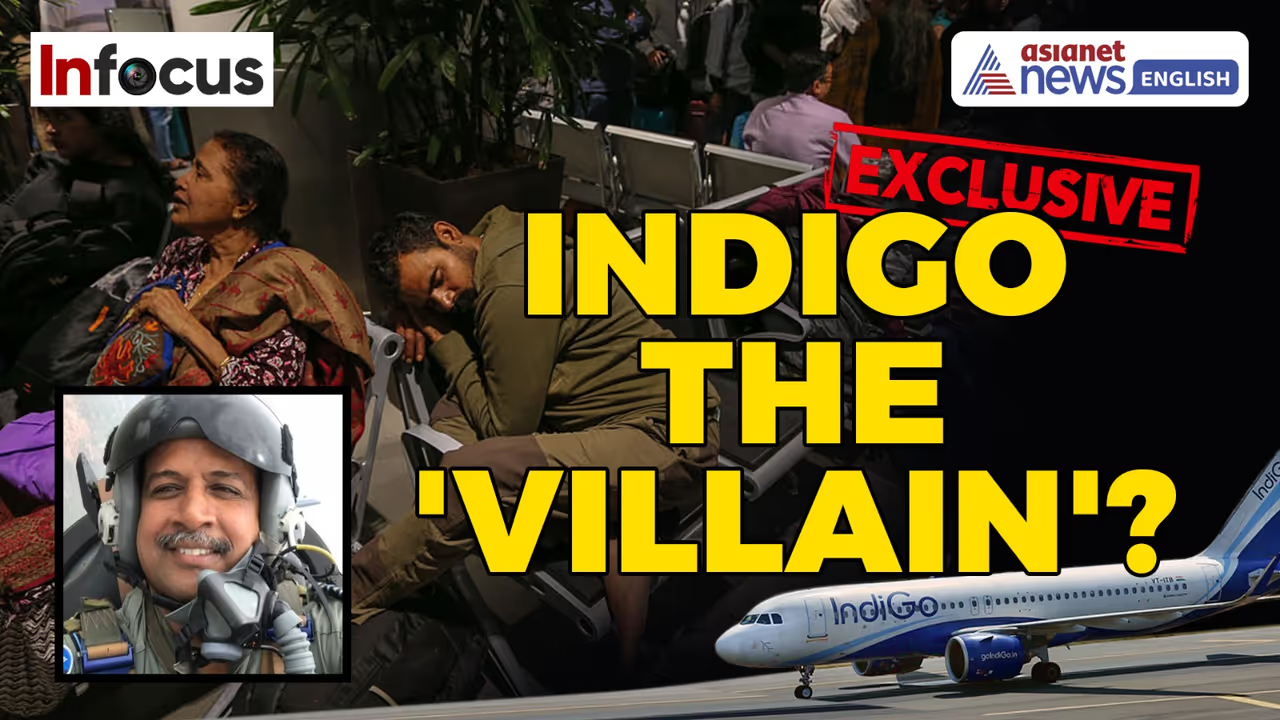
Aviation expert Group Capt MJ Augustine Vinod (Retd) breaks down IndiGo’s massive flight meltdown, exposing pilot shortages, FDTL shock, infrastructure gaps and why India’s aviation system was bound to crack.
As IndiGo enters its sixth day of unprecedented chaos—with over 220 more flights cancelled on Sunday across Delhi and Mumbai, thousands stranded, and the DGCA issuing show-cause notices—aviation experts are trying to decode what exactly triggered this systemic collapse in India’s largest airline.
To understand the complexity behind the meltdown, Asianet Newsable English spoke with Group Captain MJ Augustine Vinod (Retd), a veteran aviator, who offers a rare, deeply technical, yet pragmatic view of what went wrong.
Related Articles

Not Deliberate—But a Failure to Anticipate Scale
When asked whether IndiGo’s severe cancellations were deliberate or a calculated move around FDTL implementation, Vinod rejects the conspiratorial interpretation outright.
“Any corporate worth its salt — especially one doing as well as IndiGo in terms of market share or overall progress in aviation — would never do something like this deliberately. It would be foolish to think so. And yet, I see such assumptions being made very often in the media,” he said.
“Who in his sane mind would do this deliberately just to tweak some law or rule that might have given them X amount in gain? Compared to that supposed gain, what they’ve lost in this entire quagmire is almost 10X or even 20X,” Vinod added.
He explains that the financial losses IndiGo has incurred—after cancelling nearly 1,600 flights on Friday, and hundreds more over the weekend—are far greater than any supposed gains from relaxing FDTL norms till February.
“If you look purely at the money, the amount IndiGo lost through this entire ordeal is far more than what it would’ve gained from the relaxation it got till February. I’m only talking about the money part here. So people who claim this happened by design, or that they engineered it — they simply don’t know what they’re talking about. So no one will do this deliberately,” Vinod explained.
Instead, Vinod believes IndiGo was “caught off guard”, pointing to operational stresses that accumulate unnoticed until one misaligned cog triggers a chain reaction.
The Domino Effect: How One Technical Hitch Can Collapse a Giant
Vinod draws attention to the ELAC software upgrades recently undertaken by Airbus operators, including IndiGo and Air India.
“Air India and IndiGo did it. But my question — and I'm not giving an answer, I'm simply asking — to the viewers watching you and to you: would that have had no effect on operations? That is question number one. In that, there is a variable. In business mathematics, everything runs on variables. And the biggest variable — the biggest cog in the wheel of this entire system — was that ELAC software upgrade or update. A small hitch here, a small hitch there… your system should ideally be able to absorb that shock,” he said.
IndiGo, with 65% of India’s market share, is too large and too tightly scheduled. Even a small disruption creates compounding ripple effects, far more severe than what a smaller airline would face.
“When you talk about a company which holds a large market share… a small cog in the wheel misaligning has a larger snowballing consequence.”
This is the aviation version of a Swiss-cheese failure model, where several small holes align to create a catastrophe.
The Captain Crunch: A Crisis Years in the Making
The government’s inquiry panel has already flagged non-provisioning of adequate arrangements for FDTL as the primary cause. Vinod goes deeper, highlighting the root of the shortage: India’s inability to produce captains fast enough.
He breaks down the mathematics:
“From the time a girl or boy finishes NEET and joins MBBS training, to the time he or she becomes a full-fledged doctor, it takes five years. For a captain, on average, it takes seven years — six years if he or she is exceptionally smart. So it takes time… and captains aren’t ready-made in India."
“You join as a First Officer, then you become a Senior First Officer, you gain experience. Then you undergo captain’s training. From the time you start captain’s training to the time you finish, it takes anywhere between 10 months to one year. I’m not batting for anybody. But let me tell you, we live in a democratic country, and our labour laws are straightforward. As far as captains are concerned, you give six months’ notice to the company, and you can leave for greener pastures,” he added.
With large numbers of Indian pilots leaving for international carriers—who offer nearly three times the in-hand salary—the system is unable to replace the outflow.
“The CEO of Air India talked about poaching. Why did he mention poaching and express such serious concern to the Indian polity? Because many airlines across the world are expanding rapidly, and they are paying amounts that are almost three times what a pilot gets in hand here. I’m talking about in-hand salary. In India, we have high taxes, so what a pilot actually gets in hand is just two-thirds of what he or she earns. But abroad, if a pilot earns the same amount, almost the entire amount goes into the pocket. So naturally most of them leave India and go abroad. Nothing wrong in that… But this is one variable you cannot design in your system to take that kind of a shock," Vindo highlighted.
Retaining pilots, he argues, requires higher salaries—but Indian carriers are bound by fare caps.
“How will you retain someone? By paying him more. How will you pay more? By earning more. How will you earn more? By loading it onto the passengers. Now, how will you load it onto the passengers? You have a cap.”
It becomes a vicious loop with no easy exit.
Dissent, Culture, and “Cartel” Allegations
In recent days, pilot unions have accused IndiGo of fostering a fear-driven culture that discourages raising safety or fatigue concerns. Vinod responds with both candour and caution.
“A dissentless organization is a dead organization… dissent in an organization is a healthy thing.”
However, he clarifies that disciplinary action is not unique to IndiGo.
“If you do [breach policy], then I will have no choice but to respectfully tell you, ‘Thank you very much for your service.’ Coming clean is not the responsibility of the company which tells you, “Thank, thank you very much.” You've stepped over the line."
He urges observers to evaluate the larger picture, not isolated claims.
Is Rolling Back FDTL the Solution?
With passengers stranded and the ministry forcing IndiGo to refund all cancelled flights by Sunday 8 PM, the debate around fatigue rules is intensifying.
Vinod strikes a balanced view:
“In the last 10, 15, 20 years… how many accidents happened because of [the older FDTL]? I don’t think any.”
But he immediately adds:
“We need to get at par with international rules regulations as far as FDTL is concerned. Rest may not be adequate for any pilot to carry out his job to the fullest capability because passenger safety is involved."
The real question, he says, is timing:
“When this was implemented in November, were we ready? I don’t know the answer. A small change in a smaller organization will not have a larger effect on the people. A small change in a larger organization will have larger effect on people. It's mathematics. It has nothing to do with IndiGo or no IndiGo."
For an airline carrying two-thirds of India’s domestic passengers, even minor shifts become seismic.
India’s Weakest Link: Training Infrastructure
Vinod paints a stark picture of India’s flight training landscape.
“We are awfully short of training facilities… we train our cadet pilots in America, New Zealand, South Africa… We don’t have training infrastructure.”
Airports, too, are not built for shock absorption.
“Charles de Gaulle appears empty… because it’s made to absorb a shock…During day-to-day operations, these airports appear absolutely empty. It’s as if you have two or three people in front of you, two or three behind you — spread across a kilometre of distance. That is how infrastructure needs to be in every airport. There is a mathematical model that determines how large an airport must be, based on growth potential and where they expect to be five or ten years down the line. That has not happened here. And the same applies to training. We are training everywhere else.”
And the DGCA?
“Our FTDs need to catch up. That has not happened. And for that to happen, everyone keeps pointing fingers at the DGCA — but the DGCA is woefully short of manpower. They are working with the same manpower they had 30 years ago. They haven’t received any incremental staffing. And in any government organization, increasing manpower requires cadre change. Cadre change needs justification, which must be passed on the floor of Parliament," Vinod added.
India’s aviation ecosystem, he suggests, is simply not scaled for its ambitions.
Why Did IndiGo Expand Winter Flights Despite Shortages?
IndiGo expanded capacity for the holiday rush. Shouldn’t the airline have known better?
Vinod says the answer lies in pilot migration:
“I would request you to find out how many Indian pilots have gone to Etihad and Emirates in the last six months. The number’s mind-boggling. Why? Greener pastures, more money. Coming back to retention policy. Aviation is so intricately connected."
IndiGo planned with the pilots it had. But the outflow—and global hiring spree—outpaced every forecast.
Price Gouging by Other Airlines
With IndiGo down, fares on other carriers have skyrocketed. Vinod doesn’t hold back.
“This is harakiri… making hay while the sun shines… finding opportunity in a disaster… God is watching all of you.”
He notes airlines may be using loopholes by inflating ancillary charges like meals, since fare caps apply only to base tickets.
The Big Picture: A Crisis Long in the Making
As IndiGo submits explanations to the DGCA and the government mulls strong action, Vinod’s assessment is unambiguous: this crisis is not about one airline. It is about systemic overload, inadequate infrastructure, global pilot migration, and unrealistic expectations from a carrier that carries 65% of India’s passengers.
In India’s case, the weakest link has simply snapped first.