
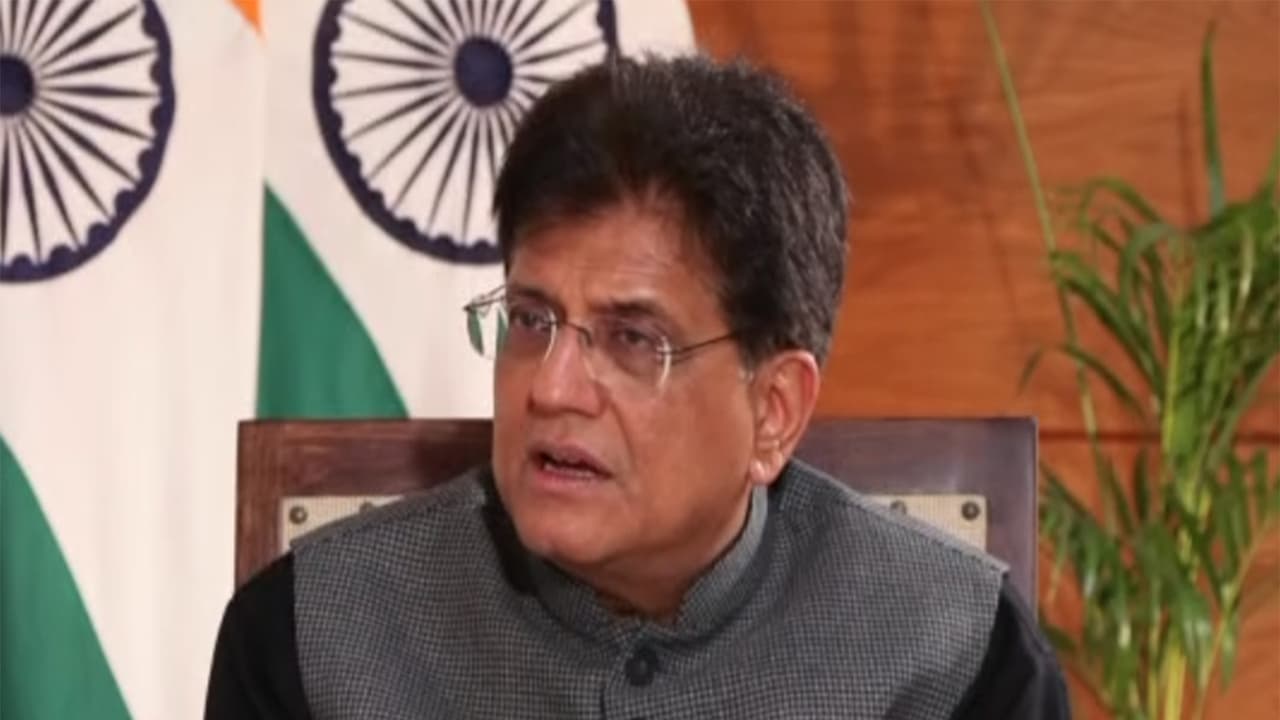
Union Minister Piyush Goyal highlights the India-US interim trade agreement as a key geopolitical move, not just a commercial pact. He states it cements a strategic partnership in defence and technology, achieved through a win-win negotiation.
Union Minister of Commerce and Industry Piyush Goyal on Saturday emphasised that the interim trade agreement between India and the US is not merely a commercial pact but a cornerstone of a major geopolitical shift. Speaking exclusively to ANI, Goyal said the agreement reflects the broader depth of the India-US partnership, which spans defence, technology, critical minerals and strategic cooperation.
Strategic Alignment Over Commercial Pact
Goyal emphasised that while trade is the vehicle, strategic alignment is the destination. The deal is designed to "cement" a partnership that is already flourishing across several high-stakes domains. "Our partnership encompasses much more than trade. We have a strong defence partnership and are members of two quadrilaterals. Both of us share interests in critical minerals and in the partnership on technology. So for us, this is a trade agreement which will further cement the US-India long-term strategic goals," he said.
Negotiations Based on Mutual Respect
Negotiations of this magnitude often conjure images of high-tension standoffs, but Goyal described the closing hours as a masterclass in mutual respect. He said that both nations acknowledged their domestic constraints. The goal wasn't to "win" a point, but to find the "fine balance" where both economies could flourish without competing destructively. "Well, I think all negotiations are conversations in a very friendly manner. Both sides always look to protect their best interests as they should. Their sensitivities on every issue that we discuss. The US may have some sensitivities, we may have some sensitivities. We must respect the sensitivities on both sides. The general approach is to reach an equitable, fair, and balanced outcome. Usually, towards the end, you are trying to bring that fine balance, which really makes it a win-win for both parties," he said.
"We have come through the negotiations, whether earlier or in the last 48 hours, with a very good agreement that will serve both countries honourably and provide opportunities for both countries in their respective areas of strength, which are quite different," he added.
A New Era of Indian Diplomacy
Goyal compared this deal to India's other Free Trade Agreements (FTAs) with developed nations and highlighted a new era of Indian diplomacy: one where India is no longer just a "market" for the West, but a complementary partner in a high-tech, strategic ecosystem. "And I think just as in all the other FTAs we have done with developed countries, and all our FTAs you must have observed are with countries that are not our competitors. They complement our economy. Similarly, the US is a country which has very deep strategic interests for India, as do we for the US," he added.
Details of the Interim Agreement
Earlier, the United States and India announced a framework for an Interim Agreement on reciprocal, mutually beneficial trade, reaffirming their commitment to a broader Bilateral Trade Agreement (BTA) launched by President Donald Trump and Prime Minister Narendra Modi on February 13, 2025.
India's Tariff Reductions
As part of the framework, India has agreed to eliminate or reduce tariffs on all US industrial goods and a wide range of US agricultural and food products, including dried distillers' grains (DDGs), red sorghum for animal feed, tree nuts, fresh and processed fruit, soybean oil, wine and spirits, and additional products.
US Reciprocal Measures
On the other hand, the United States will impose a reciprocal tariff of 18 per cent on goods originating in India, including textiles and apparel, leather and footwear, plastic and rubber products, organic chemicals, home decor, artisanal goods and certain machinery. Subject to the successful conclusion of the Interim Agreement, the US has said it will later remove reciprocal tariffs on select items, including generic pharmaceuticals, gems and diamonds, and aircraft parts. The United States will also remove tariffs on certain aircraft and aircraft parts from India, which were imposed to address national security threats, the joint statement said.
According to the statement, India will eliminate or reduce tariffs on all US industrial goods and a wide range of US food and agricultural products, including dried distillers' grains (DDGs), red sorghum for animal feed, tree nuts, fresh and processed fruit, soybean oil, wine and spirits, and additional products. (ANI)
(Except for the headline, this story has not been edited by Asianet Newsable English staff and is published from a syndicated feed.)