
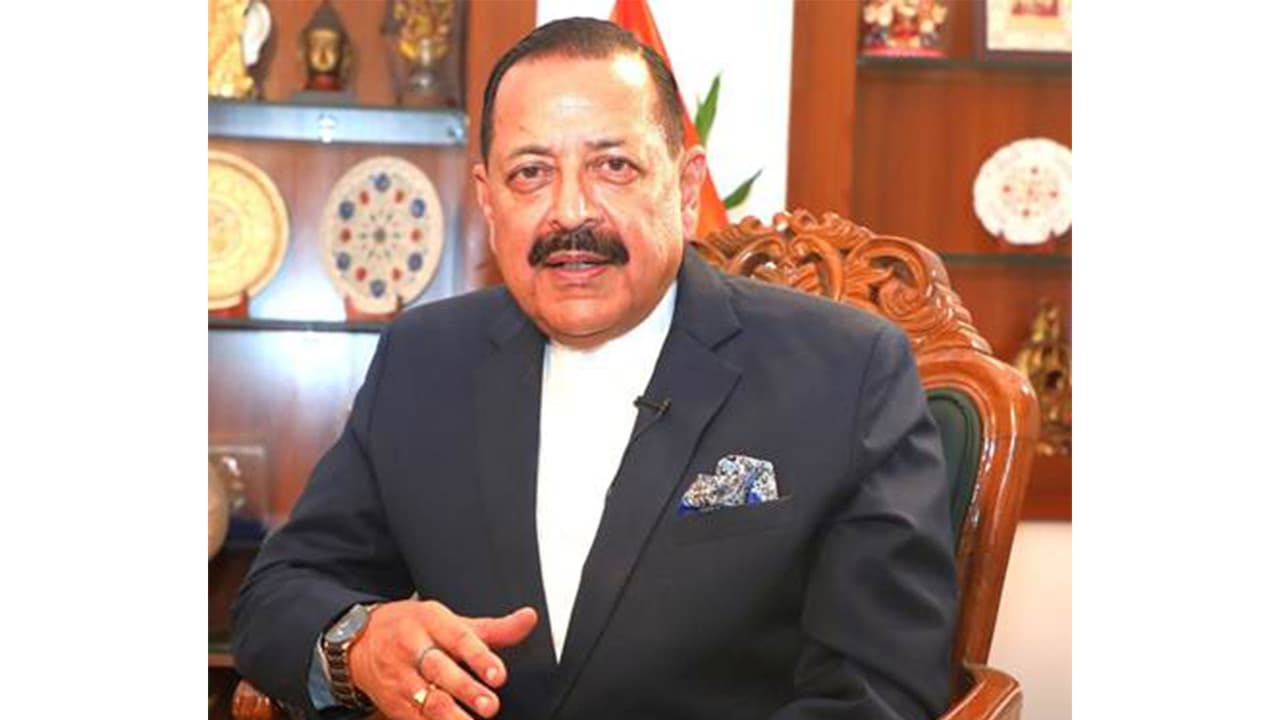
Union Minister Jitendra Singh hailed 12 years of the Modi govt for transforming India into an aspirational nation. He highlighted growth in the space and startup sectors and key governance reforms that have fostered a culture of merit and innovation.
Union Minister Jitendra Singh on Sunday said that 12 years of the Narendra Modi government have transformed India into an aspirational nation driven by opportunity, innovation and self-belief, while asserting that governance reforms, technological democratisation and citizen-centric policies have reshaped the way Indians perceive their prospects.
According to a press release, the Minister outlined the next phase of growth, stating that India's space economy, currently close to $9 billion, is expected to expand to about $45 billion over the next seven to eight years as the country advances towards the goal of becoming a developed nation by 2047.
Exponential Growth in Space and Startup Ecosystems
Reflecting on Prime Minister Narendra Modi's 4,399 days in office as a continuously serving elected Prime Minister, Dr. Jitendra Singh highlighted a range of measurable outcomes over the past decade. He said India's space startup ecosystem had grown from a single-digit number of startups a few years ago to around 400 today, with one startup recently attaining unicorn status. India's space economy is now valued at nearly $9 billion and is projected to reach $45 billion by the end of the next seven to eight years.
The Minister said the country's startup ecosystem had expanded from about 350-400 startups in 2014 to more than 2.3 lakh at present, generating nearly 24-25 lakh jobs. Nearly half of these startups are located in Tier-II and Tier-III cities, while 35-39 per cent are women-led.
He also noted that a recent space launch witnessed the participation of around 1,500 media personnel and nearly 10,000 spectators, reflecting growing public engagement with science and technology.
Citizen-Centric Governance Reforms
The release further stated that Jitendra Singh said some of the government's earliest reforms symbolised a shift towards a citizen-centric governance model. He cited the decision to end the requirement of gazetted-officer attestation of documents and permit self-attestation as a landmark step that signalled trust in citizens, particularly the youth.
The Minister also referred to the abolition of interviews in several categories of government recruitment, saying the move reduced opportunities for nepotism, discretion and malpractice while strengthening merit-based selection.
"These reforms helped create confidence that success could be achieved through ability and hard work rather than influence or recommendation," the Minister added.
Fostering an Aspirational Culture
Arguing that the most profound change of the past 12 years has been psychological, in addition to procedural, Jitendra Singh said India had witnessed the rise of a new aspirational culture.
"The change of mindset that has happened in the last 12 years under Prime Minister Modi is one of the biggest hallmarks," he said. "The kind of aspirational surge that has happened -- 'I can also do it' -- was not there earlier."
The Minister said this shift was visible in the growing number of civil services toppers emerging from small towns and non-metropolitan backgrounds, reflecting the democratisation of opportunity through technology, transparency and fair competition.
Scientific Achievements and Institutional Transformation
The Minister also linked India's scientific achievements to this broader transformation. Referring to the Chandrayaan missions, he said the government had fostered a culture in which citizens increasingly identify with national scientific achievements and view innovation as a shared national endeavour.
He recalled that Prime Minister Modi encouraged scientists after setbacks and celebrated their successes, helping normalise the idea that failure is a part of innovation and progress.
Singh said India's successful landing near the Moon's south pole had strengthened public interest in science, while earlier discoveries by Indian lunar missions had helped identify evidence of water molecules on the Moon.
Opening Strategic Sectors to Private Participation
Highlighting institutional changes, Jitendra Singh said the Modi government had opened strategic sectors such as space and parts of the nuclear ecosystem to private participation, ending decades of restricted access. He said these sectors had traditionally operated behind closed doors but were now integrated with industry, entrepreneurs and startups.
According to the Minister, this policy shift had expanded career opportunities, accelerated innovation and aligned India's scientific ecosystem with global best practices.
He also noted that initiatives such as Viksit Bharat reflected a broader emphasis on benchmarking India's progress against international standards rather than domestic comparisons alone.
Transparent Welfare Delivery
The Minister further argued that welfare delivery had also moved towards universal and transparent implementation. Referring to housing and other welfare programmes, he said benefits were being delivered without discrimination based on caste, religion or any other affiliation, creating greater trust in public institutions and governance systems.
The Road Ahead to 2047
Looking ahead, Jitendra Singh said India's development journey would require deeper public-private collaboration, stronger participation of women and youth, continued expansion of emerging sectors such as space, nuclear energy and quantum technologies, and adherence to global standards of performance and innovation.
The Minister maintained that the government's long-term objective was not merely economic growth but the creation of an empowered and aspirational society capable of contributing to the vision of a developed India by 2047.
The remarks place the government's 12-year record within a broader narrative of governance reform, institutional transformation and an effort to shift India from a culture of entitlement and dependence towards one driven by aspiration, merit and innovation. (ANI)
(Except for the headline, this story has not been edited by Asianet Newsable English staff and is published from a syndicated feed.)