
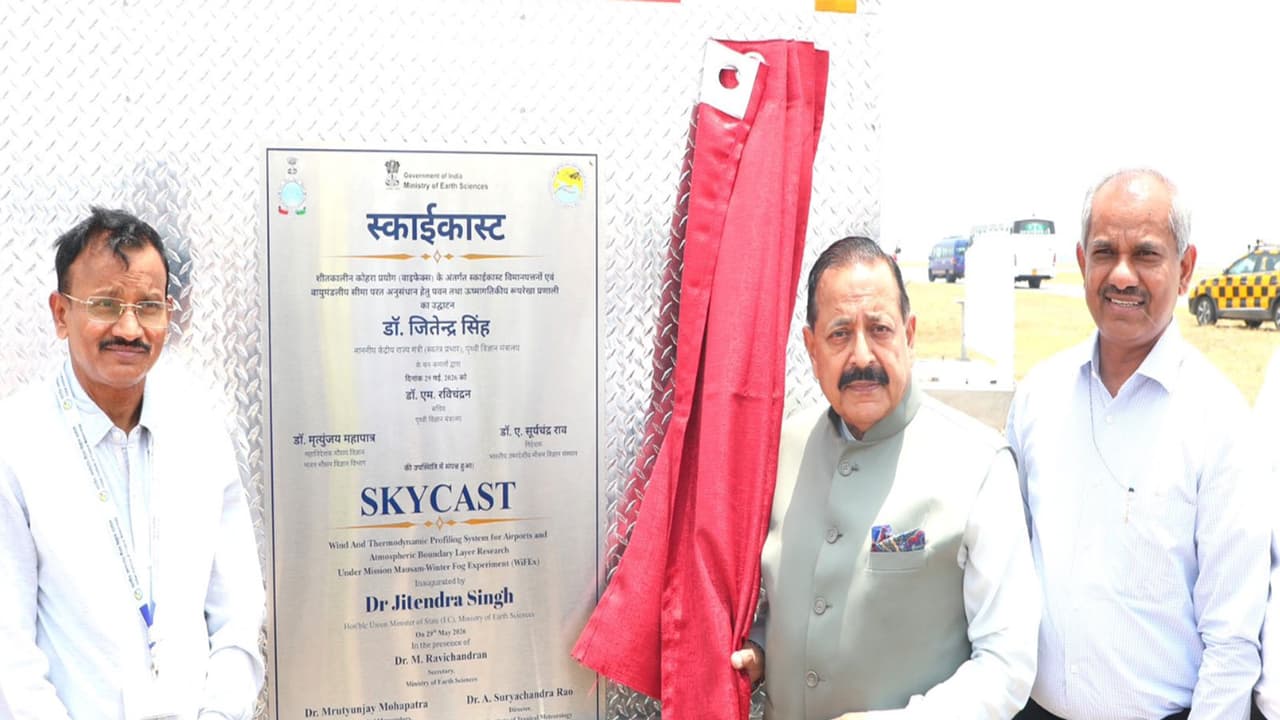
Union Minister Jitendra Singh inaugurated India's first 'SkyCast System' at Delhi's IGI Airport. The advanced weather monitoring system will enhance aviation safety by providing real-time data, reducing fog-related delays and cancellations.
A New Era in Indian Aviation
Union Minister for Science and Technology Jitendra Singh today inaugurated India's first "SkyCast System" at Indira Gandhi International Airport in the national capital, calling it the beginning of a new era in Indian aviation.
The Minister informed that only 18 such advanced systems exist across the world so far and India has now become the 19th in the world to install this integrated atmospheric remote sensing system for aviation weather monitoring.
After IGI Airport Delhi, the second such facility will come up at Jewar Airport, followed by expansion to other airports across India, he said.
Enhancing Aviation Safety
Jitendra Singh inaugurated the SkyCast System and Fog Observatory facility at Glide Path 10, followed by a technical briefing and demonstration by IITM scientists. He credited Prime Minister Shri Narendra Modi's vision behind "Mission Mausam" for making such futuristic weather infrastructure possible. He said SkyCast will bring a major transformation in aviation safety by providing real-time information to pilots and aviation operators during critical weather situations.
The Minister said passengers can look forward to a future where flight disruptions caused by fog and turbulence will significantly reduce. He said the system will provide advance alerts to aircrew and pilots even within short time windows of around three hours, enabling them to decide the safest time for landing and avoiding unnecessary diversions, cancellations and delays.
Technical Specifications of SkyCast
Jitendra Singh said SkyCast is one of the biggest landmarks in India's aviation history as it combines multiple atmospheric observation technologies for fog monitoring, turbulence detection and high-impact weather forecasting.
The system integrates state-of-the-art atmospheric remote sensing technologies, including Radar Wind Profiler, SODAR, Microwave Radiometer, Ground-based Fog Aerosol Spectrometer (GFAS) and CL61 Lidar-based Ceilometer to provide comprehensive real-time atmospheric intelligence. He said the facility will strengthen monitoring and warning capabilities across runways, making take-offs and landings safer.
Core Components and Capabilities
The Minister said the core of SkyCast is an advanced boundary layer Radar Wind Profiler, which continuously measures wind speed, wind direction, turbulence, vertical velocity and boundary-layer dynamics up to nearly 3 kilometres above the airport. These parameters are crucial during aircraft descent and landing operations, where precise atmospheric information helps improve safety.
The SkyCast facility also includes advanced fog monitoring instruments such as the Ground-based Fog Aerosol Spectrometer (GFAS), which provides detailed information on fog droplets, aerosols and aerosol-fog interactions. Jitendra Singh said this is particularly important for cities like Delhi, where pollution particles interact with fog and affect visibility conditions.
A release said that the system also integrates the CL61 Lidar-based Ceilometer, which continuously monitors the vertical structure of fog. This helps understand fog formation, visibility reduction and atmospheric conditions affecting aviation operations.
SkyCast brings together real-time measurements of fog, aerosols, turbulence, moisture, visibility and atmospheric conditions into a single advanced aviation weather intelligence framework. The system will support pilots, airlines, airport operators and air traffic management agencies with accurate nowcasting and early warning services.
Scientific Foundation and Future Vision
The scientific foundation of SkyCast comes from the Winter Fog Experiment (WiFEX), jointly initiated by IITM and IMD under the Ministry of Earth Sciences at IGI Airport in 2015. WiFEX generated critical understanding of fog formation, aerosol-cloud interaction, visibility reduction and urban boundary-layer processes, which contributed to the development of this next-generation operational system.
Jitendra Singh said India is moving towards an era of "fog-free flights" through scientific innovation and advanced weather technologies. Referring to Prime Minister Shri Narendra Modi's vision of taking aviation from "Hawai Chappal to Hawai Jahaz", the Minister said India is now also moving towards democratisation of weather services for the benefit of aviation and citizens.
Secretary, Ministry of Earth Sciences, Dr. M. Ravichandran said the SkyCast facility will not only support aviation operations but will also strengthen India's overall weather forecasting capabilities. He said vertical profiles of wind, humidity and temperature generated through such advanced instruments will improve future weather predictions. He added that under Mission Mausam, advanced observational networks including Doppler Weather Radars and similar systems are being expanded across India to ensure better monitoring of weather systems.
Ravichandran said such facilities will generate more high-quality atmospheric data, which will significantly improve forecast accuracy in the coming years. He said these technologies will be increasingly deployed across airports and other parts of India, while aircraft-based observations will also be integrated to further enhance forecasting capabilities.
Beyond aviation, SkyCast observations will support advanced forecasting models, artificial intelligence-enabled decision support systems, urban weather forecasting, pollution management, transport advisories and disaster preparedness initiatives.
Minister's Remarks on 'Ease of Travel'
In a post on X, Jitendra Singh said the SkyCast System under Mission Mausam reflects India's commitment towards building weather-smart infrastructure, strengthening aviation resilience and ensuring safer and more reliable services through scientific innovation, the release said.
"In the pursuit of 'Ease of Travel by Air', this marks a new beginning in the Aviation history of India...a milestone indeed! In other words, a new era of weather-smart aviation! India's first 'SkyCast' System launched at IGI Airport New Delhi. 'SkyCast' will provide real-time weather intelligence to Pilots, enhancing safety, and reducing frequency of avoidable flight delays, diversions and cancellations caused by fog and turbulence," he said.
"India becomes the 19th country in the world to deploy an advanced integrated aviation weather monitoring system. Next SkyCast facility to come up at Jewar Airport, followed by expansion across other airports in India. Developed under "Mission Mausam", SkyCast integrates advanced atmospheric technologies for safer take-offs and landings. SkyCast System combines Radar Wind Profiler, Ground-based Fog Aerosol Spectrometer, Lidar Ceilometer and other advanced sensors to monitor atmosphere up to 3 km," he added. (ANI)
(Except for the headline, this story has not been edited by Asianet Newsable English staff and is published from a syndicated feed.)