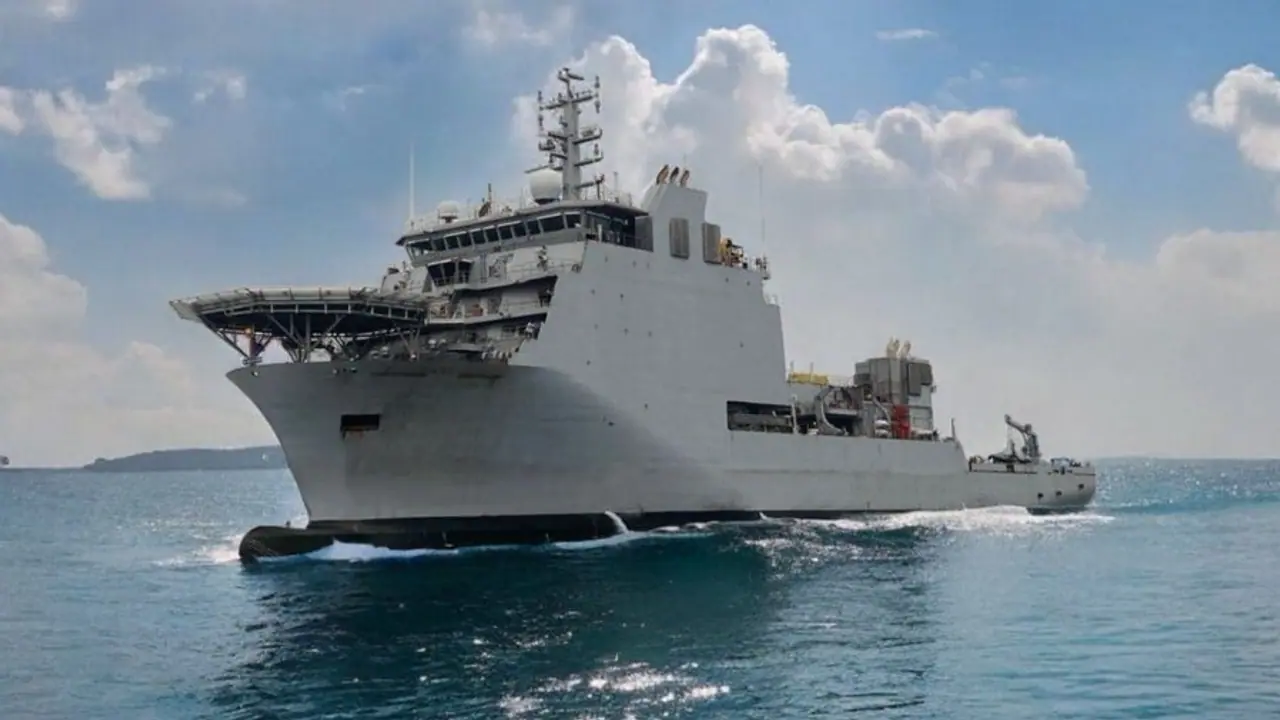
India has formally commissioned its first fully indigenous Diving Support Vessel (DSV), INS Nistar, on Friday at the Naval Dockyard in Visakhapatnam.
New Delhi: India has formally commissioned its first fully indigenous Diving Support Vessel (DSV), INS Nistar, on Friday at the Naval Dockyard in Visakhapatnam.
Built by Hindustan Shipyard Limited, the 118-metre-long vessel marks a major step in India’s efforts to strengthen maritime self-reliance.
INS Nistar is engineered for a wide range of underwater operations, including submarine rescue, saturation diving, salvage, and recovery of sunken assets.
Related Articles

“The project is a step towards realising the Indian Navy’s vision of designing and constructing complex indigenous platforms,” the defence ministry stated.
The Indian Navy frequently undertakes underwater inspections, recovery of sunken ships or aircraft, and diving-based search and rescue missions.
All You Need To Know About INS Nistar
The vessel will serve as the mother ship for India’s Deep Submergence Rescue Vehicle (DSRV) system, designed to extract trapped submariners from depths of up to 1,000 metres.
It is also equipped with Remotely Operated Vehicles, a dynamic positioning system, a 15-tonne subsea crane, and a side scan SONAR for undersea search and recovery tasks.
INS Nistar can support deep-sea saturation diving up to 300 metres and side diving up to 75 metres.
It has a six-person decompression chamber and a hyperbaric medical system for treating diving-related injuries. Its onboard hospital includes an operating theatre, an intensive care unit, and an eight-bed facility.
The ship can remain at sea for more than 60 days without needing to dock and can house over 200 personnel.
It is powered by two diesel engines and can cruise at 14 knots. A helicopter deck ahead of the superstructure allows for airborne search and rescue and casualty evacuation.
For self-defence, INS Nistar is equipped with two AK-630 30-mm close-in weapon systems.
The defence ministry said the vessel is more than 80% indigenous and involves contributions from over 120 Indian micro, small and medium enterprises.
A sister ship, Nipun, is expected to join the fleet in the near future.