
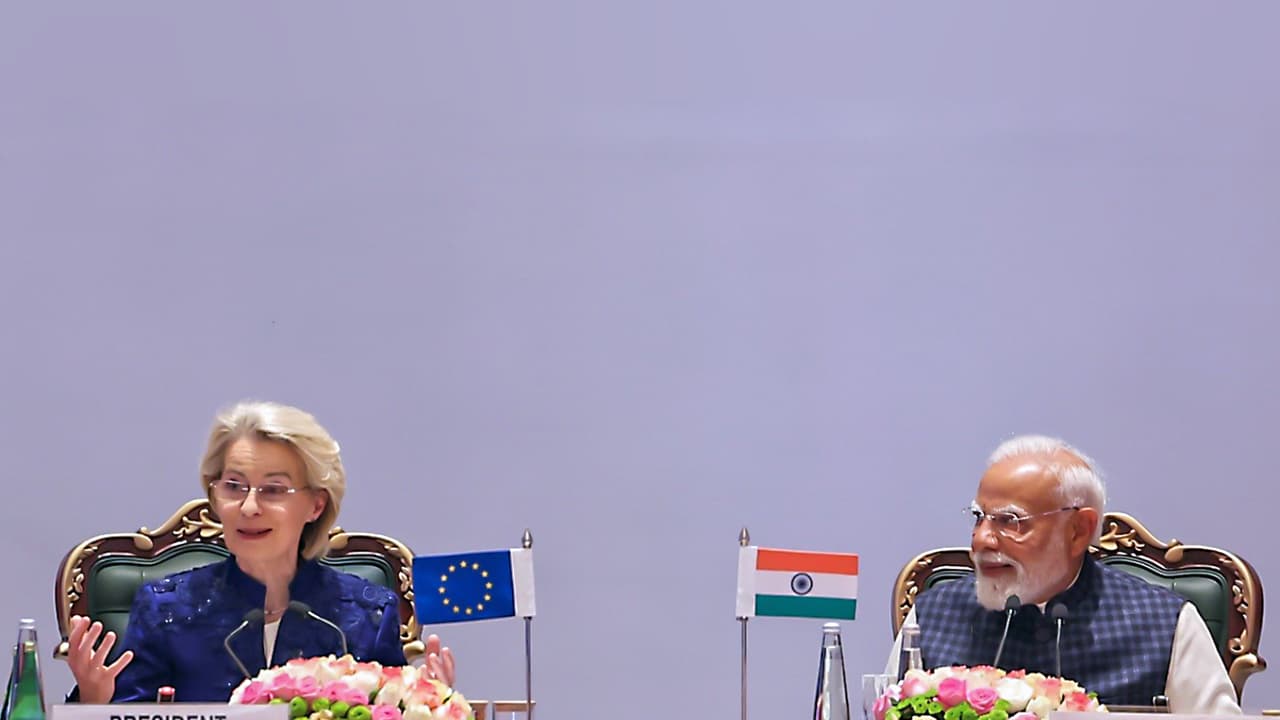
The India-EU FTA is a strategic economic deal poised to boost India's exports. Key sectors like textiles, gems & jewellery, marine products, and chemicals will gain preferential access, significantly expanding trade and fulfilling the Viksit Bharat vision.
India's Free Trade Agreement (FTA) with the European Union is emerging as one of the country's most strategic economic partnerships, with the potential to significantly reshape India's trade and innovation landscape. This agreement supports India's approach to securing a trusted, multifaceted partnership. It will bring key opportunities for growth, export expansion, and continue to fulfil Prime Minister Narendra Modi's vision of Viksit Bharat.
Key Benefits and Tariff Elimination
Further, the FTA is expected to boost India's exports to the European Union (EU), currently valued at approximately INR 1.44 lakh crore (USD 16.6 billion), according to the Gujarat Chief Minister's Office. As a growing economy, India has gained preferential access to the European Markets across 97 per cent of tariff lines and 99.5 per cent of trade value. 70.4 per cent tariff lines covering 90.7 per cent of India's exports will have immediate duty elimination for important sectors such as textiles, leather and footwear, tea, coffee, spices, sports goods, toys, gems and jewellery, marine products (shrimp, prawns etc.), processed food items, preserved vegetables, bakery products, automobiles, steel, pharmaceutical, chemicals etc. In FY 2024-25, these major sectors/products accounted for 25 per cent of Gujarat's total exports to the EU.
Boost for Textiles and Apparel Sector
The EU is India's second-largest export destination for textiles and apparel. Gaining zero duty access in textiles and clothing, covering all tariff lines and reducing tariffs by up to 12 per cent, would open the EU's USD 263.5 billion import market. Building on India's current global textile & apparel exports of USD 36.7 billion, including USD 7.2 billion to the EU, this would significantly expand opportunities, particularly in yarn, cotton yarn, man-made fibre apparel, ready-made garments, men's and women's clothing and home textiles. India's textile exports to the EU are led by Ready-Made Garments (RMG) (~60 per cent), followed by Cotton textiles (17 per cent) and Man-made fibre and MMF textiles (12 per cent). Gujarat's Surat drives production of MMF and synthetic textiles. Further, this would strengthen India's presence in blended and man-made fibre products and local industries, enabling them to scale, generate employment, and reinforce their position as a reliable, sustainable, and high-value sourcing partner.
Major Gains for Gems and Jewellery
The gems and jewellery sector, rooted in heritage craftsmanship and powered by a strong MSME base, is set to gain a major competitive edge in the EU market. Surat, one of the world's largest diamond processing hubs, hosts over 5,000 units, including some of the most advanced large-scale cutting and polishing facilities globally. With preferential access to the EU's USD 79.2 billion import market under the FTA, India's USD 2.7 billion jewellery exports are poised for significant growth. Further strengthening this advantage, the Surat SEZ houses more than 250 units spanning jewellery manufacturing, diamond processing, and textiles, positioning the region for accelerated expansion in high-value exports.
Growth in Marine Exports
India's marine export to the EU is currently valued at USD 1 billion. The preferential access, through FTA covering 100 per cent of trade value, by reducing tariffs of up to 26 per cent is expected to cater to the EU marine market for imports (USD 53.6 billion). Marine exports from Gujarat will see a major boost in value-added seafood.
Chemical Sector to See Significant Growth
By 2047, India is projected to capture nearly 12 per cent of the global chemical market and emerge as a USD 1 trillion chemical manufacturing hub. Under the India-EU FTA, 97.5 per cent of India's chemical export basket by value will face zero duty, removing tariffs of up to 12.8 per cent and enhancing competitiveness across inorganic, organic, and agrochemical segments. This preferential access is expected to accelerate exports, strengthen MSME-led clusters, and promote high-value, sustainable, and technology-driven products, positioning India as a reliable supplier to the EU's USD 500 billion chemical import market. South Gujarat drives this growth momentum as the state's leading chemical hub, with the Surat Economic Region contributing nearly 70 per cent of Gujarat's chemical GVA. Supported by robust industrial ecosystems and strategic proximity to key ports such as Dahej and Hazira, along with access to Mundra and JNPT, the region is well-positioned to leverage new export opportunities under the FTA.
Vibrant Gujarat to Leverage FTA Opportunities
The upcoming Vibrant Gujarat Regional Conference (VGRC), South Gujarat, scheduled for April 2026 in Surat, will serve as a strategic platform to operationalise opportunities created by the India-EU FTA. Bringing together high-growth sectors such as textiles & apparel, gems & jewellery, chemicals & petrochemicals, and marine products, the Regional Conference will connect South Gujarat's industrial strengths with expanding business demand in the EU.
With the "Mother of All Deals" eliminating tariffs on 99.5 per cent of trade value, VGRC South Gujarat offers a timely opportunity for industry leaders to tap favourable market access. The Regional Conference will enable regional industries to fully leverage the FTA and accelerate resilient, future-ready export growth. (ANI)
(Except for the headline, this story has not been edited by Asianet Newsable English staff and is published from a syndicated feed.)