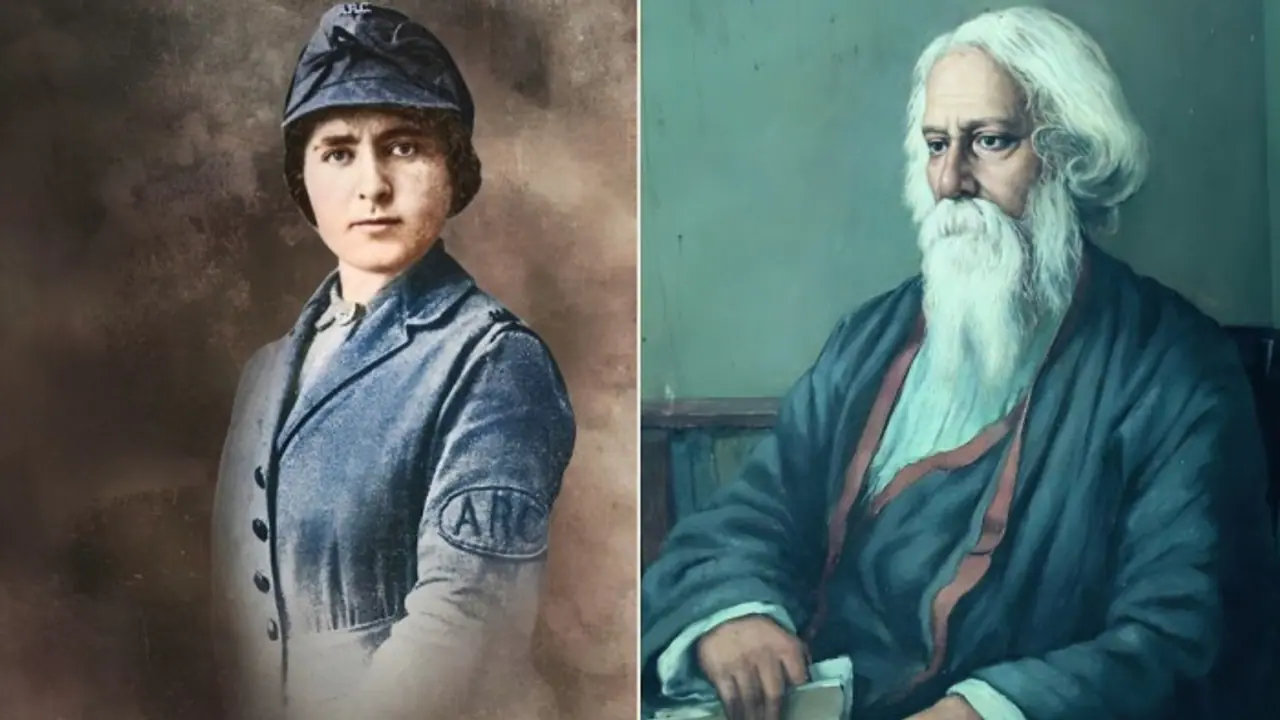
Schlomith Flaum, a Jewish educator from Lithuania, spent two years in Santiniketan in the 1920s. Deeply influenced by Tagore, she became his informal ambassador and helped connect India, Israel, and Lithuania through her writings.
Schlomith Frieda Flaum was born on March 18, 1893, in Lithuania. In the early 1920s, she was studying in New York, training to become a teacher at Columbia University. One day, she attended a lecture by Indian poet Rabindranath Tagore at a Jewish synagogue. That moment changed her life.
Fascinated by Tagore and his ideas, she decided to travel to India in 1922. She arrived in Santiniketan, a unique school started by Tagore in West Bengal, and stayed there for two years, according to The Better India.
Life in Santiniketan and love for India
At Visva Bharati, the college in Santiniketan, Flaum taught German and also picked up some Sanskrit and Bengali. She became the head of a kindergarten and was very active in the learning community.
Related Articles

Flaum met many famous Indian leaders during her stay, including Mahatma Gandhi, Sarojini Naidu, and Annie Besant. Her time in India made a deep impression on her. She later wrote that Santiniketan helped her understand herself and her identity better.
A voice for Tagore in Hebrew
Flaum became a kind of informal ambassador for Tagore. She wrote two books and more than twenty articles in Hebrew about her time in India, Tagore, and Indian culture. Her writings helped spread Tagore’s message across Israel.
Even after leaving India in 1924, she continued to follow Tagore’s work. She met him again in Berlin in 1930 and later wrote his biography in Hebrew in 1946, according to The Better India.
A new book on her life
In 2018, the embassies of Israel and Lithuania helped publish a book called From Lithuania to Santiniketan by Dr. Shimon Lev.
The book shares Flaum’s story, including her original writings, and the letters she and Tagore exchanged between 1922 and 1940.
The book is divided into three parts: an introduction by Dr. Lev, English translations of Flaum’s Hebrew writings, and copies of the letters between her and Tagore.
Remembering her legacy
Flaum passed away in Israel on January 2, 1963. She reportedly died poor, lonely and mostly forgotten. But her writings still remain valuable, especially for those interested in cultural history.
Scholars say her works give a unique, female-centered view of India during the early 20th century, a time when both India and the West were going through major changes. She called India “the land of poetry and imagination” and described the energy she felt during her time there.
Though her life ended in hardship, Schlomith Flaum’s journey, from Lithuania to Santiniketan, helped build a rare and meaningful connection between three very different countries: India, Israel, and Lithuania.