
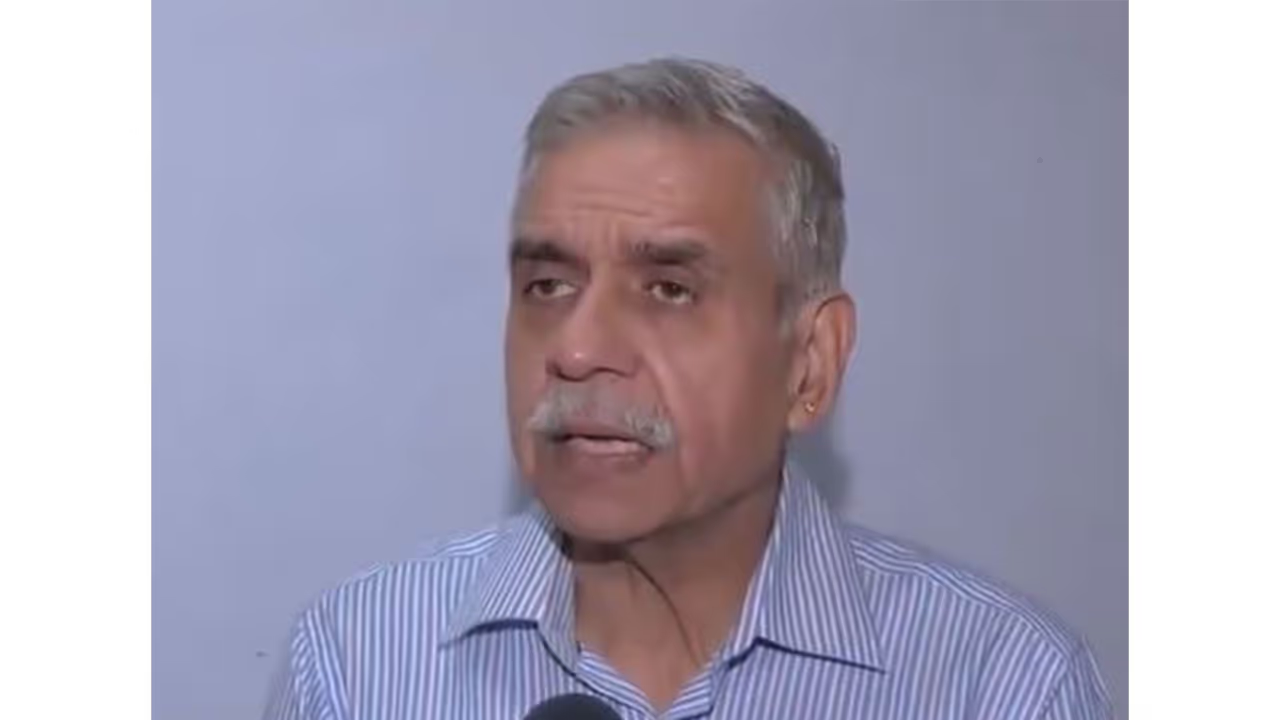
Congress leader Sandeep Dikshit slammed the Centre's 'unclear' China policy, questioning the rising trade deficit despite border tensions. He also raised doubts about the agenda of potential bilateral talks between the two countries' leaders.
Congress leader Sandeep Dikshit on Thursday took a sharp dig at the Central government over its foreign policy and economic engagement with Beijing, saying that India's policy towards China "isn't very clear," pointing out the continuously rising trade deficit between the two nations despite border tensions.
Speaking on the sidelines of discussions surrounding the BRICS Summit, Dikshit raised questions regarding the agenda of potential bilateral talks between the leadership of both countries. "Our policy towards China isn't very clear... Our trade deficit keeps increasing year after year. During the 6-7 years when China was our main adversary, our trade increased 3-4 times. After that, our trade deficit multiplied several times," Dikshit told ANI.
Questioning the effectiveness of high-level diplomatic engagements without tangible progress on ground realities, the Congress leader remarked, "Now, it's being said that the leaders of both countries will meet. If the two leaders meet and there's no trouble on the border, then what will they discuss?"
BRICS Summit and Alliance Expansion
Dikshit's remarks came amid New Delhi gearing up to host the BRICS Summit for the fourth time. India's Chairship of the 18th BRICS Summit is guided by the theme "Building for Resilience, Innovation, Cooperation and Sustainability", deploying a human-centric approach across its core pillars to reinforce institutional strength and support sustainable growth.
The alliance has undergone a transformative evolution since its origin as the BRIC grouping comprising Brazil, Russia, India, and China, which convened its first Foreign Ministers' meeting on the sidelines of the UN General Assembly in New York in 2006 and held its inaugural summit in Yekaterinburg, Russia, in 2009.
The bloc expanded to BRICS following South Africa's admission in 2011, and later underwent a transformative expansion by welcoming Egypt, Ethiopia, Iran, Saudi Arabia, and the UAE as full members in January 2024, followed by Indonesia in January 2025. Featuring 11 full member states alongside an expanding array of partner nations, the alliance commands significant global economic and diplomatic influence. (ANI)
(Except for the headline, this story has not been edited by Asianet Newsable English staff and is published from a syndicated feed.)