
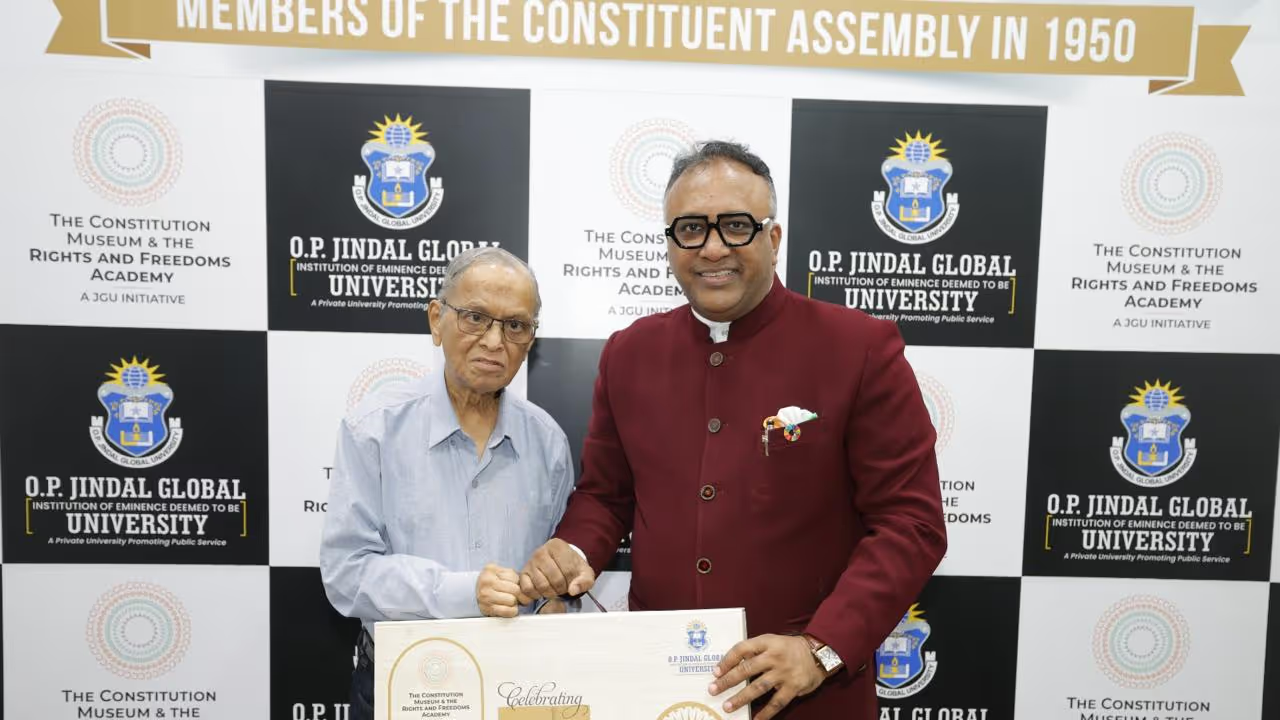
At Jindal Global University’s 17th anniversary, Infosys founder Narayana Murthy emphasized that ideas, entrepreneurship, and job creation are vital for India to become a developed nation. He highlighted the importance of ethical leadership, integrity, and learning from failure.
‘Ideas and Enterprise’ Key to India’s Growth
Infosys founder N.R. Narayana Murthy has called for greater emphasis on ideas, enterprise and job creation as India works towards becoming a developed nation. Speaking at the 17th Anniversary of O.P. Jindal Global University (JGU) and University Day, Murthy said entrepreneurship, ethical leadership and innovation would play an important role in shaping India’s future.
“India can create jobs through ideas and enterprise which is the only way for our country to become a developed nation in the future,” said Mr. N.R. Narayana Murthy, Founder, Infosys, during the event. He was the distinguished chief guest and addressed the audience on “Ethical Leadership, Transformative Growth & Technology - The Infosys Story & the Future of India”.
Murthy also spoke extensively about the role of values in personal and professional life. “It is important to note that everything we do in our lives is the result of the culture instilled in us through family values, peers and our environment as hard work, honesty, respect and integrity must come before personal gain. We need to ensure that younger colleagues follow good principles and that every decision they take brings respect from society and stakeholders.”
‘The Softest Pillow Is a Clear Conscience’
Addressing the young audience at JGU, Murthy offered another message on the importance of ethical conduct. “The softest pillow is a clear conscience,” he said. “It’s very simple to do the right thing if you set it as the benchmark.”
Recalling his own university years and entrepreneurial journey, Murthy said he was brought up in a value system that emphasised earning respect from society. He also spoke candidly about failure, recalling that his first company did not succeed before he went on to establish Infosys.
“Failure is like a series of steps towards success. If you learn lessons from it and do not repeat those mistakes, then you can overcome failure. You should not get demotivated by failure into inaction. Scientists and researchers do not give up if they do not get results. They are trained to introspect and start again. You need to think rationally with concentration and then succeed,” he advised the students.
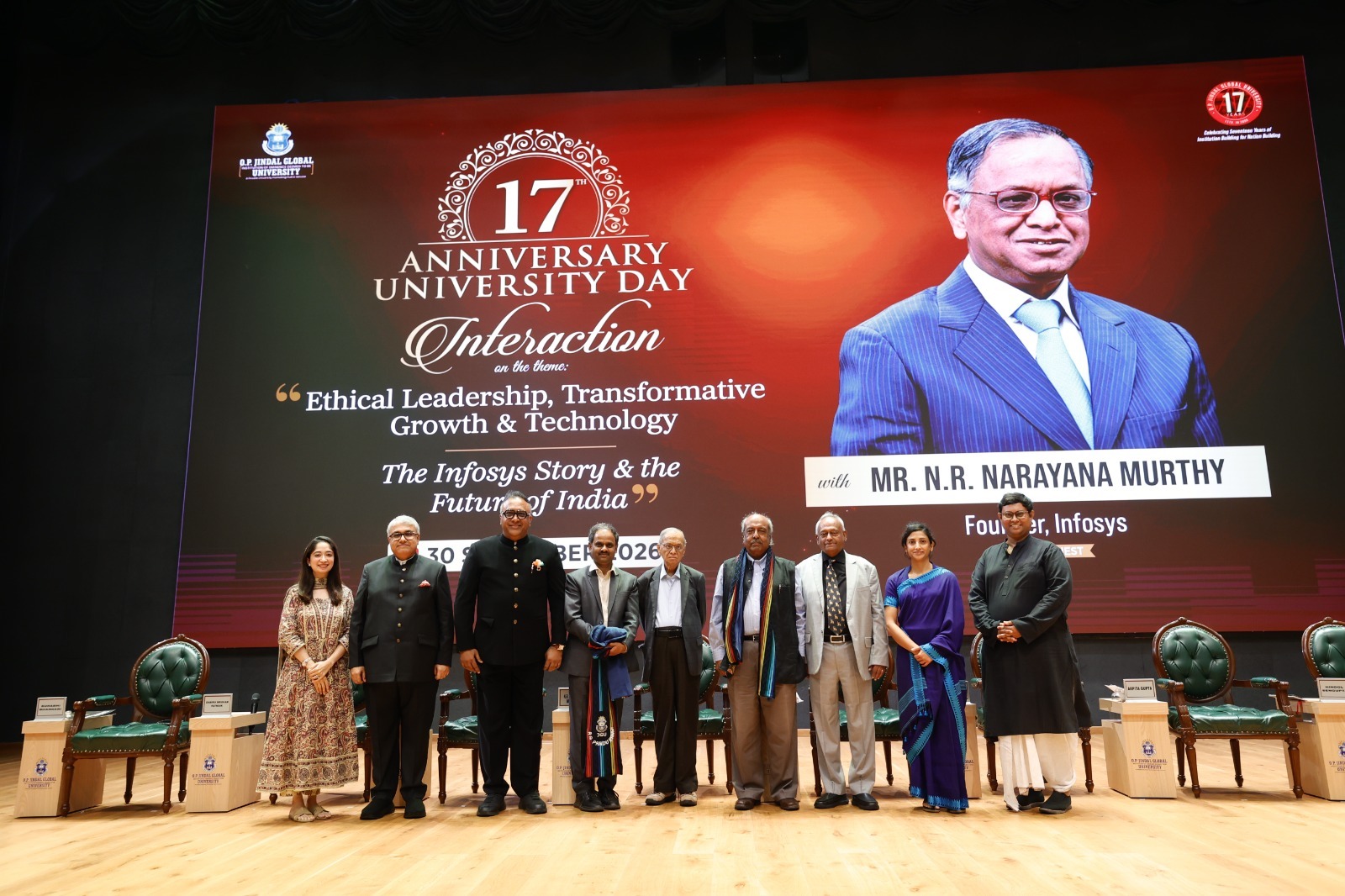
JGU Highlights Values, Research and Nation-Building
In his opening address, Prof. (Dr.) C. Raj Kumar, Founding Vice Chancellor of O.P. Jindal Global University, welcomed Murthy and highlighted his journey in building Infosys into a globally respected institution.
“It is my honour to welcome Mr. N. R. Narayana Murthy, Founder of Infosys, who has demonstrated through his own extraordinary journey how a world-class institution can be built in India and earn global respect. O.P. Jindal Global University has a similar vision: institutions are sustained not only by buildings, resources, rankings or reputations. They are sustained by values and they endure when integrity becomes institutional culture, when excellence becomes habit and when leadership becomes responsibility. India possesses an extraordinary civilisational heritage of learning. Our ambition was to renew India’s historic place in the global world of ideas and knowledge. We often speak about inter-generational equity in the context of sustainable development — the idea that one generation must not pursue its progress by diminishing the opportunities available to future generations. We, at JGU today, are custodians of something that belongs not only to us but also to generations whom we may never meet,” Prof. Kumar said.
Prof. Dabiru Sridhar Patnaik, Registrar, O.P. Jindal Global University, delivered the Welcome Address and spoke about the parallel journeys of Infosys and JGU.
“It is our privilege to have Shri N.R. Narayana Murthy, Founder, Infosys—a visionary leader and distinguished institution-builder—as the Chief Guest for our 17th University Day. Today's gathering brings together two founding stories. One began with the aspiration to create a globally respected technology enterprise. The other began with the aspiration to create a globally respected university. Infosys became a symbol of how values, integrity, professionalism, and excellence can create institutions that inspire trust across the world. Similarly, JGU's journey has been about building an institution that seeks to transform lives through education and contribute to nation-building. Both were built on the belief that institutions matter and are sustained by values, by long-term purpose rather than short-term gain and by a commitment to excellence that never compromised integrity,” Patnaik said.
Introducing the chief guest, Prof. R. Sudarshan, Dean, Jindal School of Government and Public Policy, spoke about Murthy’s contribution to nation-building and the creation of a globally recognised institution. He also highlighted the philanthropic initiatives undertaken by Murthy and his family, including efforts aimed at preserving and promoting knowledge and learning.
“Padma Vibhushan Mr. N.R. Narayana Murthy is an example of what vision, ideas, innovation and hard work can achieve through ethical leadership. He carries forward the philosophy that what you create is held in trusteeship for the greater public good,” Prof. Sudarshan said.
Mr. K. Jairaj, IAS, Former Additional Chief Secretary, Government of Karnataka, delivered the special address. He congratulated JGU on its 17th University Day celebrations and spoke about the technological, entrepreneurial and philanthropic milestones of Infosys under Murthy’s leadership.
The University Day also marked the release of the JGU Research Report 2026. Prof. (Dr.) Arpita Gupta, Dean of Research, highlighted the university’s research output and its wider relevance.
“The Research Ecosystem of JGU has seen the publication of 11,000 research articles with nearly 800 student contributions in Scopus-indexed research publications. This has wider impact for policy development and social relevance for AI, smart cities, climate change, entrepreneurship, health, gender, micro-credit and more,” Prof. Gupta said.
The event concluded with remarks and a vote of thanks by Prof. (Dr.) Hindol Sengupta, Executive Dean, Jindal School of International Affairs.
