
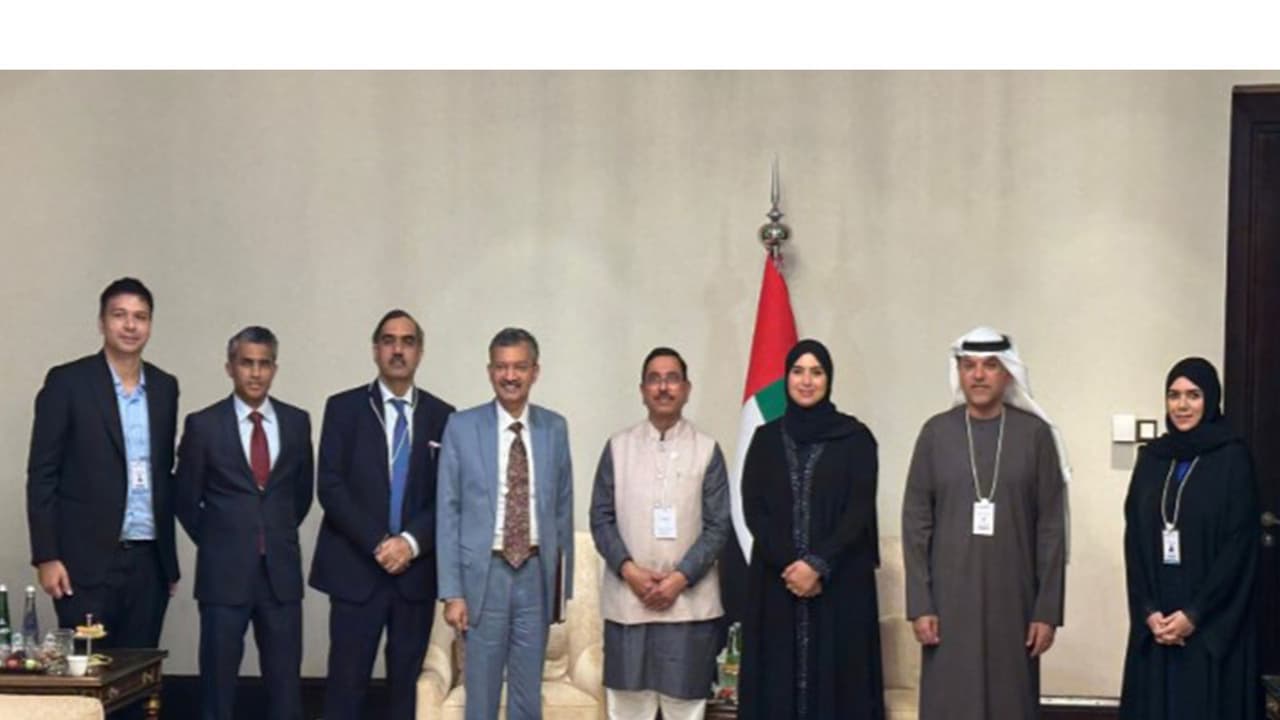
At the 16th IRENA Assembly, Union Minister Pralhad Joshi said India's energy transition is a people-centric mass movement, highlighting goals of 500 GW non-fossil fuel capacity by 2030 and achieving targets five years ahead of schedule.
Union Minister for New and Renewable Energy, Pralhad Joshi, on Sunday, highlighted India's people-centric and inclusive approach to the global energy transition while addressing the 16th Assembly of the International Renewable Energy Agency (IRENA) in Abu Dhabi.
Joshi said India's energy transition is guided by the principle of Vasudhaiva Kutumbakam - One Earth, One Family, One Future, anchored in equity, inclusivity, and policy stability. "Energy transition must become a mass movement driven by equity and inclusion," he emphasised, outlining India's commitment to achieve 500 GW of non-fossil fuel installed capacity by 2030 and Net Zero emissions by 2070.
India's Renewable Energy Milestones
The Minister highlighted that India has already reached 50 per cent of its installed electricity capacity from non-fossil sources in 2025, five years ahead of its Paris Agreement targets, with renewable energy capacity crossing 266 GW.
Strengthening the Clean Energy Ecosystem
He underscored India's efforts to strengthen clean energy supply chains, expand domestic manufacturing across solar, wind, batteries and electrolysers, and modernise grids through Green Energy Corridors and innovative bidding mechanisms.
Flagship Programmes for Households and Farmers
Emphasising flagship programmes for households and farmers, Joshi noted that under the PM Surya Ghar: Muft Bijli Yojana, 2.5 million households have benefitted from rooftop solar, with a target of 10 million by 2027. The PM-KUSUM scheme has supported 2.17 million farmers through solarisation and replacement of diesel pumps.
Call for International Cooperation
Joshi called for stronger international cooperation, including technology transfer, low-cost finance, capacity building, and standard harmonisation to help developing countries scale up renewable energy. He reaffirmed India's support for IRENA and pledged to share technical expertise with member countries, especially Least Developed Countries and Small Island Developing States.
India-UAE Bilateral Collaboration
The Union Minister also held a bilateral meeting with the UAE Minister of Climate Change and Environment, Dr. Amna bint Abdullah Al Dahak, to further strengthen India-UAE collaboration in renewable energy, decentralised energy solutions, manufacturing, storage, technology cooperation, and blended finance, aligned with the UAE's Net Zero 2050 goals.
Joshi emphasised that India's energy transition is not merely about capacity addition but about people, opportunity, and a shared sustainable future, positioning India as a global leader in clean energy. (ANI)
(Except for the headline, this story has not been edited by Asianet Newsable English staff and is published from a syndicated feed.)