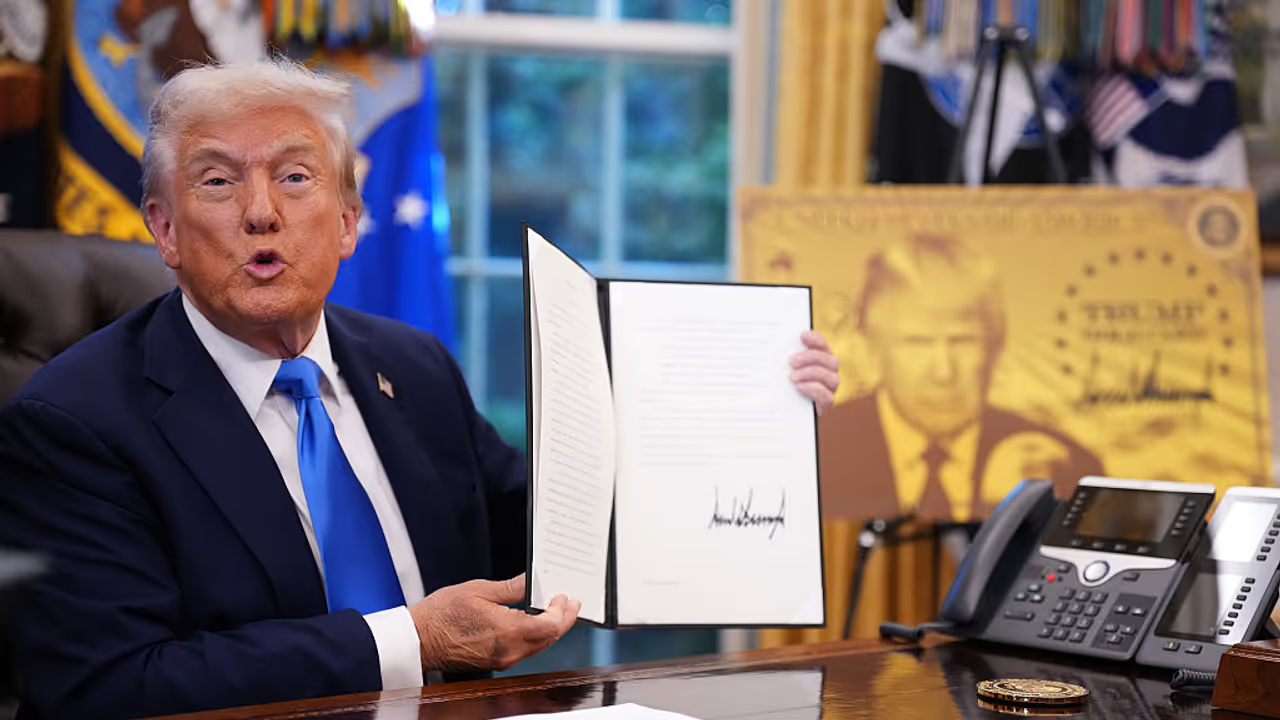
India expresses concerns over US's $100,000 annual fee on H-1B visas, highlighting potential disruptions to skilled talent mobility. MEA said industry in both nations has a stake in innovation and can be expected to consult on the best path forward.
In a significant policy shift, the United States announced a substantial increase in the annual fee for H-1B visa applications, raising it to $100,000. This move has elicited strong reactions from India, which is the largest beneficiary of the H-1B program. The Indian government and industry bodies have expressed concerns over the potential disruptions to skilled talent mobility, economic growth, and the humanitarian impact on families.
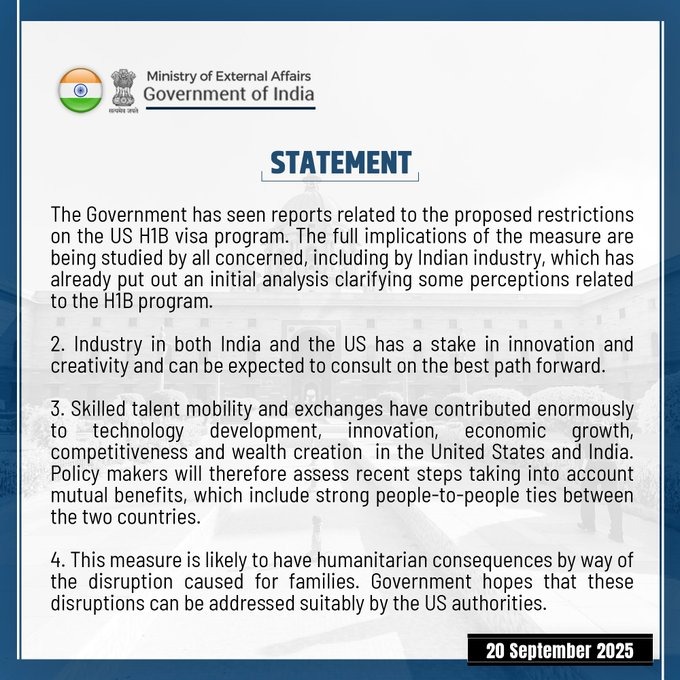
India's statement on US's H-1B visa fee hike
The Ministry of External Affairs (MEA) issued a statement expressing that the full implications of the new H-1B visa fee are being studied. The MEA highlighted that skilled talent mobility has significantly contributed to technology development, innovation, economic growth, competitiveness and wealth creation in both the United States and India. The government emphasised that policymakers should assess recent steps considering mutual benefits, including strong people-to-people ties between the two countries.
- The Government has carefully seen reports related to the proposed restrictions on the US H1B visa program. The full implications of the measure are being studied thoroughly by all concerned stakeholders, including by Indian industry, which has already put out an initial analysis clarifying some common perceptions and misconceptions related to the H1B program.
- Industry in both India and the US has a significant stake in fostering innovation and creativity and can be expected to actively consult and collaborate on the best path forward for mutually beneficial outcomes.
- Skilled talent mobility and exchanges have contributed enormously to technology development, innovation, economic growth, competitiveness, and wealth creation in the United States and India. Policy makers will therefore carefully assess recent steps, taking into account mutual benefits, which also include strong people-to-people ties and cultural connections between the two countries.
- This measure is likely to have serious humanitarian consequences due to the disruption caused for families and individuals dependent on the program. The Government hopes that these potential disruptions can be addressed promptly and suitably by the US authorities to minimize adverse impact.
NASSCOM's concerns
The National Association of Software and Service Companies (Nasscom), India's premier IT industry body, has raised alarms over the new policy. Nasscom warned that the sudden imposition of the $100,000 annual fee could disrupt business continuity for Indian technology services firms, particularly affecting onshore projects in the United States. The organization also criticized the one-day implementation deadline, stating that such a short notice creates considerable uncertainty for businesses, professionals, and students across the world. Nasscom emphasized that adjustments of this nature could have ripple effects on America's innovation ecosystem and the wider job economy. The body also pointed out that Indian IT companies have been steadily reducing their dependence on the H-1B visa route by increasing local hiring in the US. Despite this, the new fee could still impact business continuity and require operational adjustments.
Related Articles

Humanitarian and economic implications
The abrupt increase in the H-1B visa fee has raised concerns about its humanitarian impact. Many Indian professionals and their families have established lives in the United States, and the new policy could lead to significant disruptions. The MEA's statement underscored the potential for such disruptions, highlighting the importance of addressing these issues to maintain strong bilateral relations. Economically, the policy could affect the broader tech ecosystem, as Indian professionals play a crucial role in various sectors, including technology, healthcare and education.
Potential benefits for India
While the immediate effects of the policy are concerning, some experts believe that the long-term impact could benefit India. Amitabh Kant, former CEO of NITI Aayog, suggested that the increased cost of H-1B visas might discourage US companies from hiring foreign talent, thereby reducing the influx of skilled professionals into the US technology sector. This could lead to more talent remaining in or returning to India, potentially strengthening India's innovation and technological ecosystem. However, this shift would require India to enhance its infrastructure and opportunities to retain and attract skilled professionals.
US perspective and policy rationale
The Trump administration has justified the $100,000 annual fee as a measure to ensure that only highly skilled foreign workers are employed in the United States, curbing the replacement of American workers. Commerce Secretary Howard Lutnick described the fee hike as a strategy to eliminate what the administration considers lower-skilled training positions while preserving opportunities for highly skilled workers. The new fee represents a dramatic increase from current H-1B processing costs, which typically amount to a few thousand dollars. The policy aims to reduce the number of H-1B applicants and ensure that the program serves its intended purpose of bringing in top-tier global talent on a temporary basis.
Legal and operational challenges
The implementation of the new H-1B visa fee has raised questions about its legality and potential challenges. The proclamation takes effect on September 21, 2025, and applies to any H-1B entering the US after 12:01 am Eastern Daylight Time. Legal experts anticipate that the policy could face court injunctions soon, as it may overstep congressional authority over immigration policy. Additionally, the abrupt rollout has created uncertainty for businesses and professionals, particularly those with ongoing projects or pending visa applications.
The US decision to impose a $100,000 annual fee on H-1B visa applications has significant implications for skilled talent exchange, economic growth and bilateral relations between India and the United States. While the policy aims to prioritise highly skilled foreign workers, it has raised concerns about its humanitarian impact and potential disruptions to business continuity. India's response highlights the importance of skilled talent mobility in fostering innovation and economic development. As the situation unfolds, it will be crucial for both countries to engage in dialogue to address the challenges and opportunities presented by this policy shift.
(With ANI inputs)