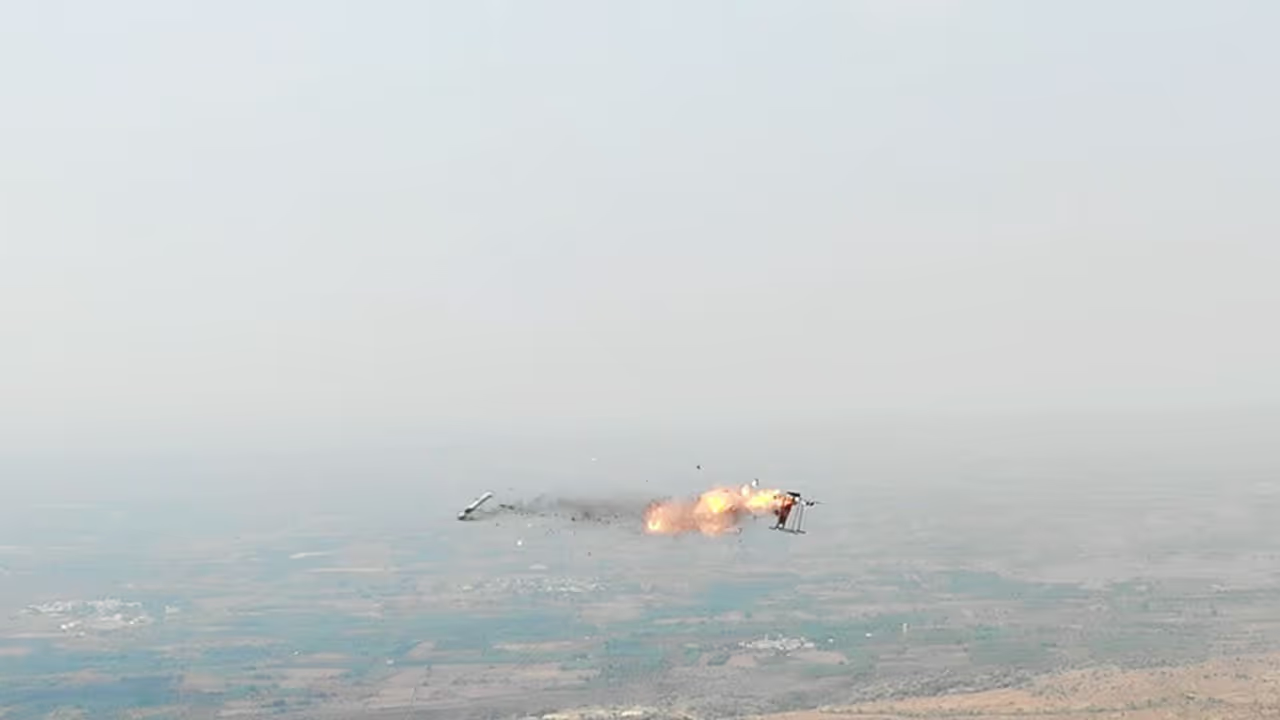
DRDO has completed final configuration development trials of its unmanned aerial vehicle-launched precision guided missile, the ULPGM-V3, testing it in both air-to-ground and air-to-air modes at the NOAR near Kurnool, Andhra Pradesh.
New Delhi: The Defence Research and Development Organisation (DRDO) has completed final configuration development trials of its unmanned aerial vehicle-launched precision guided missile, the ULPGM-V3, testing it in both air-to-ground and air-to-air modes at the National Open Area Range (NOAR) near Kurnool, Andhra Pradesh on Tuesday.
The V3 is an upgraded version of the ULPGM-V2, an earlier DRDO variant that had already been developed and delivered.
Weighing 12.5 kg, the missile uses a passive homing system with an imaging infrared seeker that enables fire-and-forget targeting in both day and night conditions.
Related Articles

It is powered by a dual-thrust solid motor, giving it a range of up to 4 km by day and 2.5 km at night, and supports two-way datalink communication for post-launch target updates.
The missile carries three modular warhead options — an anti-armour warhead designed to defeat modern armoured vehicles fitted with rolled homogeneous armour and explosive reactive armour; a penetration-cum-blast warhead for use against bunkers; and a pre-fragmentation warhead offering a high-lethality zone.
Also referred to as the ULM-ER, or unmanned launched munition – extended range, the system was first publicly displayed at Aero India 2025 in Bengaluru in February.
The trials were conducted using an integrated ground control system designed to automate readiness checks and launch operations.
The missile was launched from a UAV developed by Newspace Research Technologies, a Bengaluru-based start-up, though DRDO is pursuing integration with longer-range, higher-endurance unmanned platforms from other Indian companies as well.
The ULPGM-V3 was developed by Research Centre Imarat in Hyderabad as the lead laboratory, with contributions from the Defence Research and Development Laboratory, also in Hyderabad; the Terminal Ballistics Research Laboratory in Chandigarh; and the High Energy Materials Research Laboratory in Pune. Production partners Adani Defence and Bharat Dynamics Limited, both based in Hyderabad, along with around 30 MSMEs and start-ups, were involved in building the system.
“The successful trials signal that the domestic supply chain for the missile is ready for serial mass production without further development work.”
The defence minister, Rajnath Singh, described the outcome as evidence that the Indian defence industry is capable of absorbing and producing critical technologies at scale.
The trials come as part of a wider push by the Indian armed forces to accelerate domestic defence capability, with capacity development exercises under way at Pokhran, Babina, and Joshimath, covering loitering munitions, runway-independent drones, counter-UAS platforms and next-generation infrared missile systems.
The DRDO chairman, Samir V. Kamat, congratulated the teams involved in the trials.