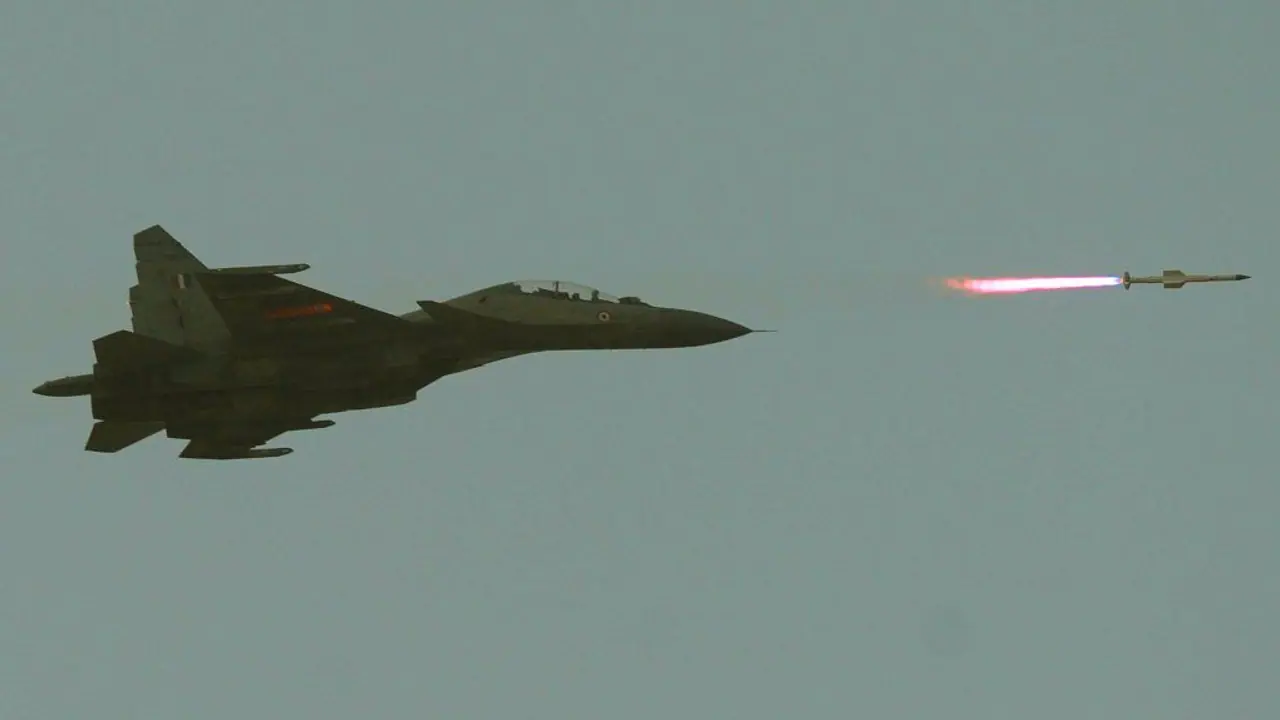
The missile, equipped with a domestically developed RF seeker, performed flawlessly, validating its range exceeding 100km. This achievement marks a significant milestone in India's defense technology.
New Delhi: Defence Research & Development Organisation (DRDO) and Indian Air Force (IAF) on Friday successfully conducted the flight-test of indigenous Beyond Visual Range Air-to-Air missile (BVRAAM) ‘Astra’ from Su-30 MKI platform off the coast of Odisha. The BVRAAM was equipped with indigenous Radio Frequency (RF) Seeker.
During the tests, two launches were carried out against high-speed unmanned aerial targets at different ranges, target aspects and launch platform conditions. In both the cases, the defence ministry said the missiles destroyed the targets with pin-point accuracy. During the tests, “all subsystems performed as per expectations including the RF seeker which has been indigenously designed & developed by DRDO.”
The flawless performance of the Astra weapon system was validated through flight data captured by Range Tracking instruments deployed by Integrated Test Range, Chandipur, it said. These successful flight tests have re-established the accuracy and reliable performance of Astra weapon system with indigenous seeker.
Related Articles

Astra BVRAAM has a range exceeding 100 kms and is equipped with state-of-the art guidance and navigation system. In addition to various laboratories of DRDO, more than 50 public and private industries including Hindustan Aeronautics Limited have contributed towards successful realisation of the weapon system.
Defence Minister Rajnath Singh complimented DRDO, IAF and industry involved in the design and development of RF seeker and stated that the successful testing of the missile with indigenous seeker is a major milestone in critical defence technology. Secretary, Department of Defence R&D and Chairman, DRDO Dr Samir V Kamat congratulated all the teams involved during the successful flight-test.