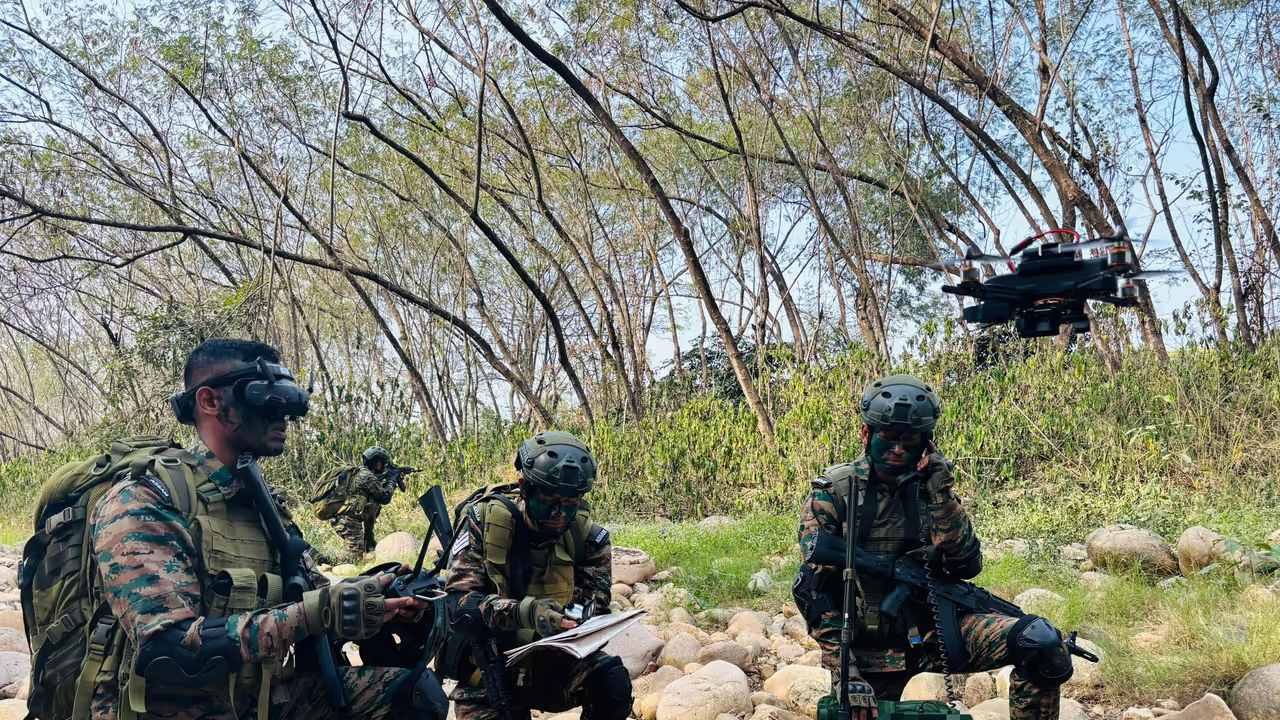
Indian Army made public its new and reorganised formations — such as Ashni platoons, Bhairav battalions, Shaktibaan regiments, and Rudra Brigades — created to enhance battlefield effectiveness and position the Army as a future-ready force.
New Delhi: Amid growing collusive threats from China and Pakistan, evident during Operation Sindoor months ago, the Indian Army has been restructuring and reorganising its forces to make them faster, more agile, and more lethal. As part of this transformation, the Army has raised several new formations at various levels, from battalions to divisions.
With Pakistan also undertaking similar reforms and China having already restructured its forces, the Indian Army on Tuesday formally announced the raising of Integrated Battle Groups (IBGs). This announcement comes after the Army made public its new and reorganised formations — such as Ashni platoons, Bhairav battalions, Shaktibaan regiments, and Rudra Brigades — created to enhance battlefield effectiveness and position the Army as a future-ready force.
While these formations share the goal of improving combat efficiency, they differ significantly in their roles, structures, and operational philosophies.
Related Articles

Is the Rudra Brigade similar to the Integrated Battle Group?
Named after the Hindu deity symbolizing destruction, the Rudra Brigade is an all-arms brigade designed for specialised, and defensively oriented active field operations.
It is a terrain and task-specific formation to be positioned to serve above the Brigade and a notch below the Division of the Army.
Whereas, Integrated Battle Group has been carved out and positioned somewhere between a Division and Corps of the force.
Its primary objective is to enable ground commanders to respond rapidly without being constrained by time-consuming decision-making procedures. IBGs are intended primarily for strike operations.
The aim has been to make these formations leaner yet more effective in tasking. “De-layering has been done to shorten the decision cycle,” sources said.
The Army plans to raise seven Rudra Brigades, of which two are already operational.
While traditional brigades are arms-specific, Rudra Brigades are structured based on terrain and assigned tasks.
The sanctioned strength of personnel of Rudra Brigade will be somewhere between 3000 to 3500. A Brigadier Rank officer Commands the Brigades of Army.
On Tuesday, Indian Army Chief General Upendra Dwivedi announced that the Panagarh-based 17 Mountain Strike Corps (MSC) has been transformed into an IBG-based structure.
Integrated Battle Groups will include elements from infantry, artillery, armour, engineers, signals, air defence, and other arms and services. Designed for rapid response, an IBG can be deployed for operations within 48 hours of receiving orders.
The 17 MSC, comprising the 59 Division headquartered in Panagarh and the 23 Division based in Ranchi, has been reorganized into four IBGs and one fire support group. The fire support group will include systems such as Pinaka, Pralay, Smerch, and BrahMos, providing long-range firepower to the IBGs.
According to an Indian Army source, battalions and units will now operate directly under IBGs, effectively removing the brigade level to shorten decision-making timelines.
Each IBG, consisting of 5,000-6,000 troops and commanded by a Major General, will operate under the Corps Headquarters.
These compact, self-sustaining, and highly mobile combat formations will typically include around 15 units each.
Why ,India, needed Integrated Battle Group?
After the 2001 Parliament attack, India launched Operation Parakram against Pakistan. However, the mobilization of troops and equipment took several weeks.
This delay compelled both military and political leadership to seek a swift, limited-war capability that could operate under a nuclear overhang.
The concept of Integrated Battle Groups (IBGs) formally took shape after the Uri attack in 2016 and the Doklam standoff with China in 2017.
In 2018, then Army Chief General Bipin Rawat has publicly acknowledged IBGs as a future organizational structure of the Indian Army.
Between 2018 and 2020, IBGs were tested and validated on both fronts — the Western front with Pakistan and the Northern front with China.
The rollout was originally scheduled for August 2021, a source said. Senior Indian Army officials, including former Chief General MM Naravane (Retd), have said the delay was caused by the COVID-19 pandemic.
The prolonged border standoff with China in eastern Ladakh, which lasted for over 4-year, also necessitated the diversion of critical resources to the northern front.
Sources in the defence establishment said that the structures were largely ready, and formations under 17 Mountain Strike Corps (MSC) were already operating in a manner consistent with the IBG concept.