
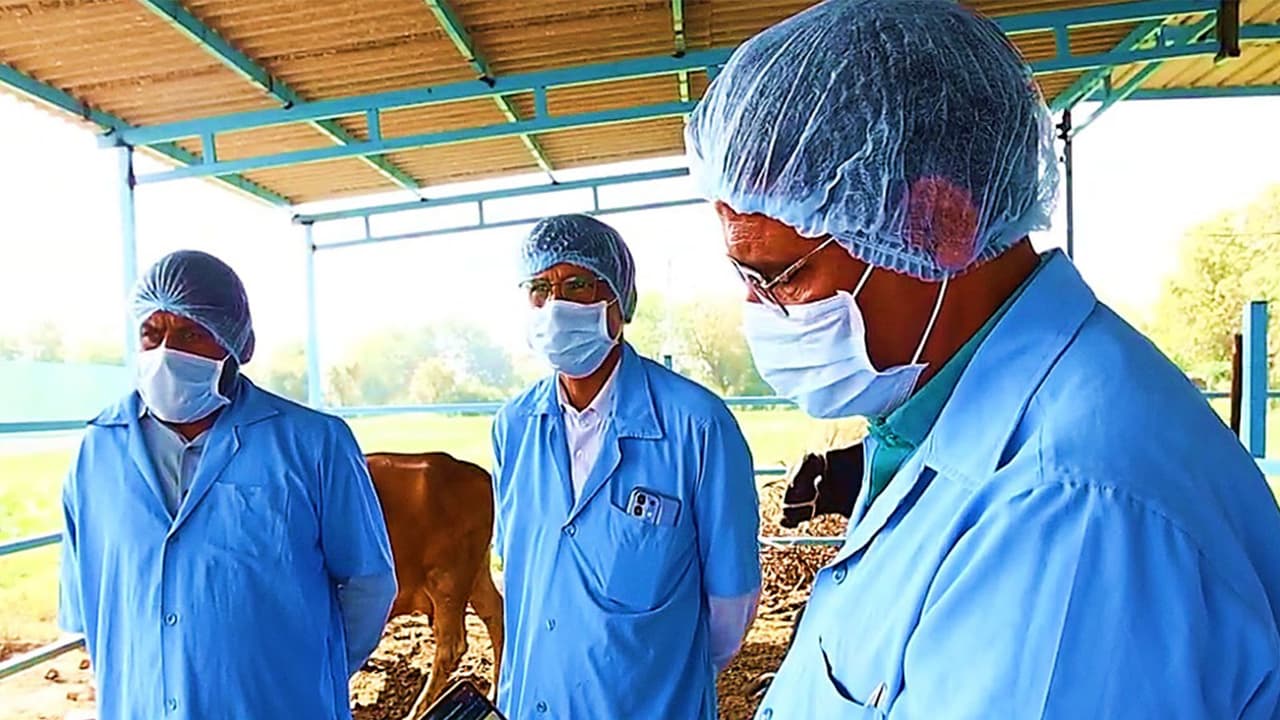
The Gujarat government has launched a massive Foot and Mouth Disease (FMD) vaccination drive. This initiative, part of the FMD-Mukt Bharat 2030 goal, aims to protect livestock, support farmers, and boost the state's dairy economy.
The Gujarat government has launched a massive vaccination drive against Foot and Mouth Disease (FMD) across the state from March 1, 2026, under the leadership of Chief Minister Bhupendra Patel, as part of the national target of achieving FMD-Mukt Bharat by 2030.
According to a press release issued by the Gujarat CMO, the Government of India, under the leadership of Prime Minister Narendra Modi, has set a national target of achieving FMD-Mukt Bharat through a comprehensive vaccination programme by 2030.
Farmers Praise Vaccination Efforts
Every six months, 42-year-old farmer Jigar Patel from Lodra village in Mansa taluka of Gandhinagar district waits for a team from the Animal Husbandry Department to visit his farm and vaccinate his cattle against the highly contagious Foot and Mouth Disease.
Patel owns 32 cattle and says regular vaccination is crucial for protecting his livelihood. "I own 32 cattle, and keeping them disease-free is essential as my income depends on their milk productivity. Any disease could reduce milk production. Fortunately, every six months, teams from the Animal Husbandry Department visit my farm and vaccinate the animals free of cost," Patel said.
According to Mahendra Patel, secretary of the Lodra Village Milk Producers' Cooperative Society, vaccination efforts are progressing steadily in the village. "There are over 1,700 cattle in Lodra village, and vaccination against FMD is currently underway. Around 50 per cent of the cattle in the village have already been vaccinated," he said.
Statewide Implementation and National Goal
The release said that in Gujarat, the state government has intensified efforts toward this goal with a large-scale vaccination drive across rural areas to protect livestock and support farmers' livelihoods.
"Across Gujarat, hundreds of staff members from the Animal Husbandry Department and dairy cooperatives are currently deployed in villages, farms, and fields to ensure that all eligible cattle are vaccinated against the disease," it stated.
At the national level, the Government of India is implementing the Livestock Health and Disease Control Programme (LHDCP), a Central Sector Scheme aimed at controlling and eventually eradicating major livestock diseases.
Foot and Mouth Disease is a highly contagious viral disease that affects cloven-hoofed animals. India launched a vaccination-based FMD control programme earlier, which was expanded in 2019 to cover the entire country.
Measuring Success and Progress in Gujarat
Dr Falguni Thakar, Director of the Animal Husbandry Department, Government of Gujarat, said they launched a massive vaccination drive against FMD across the state on March 1, 2026. "We conduct vaccination drives twice a year. The effectiveness of these drives can be assessed through the reduction in outbreaks and the decline in the circulation of the FMD virus, indicated by lower prevalence of Non-Structural Protein (NSP) antibodies in susceptible animal populations," Dr Thakar said.
She added that the state has reported very few FMD outbreaks in recent years. "Gujarat has recorded only a few scattered and isolated outbreaks over the past several years, and these have generally been less severe. Due to the vaccination programme, Sero surveillance results show that virus circulation has reduced to 3% in 2025, while Sero monitoring indicates that herd immunity has increased to 80.0%. This reflects the positive impact of vaccination and improved biosecurity measures. Under the leadership of Chief Minister Bhupendrabhai Patel, Gujarat is making remarkable progress toward becoming an FMD-free state in the coming years," Dr Thakar said.
Economic Significance and Future Prospects
The release said veterinarians explain that FMD is characterised by acute fever and the formation of vesicles in the mouth and on the feet of affected animals. The disease can lead to significant economic losses due to reduced appetite, loss of body weight, decreased milk production, reduced draft power, and abortions in livestock.
According to estimates, Gujarat has a cattle and buffalo population of over two crores, of which 1.71 crore are eligible for FMD vaccination.
The release said the livestock sector plays a vital role in the Indian economy and is a key source of livelihood for rural households. Women, in particular, form the backbone of livestock management in many rural communities.
"Achieving FMD-free status would also significantly boost the potential for exporting dairy products to global markets," it stated.
Officials note that animal diseases remain a major challenge to the growth of the livestock sector. Foot and Mouth Disease alone is estimated to cause economic losses of around Rs 24,000 crore annually in India.
"Effective control and eventual eradication of the disease would help increase milk production, strengthen the livelihoods of millions of farmers, boost their incomes, and enhance exports of milk and livestock products in line with international trade standards," the release said.
With the launch of the National Animal Disease Control Programme (NADCP) in 2019, now integrated under the Livestock Health and Disease Control Programme (LHDCP), the entire country is now covered under a structured vaccination programme aimed at eliminating major livestock diseases.
According to the release, Gujarat has made significant progress in controlling FMD, with only one outbreak reported in 2022-23, 11 outbreaks in 2023-24, zero outbreaks in 2024-25, and two outbreaks in 2025-26 so far. The number of FMD vaccines administered has also increased significantly, from 1,58,84,518 in 2022-23 to 3,04,40,916 in 2025-26, it added.
(Except for the headline, this story has not been edited by Asianet Newsable English staff and is published from a syndicated feed.)