
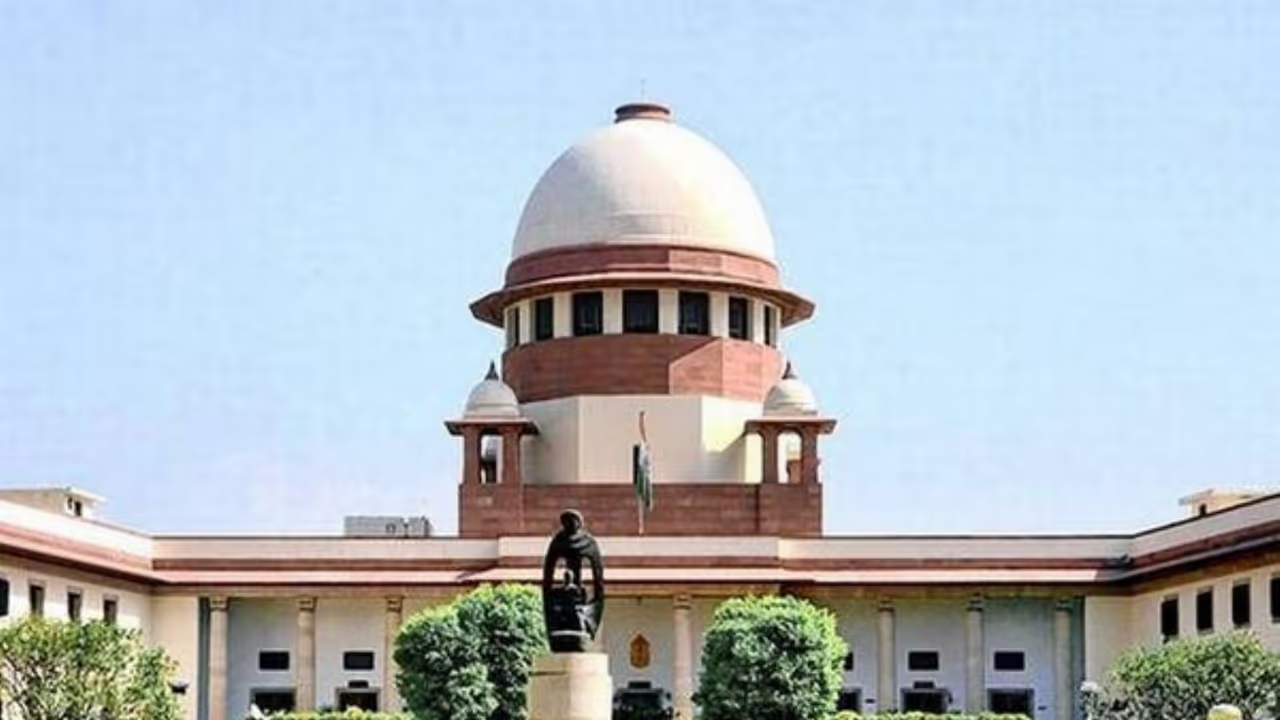
The Supreme Court declined to interfere with a Calcutta High Court order that held a PIL maintainable. The PIL alleges violations of forest rights in obtaining consent for the proposed Great Nicobar Island infrastructure project.
The Supreme Court on Monday declined to interfere with a Calcutta High Court order holding maintainable a PIL alleging violations of forest rights in obtaining consent for the proposed Great Nicobar Island infrastructure project.
A bench of Chief Justice of India Surya Kant and Justices Joymalya Bagchi and V Mohana noted that the matter is already pending before the High Court and has been listed for hearing on November 25-26. The bench urged the High Court to take up the matter on the scheduled dates and complete pleadings in connected proceedings.
Arguments and Constitutional Concerns
Attorney General R Venkataramani, appearing for the Centre, argued that the issue involved a project of “great national importance” and questioned the maintainability of the PIL, particularly in view of parallel proceedings before the National Green Tribunal challenging the environmental clearance. Senior advocate S Muralidhar, appearing for petitioner Meena Gupta, submitted that the PIL concerned the rights of Particularly Vulnerable Tribal Groups (PVTGs) and was therefore maintainable.
Protection of Indigenous Culture
Justice Bagchi also raised questions concerning the constitutional protection of the identity and culture of indigenous communities, asking whether vulnerable tribal groups should be fully integrated with the mainstream or allowed to retain their distinct identity. “Preservation of culture is a constitutionally protected fundamental right,” Justice Bagchi observed.
Background of the Appeal
The Calcutta High Court had on May 6 rejected the Centre’s preliminary objection to the PIL, holding that there could be no “thumb rule” on locus standi in public interest litigation, particularly where vulnerable communities are concerned. The Central government approached the top court against the High Court order. (ANI)
(Except for the headline, this story has not been edited by Asianet Newsable English staff and is published from a syndicated feed.)