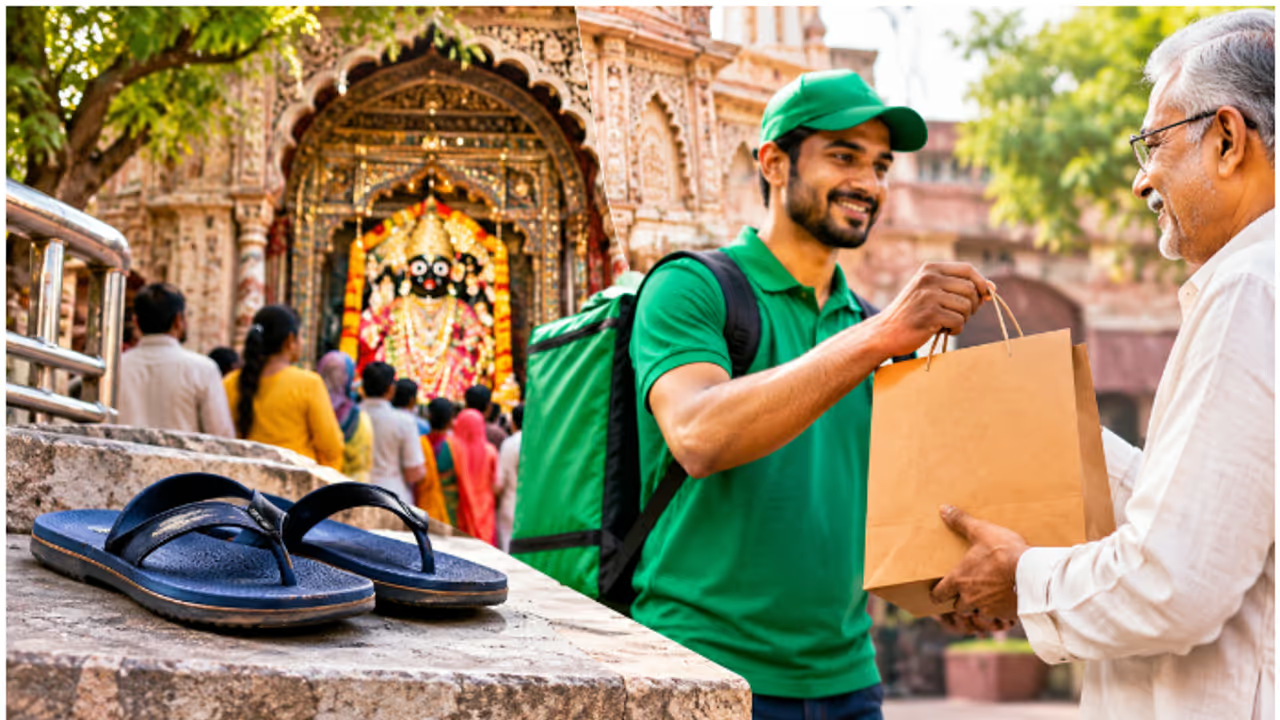
A visit to Vrindavan's Banke Bihari temple took an unexpected turn when an author's father's slippers went missing. But a quick-commerce order delivered a replacement pair in just 10 minutes, leaving social media buzzing
A visit to the famous Banke Bihari temple in Vrindavan turned into an unexpected experience for author and entrepreneur Sandeep Mall and his father. After offering prayers, the family discovered that his father's slippers had gone missing outside the temple.
Footwear theft is a familiar inconvenience for many devotees visiting crowded religious places. However, instead of searching for a nearby shop or struggling to find a replacement, Mall decided to use a quick-commerce platform.
What followed was rather surprising. A fresh pair of slippers was delivered directly outside the temple in just 10 minutes.
Related Articles

Mall shared the experience on X (formerly Twitter) on November 9, describing how quickly the service came to their rescue. He expressed amazement at the speed of delivery, suggesting that such convenience would be difficult to imagine elsewhere.
The unusual incident soon caught the attention of social media users, turning an everyday inconvenience into a talking point about India's growing quick-commerce industry.
Viral Post Triggers Debate As Social Media Users Share Their Experiences
Mall's post did not just attract reactions about the delivery service. It also encouraged people to share their own experiences of relying on online platforms during unexpected situations.
One user recalled how their daughter managed to arrange outfits for a Diwali office celebration through Myntra. She reportedly placed an order for two dresses at around 6.30 pm and received them in time for an event scheduled at 8 pm. The daughter apparently preferred not to repeat outfits at office gatherings or on Instagram.
Another user offered a humorous take on the temple incident, suggesting that the person who took the slippers might have needed them, while the situation simultaneously created business for the delivery platform and its delivery partner.
Others highlighted similar instances where quick-commerce services had proved useful at short notice.
One user recalled ordering a raincoat through Blinkit after it suddenly started raining while leaving the office. The same person also shared an experience of ordering a bicycle lock while standing in a parking area and receiving it within just five minutes.
These experiences highlighted how instant delivery services are increasingly being used for much more than groceries and household essentials.
'Two Indias' Debate: Quick Commerce Convenience Also Raises Economic Questions
While many users were impressed by the 10-minute delivery, others looked beyond the convenience and discussed the economic realities behind such services.
Some commenters pointed out the contrast between two situations unfolding at the same location: the familiar problem of footwear theft outside a temple and the availability of technology-driven deliveries within minutes.
The discussion also touched upon India's labour market and affordability. One user argued that the accessibility of such services is connected to the country's economic conditions and the availability of relatively affordable delivery labour.
Comparisons with Europe also entered the conversation, with a commenter pointing out that services such as Uber are readily accessible in many places, while Amazon deliveries can also be relatively quick.
The incident therefore became more than a story about a missing pair of slippers. It highlighted the contrasting realities of a country where traditional everyday problems continue to exist alongside rapidly advancing technology.
Quick commerce, which initially became popular for delivering groceries, fruits, vegetables and other daily necessities, has steadily expanded its reach. Today, customers increasingly turn to these platforms when they need something urgently, sometimes in situations they never expected.
Mall's experience outside Banke Bihari temple offered a striking example of this changing consumer behaviour, while also prompting questions about the economic realities supporting the convenience.