
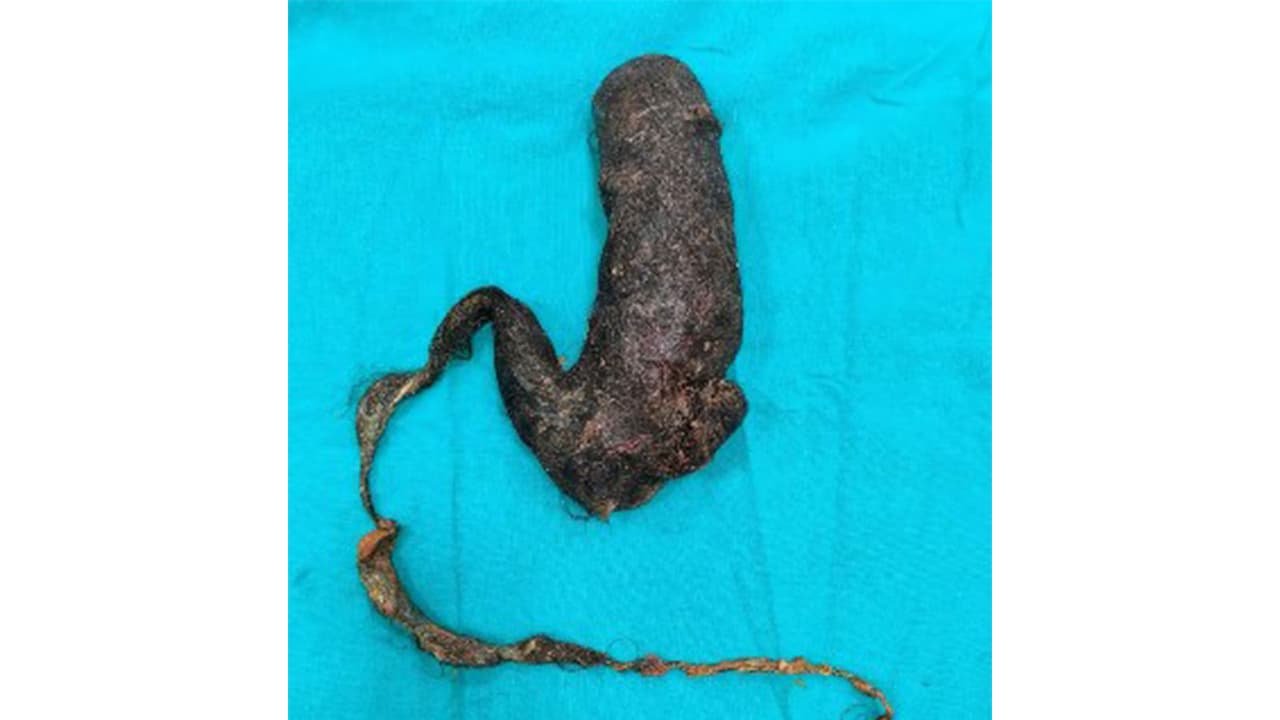
A 30-year-old woman's chronic stomach pain was caused by a giant hairball linked to trichotillomania. Doctors at Amrita Hospital, Faridabad, successfully removed the mass, highlighting the connection between mental and physical health.
The 30-year-old woman was surprised to discover a giant hairball taking up a large part of her stomach, leading to constant stomach pain and loss of appetite, doctors at Amrita Hospital, Faridabad said.
Since February, Shashi had suffered from abdominal pain, poor appetite, nausea and an uncomfortable feeling of fullness even after small meals. Over the months her condition deteriorated and she moved from one health centre to another in search of treatment. But no cause was ever found and she kept on deteriorating.
A Surprising Diagnosis
When she presented to Amrita Hospital, Faridabad, a detailed clinical examination unearthed the unexpected culprit behind her symptoms - a large trichobezoar (a compact mass of ingested hair) that had been building up in her stomach over the years. Doctors discovered the condition was associated with trichotillomania, a psychiatric disorder characterized by an overwhelming urge to pull out one's own hair.
Understanding the Condition
In some cases, patients also develop trichophagia, the practice of eating hair. The human body can't digest hair, so it just accumulates in your stomach over time. It can form a huge mass that causes serious complications.
In severe cases, this condition can develop into Rapunzel syndrome, a rare and serious form of trichobezoar. In this condition, the bulk of the bezoar is within the stomach with a long tail-like extension passing through the pylorus into the small intestine and sometimes as far as the colon. Rapunzel syndrome is named for the fairy tale character with long hair and is associated with a higher rate of major surgical complications such as complete bowel obstruction, protein-losing enteropathy, intestinal perforation and life-threatening infections.
Surgical Treatment and Recovery
The patient was managed by a multi-disciplinary team comprising Dr Saleem Naik, Dr Puneet Dhar and Dr Jaya Agarwal, Department of Gastrointestinal Surgery, Amrita Hospital, Faridabad. After thorough assessment and counselling, the surgical team carried out an exploratory laparotomy and successfully extracted the large trichobezoar.
If left untreated, these cases can result in intestinal obstruction, severe malnutrition, perforation of the stomach and infection and, in rare cases, can be fatal.
Under the Pradhan Mantri Jan Arogya Yojana (PM-JAY) scheme, treatment was provided, ensuring access to advanced tertiary care without any financial burden.
"Shashi came through without any complications. She was mobilised early after surgery, gradually allowed oral feeding and responded well to postoperative care. She was discharged on the fourth post-operative day in a stable condition.
The Link Between Physical and Mental Health
Doctors recommend long-term psychiatric follow-up and behavioural therapy for the underlying trichotillomania and to prevent recurrence. Experts say the condition highlights an important connection between mental health and physical illness, though trichobezoars are rare.
The case also highlights the importance of multidisciplinary care, in which surgeons and mental health professionals work together to treat both the symptom and the underlying cause.
For Shashi and her family, the diagnosis was a surprise. It served as a reminder for doctors that some of the most common symptoms can sometimes mask some of the most unusual medical conditions. Her recovery also underscores the critical importance of early diagnosis, timely surgery, psychiatric support, and access to quality healthcare through schemes like PM-JAY. (ANI)
(Except for the headline, this story has not been edited by Asianet Newsable English staff and is published from a syndicated feed.)