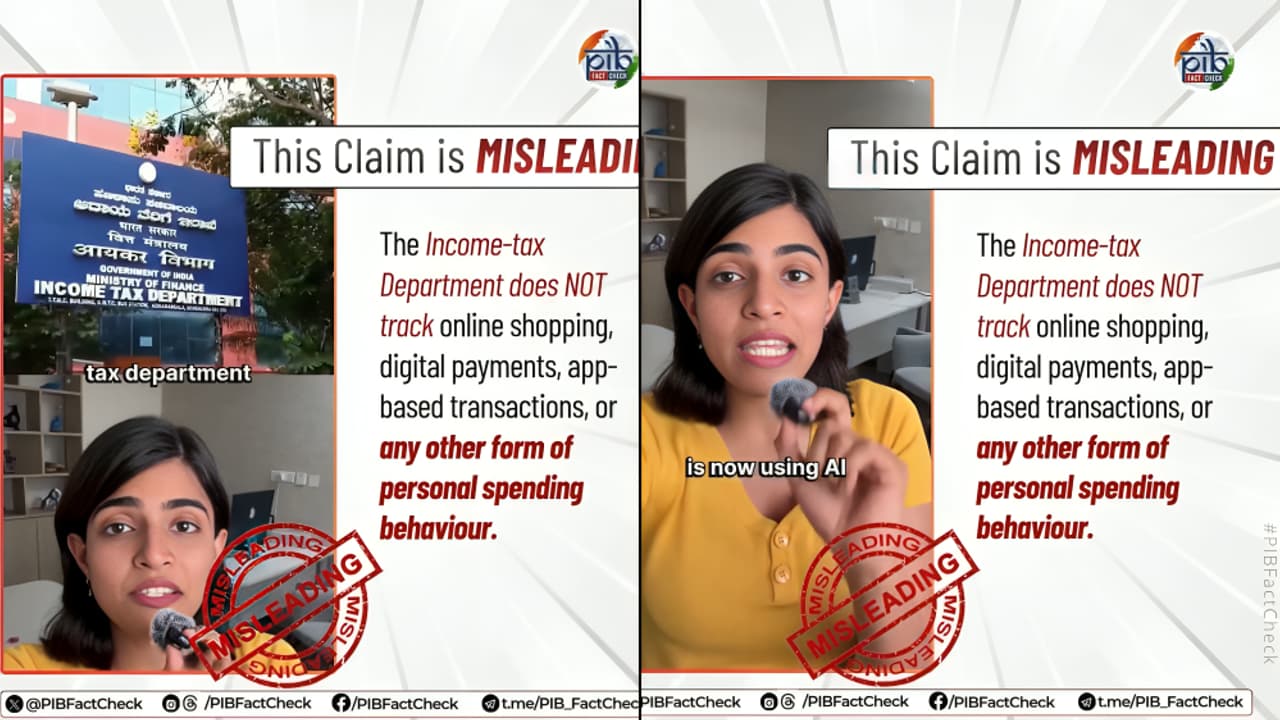
PIB Fact Check has clarified that claims about the Income Tax Department tracking online shopping, digital payments or personal spending are misleading. The agency said there is no system of monitoring of taxpayers' personal digital lives.
A claim circulating on social media has raised concerns that the Income Tax Department (ITD) is tracking people's online shopping, digital payments and lifestyle choices. The claim was shared through an Instagram post by an account named 'bingewealth'.
India's official fact-checking agency, PIB Fact Check, has clarified the issue. In a post shared on X, PIB Fact Check said the claim is misleading and does not reflect the real position of the Income Tax Department.
What the ,viral, claim said
According to PIB Fact Check, the Instagram post suggested that the Income Tax Department is using artificial intelligence to monitor people’s personal digital activity.
This included online shopping habits, app-based transactions, digital payments and even lifestyle spending. The claim created confusion and fear among users, many of whom believed the government was closely watching their personal online behaviour.
Related Articles

The post gained attention as discussions around the new Income Tax Act, 2025 have increased in recent months.
PIB fact check says claim is misleading
PIB Fact Check clearly stated that the claim is misleading. The official handle explained that the Income Tax Department does not track people’s online shopping, digital payments, app usage or personal spending behaviour. It also said there is no system or mechanism in place to monitor an individual’s digital or online activity.
In its post, PIB Fact Check said the claim creates unnecessary fear and misunderstands how income tax reporting works in India.
No surveillance of personal digital behaviour
According to PIB Fact Check, the Income Tax Department does not monitor personal digital activity in any form. This includes:
- Online shopping history
- Digital wallet payments
- App-based transactions
- Lifestyle or personal spending choices
The fact-checking agency stressed that such activities are not tracked by the tax department and that there is no behavioural profiling of individuals.
What section 285BA actually means
The confusion, PIB Fact Check said, appears to come from a misunderstanding of Section 285BA of the Income Tax Act, 1961. This section deals with the Statement of Financial Transactions, also known as SFT. Under this framework, certain high-value financial transactions are reported to the tax authorities.
However, PIB Fact Check made it clear that this does not involve surveillance or tracking of individuals.
Who reports these transactions
Under the SFT system, only specified entities are required to report certain transactions. These entities include:
- Banks
- Financial institutions
- Registrars and similar bodies
They report limited high-value transactions as part of routine legal compliance. These rules have been in place for many years and are not new. PIB Fact Check said this reporting is meant to ensure transparency in large financial dealings, not to monitor daily spending or online behaviour.
What is income tax act 2025
The Income Tax Act, 2025 is a new law that will replace the old Income Tax Act of 1961. From April 1, 2026, the 1961 law will no longer apply. The new Act aims to simplify the tax system and make compliance easier for citizens.
According to official information, the 1961 Act had 819 complex sections. The new Income Tax Act, 2025 reduces this number significantly, with fewer and clearer provisions.
The government has said the new Act is designed to remove complexity and reduce confusion. The aim is to make tax laws easier to understand, reduce lengthy explanations, and ensure smoother compliance for taxpayers.
PIB Fact Check did not suggest that the new law expands surveillance powers over ordinary citizens' personal lives.
One part of the debate focuses on Section 247 of the Income Tax Act, 2025. This section replaces Section 132 of the older 1961 law. Under Section 132, tax authorities had the power to enter properties, seize documents, equipment and access digital data during search operations.
The new Section 247 allows an authorised officer to gain access to a computer system or what is described as a “virtual digital space” by overriding access codes.