
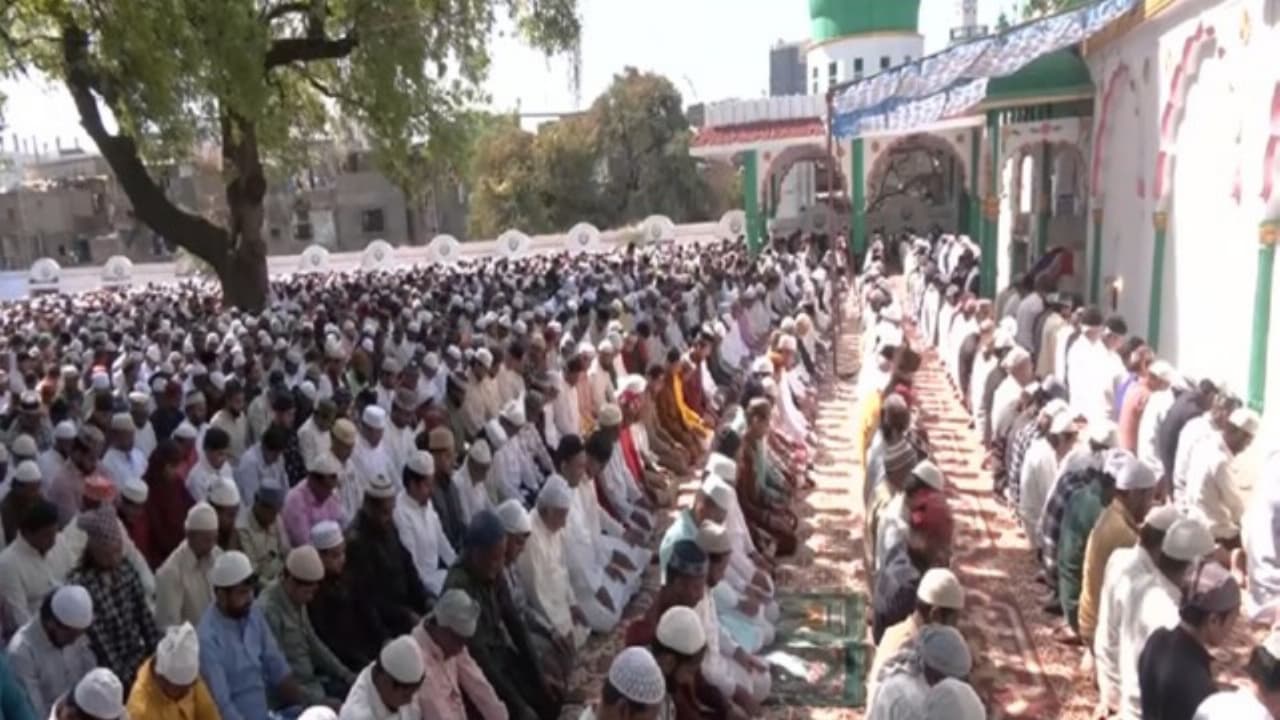
On Eid al-Fitr in Indore, Shahar Qazi Ishrat Ali led prayers and voiced concerns about drug abuse among youth, calling for a social boycott of sellers. He also advocated for the boycott of foreign products in favour of indigenous goods.
Hundreds of people gathered at the Sadar Bazaar Eidgah in Madhya Pradesh's Indore and offered Namaz on the occasion of Eid al-Fitr on Saturday. Shahar Qazi Ishrat Ali led the namaz on the occasion, and following the prayers, people greeted each other warmly by embracing and exchanging Eid wishes.
Qazi Addresses Drug Abuse, Calls for Boycott of Foreign Goods
Speaking to reporters here, Qazi Ishrat Ali also expressed concern about the increasing trend of intoxicants among youth, stressing that it is troubling that drug peddlers themselves are from within the community and urged that such sellers should face social boycott. "I extend my Eid greetings to everyone. One concern is that substance abuse has become common among the youth nowadays, and it is distressing that even those selling intoxicants themselves are Muslims. We have said that such drug sellers should face social boycott, as they are destroying generations for the sake of some coins," Shahar Qazi Ali said.
He further highlighted that the foreign products should be boycotted and the use of indigenous products should be promoted. "Secondly, there are some evil forces in the world that have become dominant and are determined to destroy it, with innocent people being killed. Thirdly, India has made significant progress since independence, and there is hardly anything in the world that is not manufactured here. Therefore, we should boycott foreign products and make use of indigenous products. We should prove ourselves to be true Indians by promoting and using locally made goods," he added.
The Significance of Eid al-Fitr and Ramazan
Eid al-Fitr is one of the most significant festivals in Islam, marking the end of the holy month of Ramazan. It is celebrated with special prayers (namaz), charity, feasting, and community gatherings. On this day, Muslims begin with morning prayers at mosques or Eidgahs, followed by greeting each other, sharing meals, and spreading messages of peace, unity, and compassion.
Ramazan, the ninth month of the Muslim calendar, is one of the most sacred times as it is believed that the Quran came down to the earth from heaven for the very first time. The holy Quran is regarded as "a guidance for men and women, a declaration of direction, and a means of salvation."
For an entire month, Muslims follow a schedule of waking up early, which they call 'Sheheri', and by 4:45 am have food, then after fasting for the whole day, not even drinking a drop of water. They perform Namaz five times a day. The early morning prayer is known as Fazar followed by Zohar in second, Ashar in third, Maghrib in fourth and the final one: Isha. The day-long fast (Roza) ends after Magrit which usually falls after 6 pm or later in the evening.
At the end of Ramazan, Eid al-Fitr celebrates the breaking of the fast. Friends and families gather for festive meals and exchange gifts. Special gifts are also given to the poor. It is also believed that fasting during the month of Ramazan is one of the Five Pillars of Islam. (ANI)
(Except for the headline, this story has not been edited by Asianet Newsable English staff and is published from a syndicated feed.)