
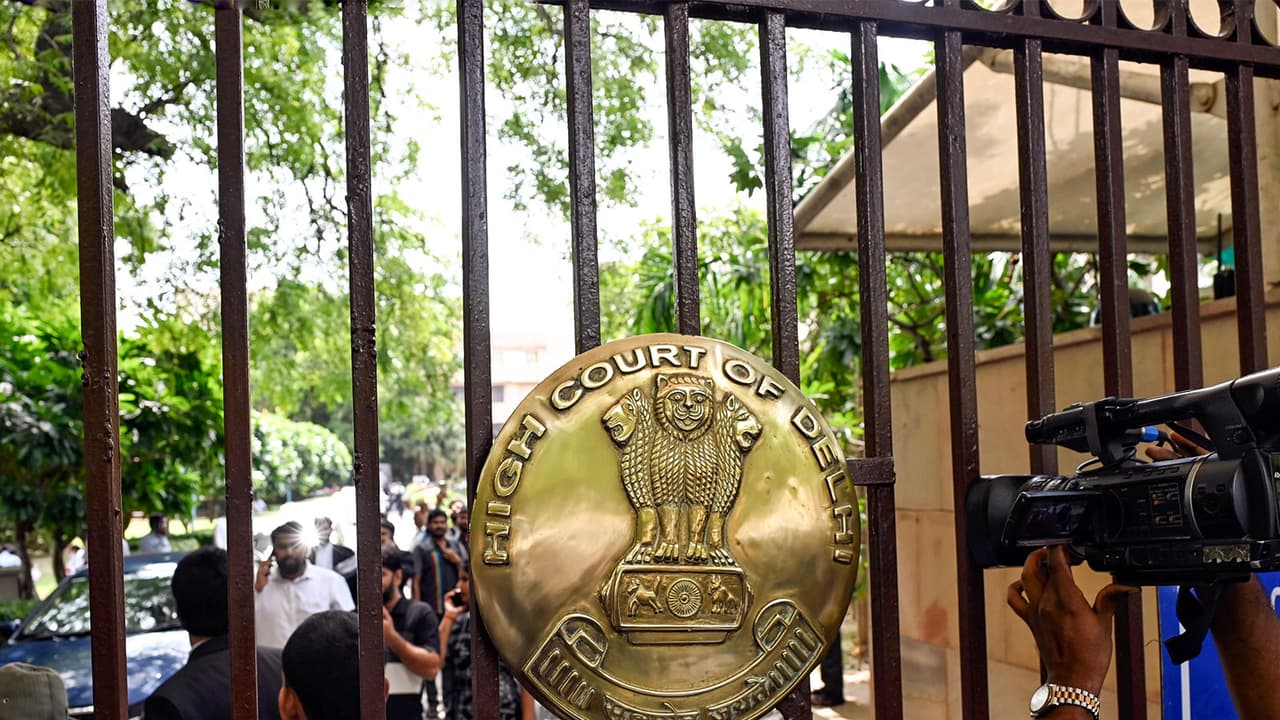
Delhi HC has ordered authorities to ensure dignified rehabilitation of JJ dwellers being relocated to Savda Ghevra, directing them to provide free metro travel, an induction cooker, and set up a 24/7 camp office to address grievances at the site.
The Delhi High Court has directed the authorities to strictly implement all commitments made regarding the rehabilitation of jhuggi-jhopri (JJ) dwellers proposed to be relocated to Savda Ghevra, while emphasising that rehabilitation must be carried out in a manner that safeguards the residents' right to live with dignity.
A Division Bench comprising Chief Justice Devendra Kumar Upadhyaya and Justice Tejas Karia passed the interim directions while hearing appeals filed by Rakesh Bansal and others, and Khushnuma Khan and others, challenging a judgment of a Single Judge dated May 11, 2026. The appellants were represented by Senior Advocate N Hariharan along with advocates Javed Ahmad, Vivek Jain, Varun Singh, Punya Rekha Angara, Aman Akhtar, Arjan Singh Mandla, Mohd. Atif, Kaleem Saifi, Mohd. Sunail, Aakriti Adtiya, Parijat, Bhumi Sharma and Urvashi Chauhan. Other appearing counsel for the appellants included Pankaj Sinha, Humaira Salam, Sunil Tiwari, Sherman Rawat, Aastha Vishwakarma, Harshit Jain, Shivang Rawat, Vikas Rathee and Vansh Kapoor. The Union of India was represented by Additional Solicitor General Chetan Sharma along with CGSCs SA Haseeb and Ashish K Dixit, and advocates Amit Gupta, RV Prabhat, Shubham Sharma, Yash Wardhan and Naman. DUSIB was represented by advocates Anuj Chaturvedi and Yashita Jain, assisted by Principal Director P.K. Jha and Legal Advisor Pranav Siroha.
Arguments and Assurances in Court
The appeals arise from the proposed relocation of JJ dwellers and concerns raised regarding the adequacy of facilities available at the rehabilitation site in Savda Ghevra. The Single Judge had directed the authorities to comply with the DUSIB rehabilitation policy, ensure essential amenities at the relocation site and require residents who had received allotments to vacate the existing camps within the stipulated period.
During the appellate proceedings, the Division Bench sought detailed affidavits from the authorities regarding the availability of schools, transport facilities, water supply, sanitation, healthcare and other civic amenities at Savda Ghevra. The appellants contended that the relocation site lacked adequate infrastructure and highlighted concerns relating to access to markets, water and electricity supply, healthcare services, educational facilities, security, child safety and overall habitability. It was also argued that Savda Ghevra is situated on the outskirts of Delhi, far from the existing places of residence and livelihood of many affected families.
On the other hand, the Union Government, the Land and Development Office (L&DO) and the Delhi Urban Shelter Improvement Board (DUSIB) submitted that the land presently occupied by the dwellers is required for security considerations and the development of defence infrastructure. The authorities assured the Court that adequate arrangements were being made to ensure meaningful rehabilitation of the affected families.
The Court recorded submissions that the Government had decided to bear the beneficiary contribution otherwise payable under the rehabilitation policy. It was also stated that all affected JJ dwellers, irrespective of questions regarding eligibility, would be provided housing units as part of the rehabilitation exercise. According to the authorities, out of 717 families identified for relocation, 248 had already accepted allotments and several had shifted to the newly allotted flats.
Authorities Detail Infrastructure at Relocation Site
Affidavits filed before the Court detailed the infrastructure available at the relocation site. The authorities stated that the colony is connected by railway, metro and bus services and is located near major road networks. Information regarding government and MCD schools in and around the area, including teacher strength and admission capacity, was also placed before the Bench. The affidavits further stated that electricity connections, street lighting, water supply infrastructure, underground reservoirs, sewerage systems, roads, parks and security arrangements are available at the site. Details regarding nearby healthcare facilities, including dispensaries and Sanjay Gandhi Government Hospital, were also furnished.
High Court's Interim Directions
During the hearing, the respondents additionally undertook to provide one ceiling fan and one induction cooker to each relocated family. DUSIB also assured the Court that assistance would be provided for securing LPG connections at the earliest. The Court was further informed that one member of each beneficiary family would be provided an AC bus pass for one year at a time, renewable up to a total period of three years. Female beneficiaries would continue to have access to free bus travel under existing schemes of the Delhi Government.
After considering the affidavits and submissions, the Bench observed that while efforts appeared to have been made to provide amenities, it was necessary to ascertain whether the facilities claimed were actually available on the ground. As an interim measure, the Court directed strict compliance with all statements and undertakings contained in the affidavits filed by DUSIB and L&DO, warning that any violation would be viewed seriously. The Bench also directed the authorities to make arrangements for free Delhi Metro travel for one member of each relocated family for an initial period of one year.
24/7 Camp Office and School Admissions Ordered
The Court further ordered DUSIB to establish a camp office at the relocation site within four days. The camp office is to be staffed round the clock by responsible officers from DUSIB, Delhi Jal Board and the concerned electricity agency to address grievances relating to civic amenities and rehabilitation issues. Additionally, the Court directed that children of relocated families be granted admission in nearby government and MCD schools and that officials posted at the camp office assist families in securing admissions. The direction was made binding upon both the Municipal Corporation of Delhi and the Education Department of the Government of NCT of Delhi.
Stressing that rehabilitation must be implemented in a manner consistent with the right to rehabilitation and the right to live with dignity, the Court warned that any non-compliance with its directions would be dealt with seriously. The matter has been listed for further hearing on July 1, 2026. (ANI)
(Except for the headline, this story has not been edited by Asianet Newsable English staff and is published from a syndicated feed.)