
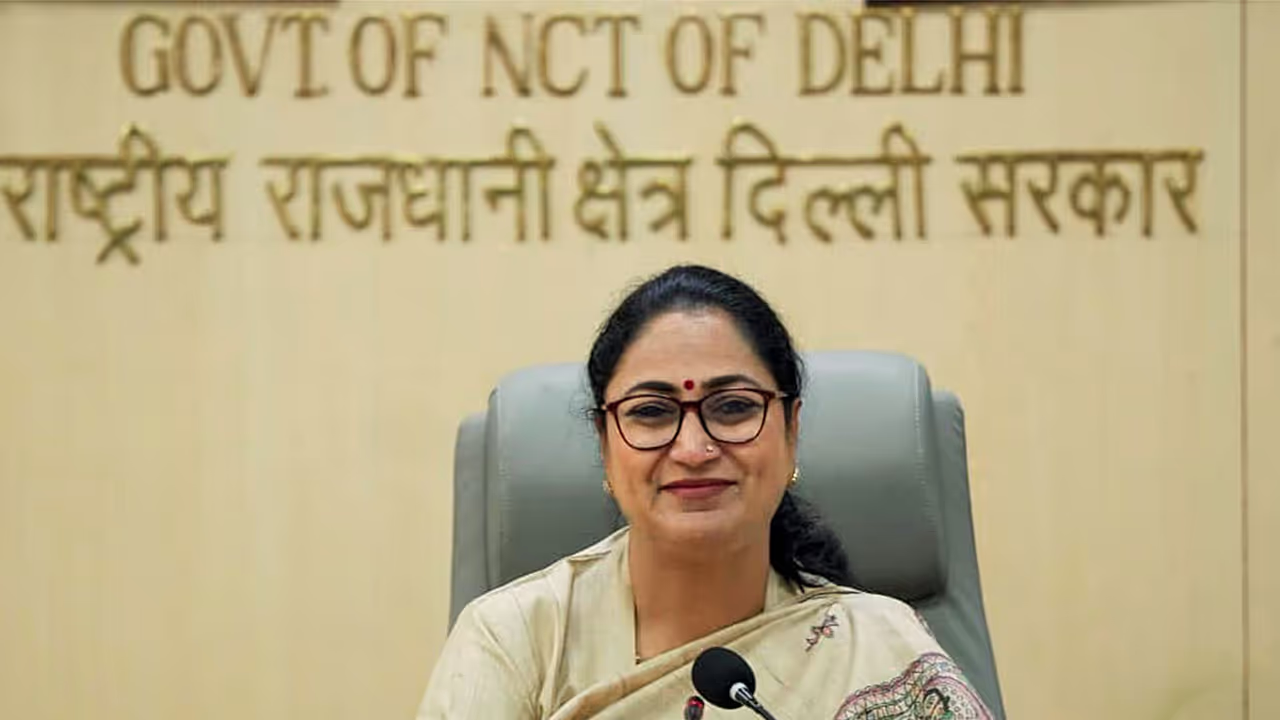
The Delhi Government, led by Chief Minister Rekha Gupta, has approved a Draft Bill for establishing private universities in the city. The bill aims to create a modern legal framework, attract world-class institutions, and align with NEP 2020.
Under the leadership of Chief Minister Rekha Gupta, the Delhi Government has taken a historic step in the field of higher education by approving the Draft Bill relating to the establishment and incorporation of private universities in the National Capital Territory (NCT) of Delhi, according to the Delhi Chief Minister's Office.
A New Era for Higher Education in Delhi
Following the approval of the Delhi Cabinet, the Bill will now be introduced in the Delhi Legislative Assembly for consideration and passage. The Chief Minister said the Bill would mark the beginning of a new era in higher education in Delhi. It seeks to create a modern, transparent and effective legal framework for the establishment of world-class private universities in the Capital.
The objective is to provide students with better academic opportunities, promote research and innovation, encourage entrepreneurship, strengthen collaboration between academia and industry, and foster international academic partnerships. The initiative is in line with the spirit of the National Education Policy (NEP) 2020 and represents a significant step towards establishing Delhi as a leading global centre for higher education.
Addressing Historical Gaps and Land Constraints
The Chief Minister said that despite being the nation's Capital, Delhi had remained one of the few major regions without a clear legal framework for the establishment of private universities. As a result, a large number of students had to move to neighbouring states or abroad in search of quality higher education.
The Bill will also pave the way for internationally reputed educational institutions and their off-campus centres to establish a presence in Delhi, enabling the Capital to strengthen its position among the country's and the world's leading higher education destinations, the CMO said. Keeping Delhi's geographical limitations and limited land availability in mind, the Bill adopts a modern approach instead of insisting on the traditional model of large land-based campuses. Rather than focusing solely on expansive horizontal campuses, greater emphasis will be placed on academic quality, adequate infrastructure, research capability, student facilities, and institutional governance. This will enable the development of modern, multi-storey urban campuses suited to a land-constrained metropolis like Delhi.
Strong Regulatory and Evaluation Framework
The Bill also provides for a strong regulatory framework to ensure accountability and transparency in the functioning of private universities. As part of this framework, the Delhi Private Universities Regulatory Authority will be established to oversee teaching standards, research, institutional governance, admissions, examinations, student records, and the overall performance of universities. The Authority will also have the power to issue corrective directions whenever necessary.
Before any private university is established, its proposal will undergo a detailed evaluation. A committee comprising senior government officials, eminent academicians, representatives of the University Grants Commission (UGC), and financial experts will conduct a thorough assessment of every proposal.
Making Delhi a 'Knowledge Capital'
Chief Minister Rekha Gupta said the Delhi Government believes that quality education should never be constrained by outdated regulations or institutional limitations. Students should have better access to excellent educational institutions, whether public or private, provided they adhere to the highest standards of transparency, accountability, and academic excellence.
Education Minister Ashish Sood said that for decades, Delhi had witnessed a striking paradox. While the Capital of India became a hub for students preparing for higher education, it did not become a destination for pursuing quality higher education itself. World-class private universities continued to be established in neighbouring states, while Delhi's students were compelled to leave their own city in search of quality institutions.
He said the Government has now taken an important step towards correcting that historic anomaly. This law is not merely about establishing private universities; it is about ensuring that Delhi's youth have access to world-class higher education within their own city. The objective is clear: to make Delhi the Knowledge Capital of India. (ANI)
(Except for the headline, this story has not been edited by Asianetnews Editorial staff and is published from a syndicated feed.)