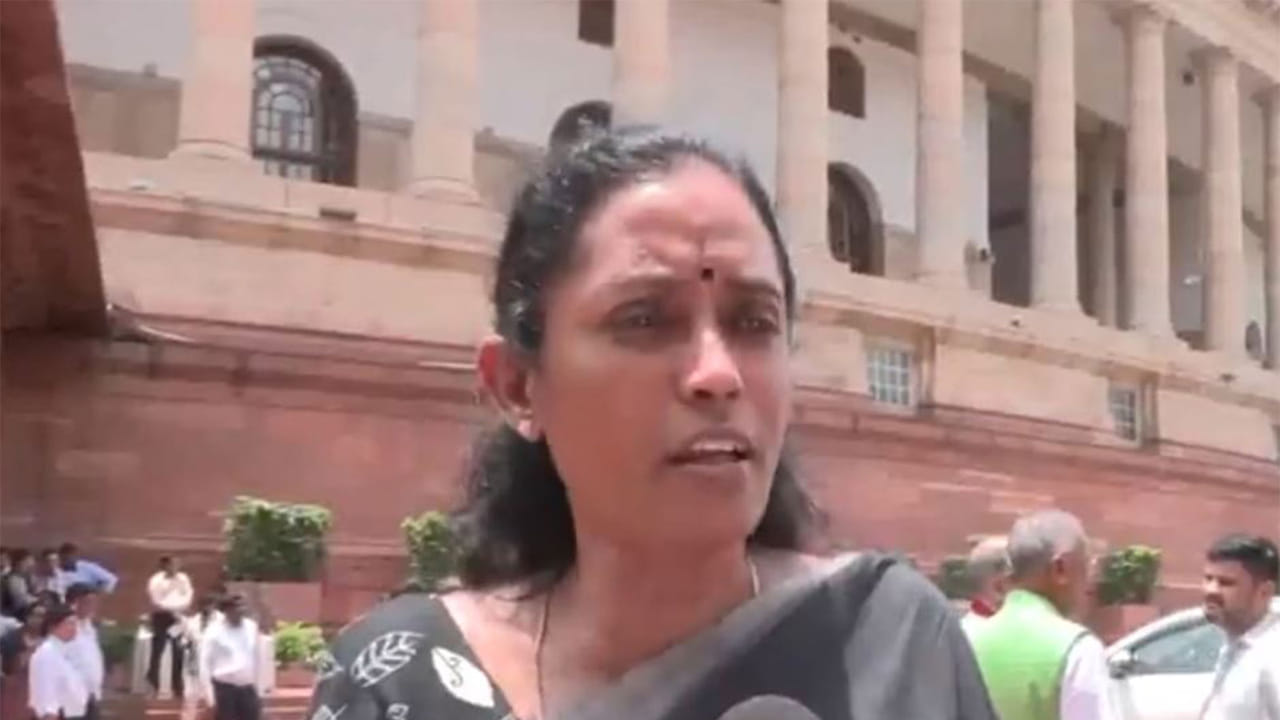
Congress MP Jothimani and P. Chidambaram criticize the 132nd Constitutional Amendment Bill, arguing that the proposed delimitation will undermine Southern states' political influence and democratic balance while lacking necessity.
New Delhi [India], November 28 (ANI): Congress MP Jothimani on Saturday termed the proposed delimitation exercise a “fundamental attempt to alter India’s political and federal balance”, warning that it could diminish the political influence of Tamil Nadu and other Southern States in relation to larger States. In a post on X, Jothimani said the exercise could have consequences for India’s democracy and federal structure for generations. “Just read the 132nd Constitutional Amendment Bill. Our worst fears have come true. This is not merely a delimitation exercise. It is a fundamental attempt to alter India's political and federal balance, with consequences that could reshape the future of our democracy for generations,” she wrote.
After the manipulation of electoral rolls through the Special Intensive Revision (SIR) and the compromising of the independence and credibility of the Election Commission of India, this proposed delimitation is an yet another instrument to manipulate electoral outcomes. The BJP - Modi government that cannot secure political legitimacy through the people's mandate must never be allowed to engineer an electoral advantage by manipulating the democratic framework. This is not about how many additional seats Tamil Nadu gets. It is about how much political power Tamil Nadu and Southern India stand to lose in relation to the much larger States. Uttar Pradesh's Lok Sabha seats will increase from 80 to 120, while Tamil Nadu's will increase from 39 to approximately 59. The gap between the two States will widen from 41 to 61 seats. This is only one illustration of how the existing political imbalance will be further amplified.
The consequences go far beyond parliamentary numbers. It is about whose voice will matter in Parliament, who will shape national policies, whose priorities will determine the national agenda and who will have a greater say in decisions concerning the country's resources and future. Southern India's political bargaining power, its economic interests and its place in national decision making are all at stake. States that have responsibly invested in education, healthcare, women's empowerment and population stabilisation cannot be penalised for their achievements. Their political voice cannot be progressively diminished while their contribution to the nation is expected to grow. A State may receive more seats in absolute numbers and still become politically weaker in relative terms. That is the fundamental danger of this exercise. It threatens to make entire regions of this country increasingly irrelevant in the political landscape. Our voices will matter less, our concerns will receive less attention, and the federal balance will be progressively undermined.
And why is women's reservation being brought in as a justification for this exercise? The 106th Constitutional Amendment providing one third reservation for women was passed by an overwhelming majority in the Lok Sabha and received the President's assent. It can and should be made operational through the necessary constitutional and legislative measures within the existing strength of 543 Lok Sabha seats and the existing strength of State Assemblies, without making a 50 per cent expansion and fresh delimitation a precondition. Using women's reservation as a mask to push through the political restructuring is a deception of the people. No government has the mandate to manipulate the democratic balance of this country through constitutional engineering . Every political party, every elected representative and every citizen who believes in this great nation has a constitutional responsibility and duty to defend our democracy, federalism and the Constitution. This is not a question of political convenience or party interests. It is about the future of India. A country cannot remain united by progressively diminishing the political voice of some of its States. You cannot demand equal responsibility and contribution from States while reducing their influence in the decisions that govern them. Such an approach will only breed mistrust, deepen divisions and eventually undermine the very foundations of our Union. This is a defining moment for Indian democracy. History will never forgive those who chose silence, surrendered their responsibility or laid down their constitutional duty when the federal foundations of this great nation were under threat.
Jothimani also alleged that the proposed delimitation exercise followed the Special Intensive Revision (SIR) of electoral rolls and what she described as the erosion of the Election Commission of India. “After the manipulation of electoral rolls through the Special Intensive Revision (SIR) and the compromising of the independence and credibility of the Election Commission of India, this proposed delimitation is yet another instrument to manipulate electoral outcomes,” she said. She accused the BJP-led government of seeking to secure an electoral advantage through changes to the democratic framework. “The BJP - Modi government that cannot secure political legitimacy through the people's mandate must never be allowed to engineer an electoral advantage by manipulating the democratic framework,” she said.
She argued that an increase in the absolute number of Lok Sabha seats would not necessarily translate into greater political influence for Southern States. “This is not about how many additional seats Tamil Nadu gets. It is about how much political power Tamil Nadu and Southern India stand to lose in relation to the much larger States,” she said. Citing the projected increase in parliamentary seats, she pointed out that Uttar Pradesh’s Lok Sabha seats would rise from 80 to 120, while Tamil Nadu’s would increase from 39 to approximately 59. According to her, the gap between the two States would widen from 41 to 61 seats. “Uttar Pradesh's Lok Sabha seats will increase from 80 to 120, while Tamil Nadu's will increase from 39 to approximately 59. The gap between the two States will widen from 41 to 61 seats. This is only one illustration of how the existing political imbalance will be further amplified,” she said. “The consequences go far beyond parliamentary numbers. It is about whose voice will matter in Parliament, who will shape national policies, whose priorities will determine the national agenda and who will have a greater say in decisions concerning the country's resources and future,” she added.
She further said that Southern India's political bargaining power, its economic interests and its place in national decision-making are all at stake. She maintained that States which had invested in education, healthcare, women’s empowerment and population stabilisation should not be penalised by a reduction in their relative political influence. “States that have responsibly invested in education, healthcare, women's empowerment and population stabilisation cannot be penalised for their achievements. Their political voice cannot be progressively diminished while their contribution to the nation is expected to grow,” she said. Questioning the government’s use of women’s reservation as a justification for the exercise, Jothimani said the 106th Constitutional Amendment providing one-third reservation for women could be implemented within the existing strength of 543 Lok Sabha seats and State Assemblies, without making a 50 per cent expansion and fresh delimitation a precondition. “And why is women's reservation being brought in as a justification for this exercise? The 106th Constitutional Amendment providing one-third reservation for women was passed by an overwhelming majority in the Lok Sabha and received the President's assent. It can and should be made operational through the necessary constitutional and legislative measures within the existing strength of 543 Lok Sabha seats and the existing strength of State Assemblies, without making a 50 per cent expansion and fresh delimitation a precondition. Using women's reservation as a mask to push through the political restructuring is a deception of the people,” she said.
She further said that no government has the mandate to manipulate the democratic balance and every political party, every elected representative and every citizen who believes in this great nation has a constitutional responsibility. “No government has the mandate to manipulate the democratic balance of this country through constitutional engineering. Every political party, every elected representative and every citizen who believes in this great nation has a constitutional responsibility and duty to defend our democracy, federalism and the Constitution. This is not a question of political convenience or party interests. It is about the future of India,” she wrote. She said that a country cannot remain united by progressively diminishing the political voice of some of its States and cannot demand equal responsibility and contribution from States while reducing their influence in the decisions that govern them. “A country cannot remain united by progressively diminishing the political voice of some of its States. You cannot demand equal responsibility and contribution from States while reducing their influence in the decisions that govern them. Such an approach will only breed mistrust, deepen divisions and eventually undermine the very foundations of our Union,” she said. She added that history will never forgive those who chose silence, surrendered their responsibility or laid down their constitutional duty. “This is a defining moment for Indian democracy. History will never forgive those who chose silence, surrendered their responsibility or laid down their constitutional duty when the federal foundations of this great nation were under threat,” she added.
Meanwhile, senior Congress leader P Chidambaram said the proposed 25-year freeze on the present relative proportion of each State’s seats in the Lok Sabha addressed two of the opposition’s concerns but did not resolve what he termed the fundamental concern. “The proposed Constitution Amendment Bill has been unveiled. The 'freeze' for 25 years of the present relative proportion of each State to the total seats of the Lok Sabha will address two of our concerns. However, the Bill does not address the first -- and fundamental –concern,” he wrote.
He cautioned that delimitation of constituencies within individual States could give the government a “free licence” to gerrymander constituencies, citing Assam and Jammu and Kashmir as examples. “While relative proportion of each State to the total is important, absolute numbers also matter. Besides, the increased strength of the Lok Sabha will entail delimitation of the constituencies within each state. That will give a free licence to the government to gerrymander the constituencies within the state -- as the government did in Assam and J&K. Gerrymandering is the greater evil and the greater danger,” he wrote. He also questioned why women’s reservation could not be implemented within the existing strength of the Lok Sabha. “The government has still not answered our primary question: why can't the 1/3 reservation for women be implemented in the present strength of the Lok Sabha?” he questioned.