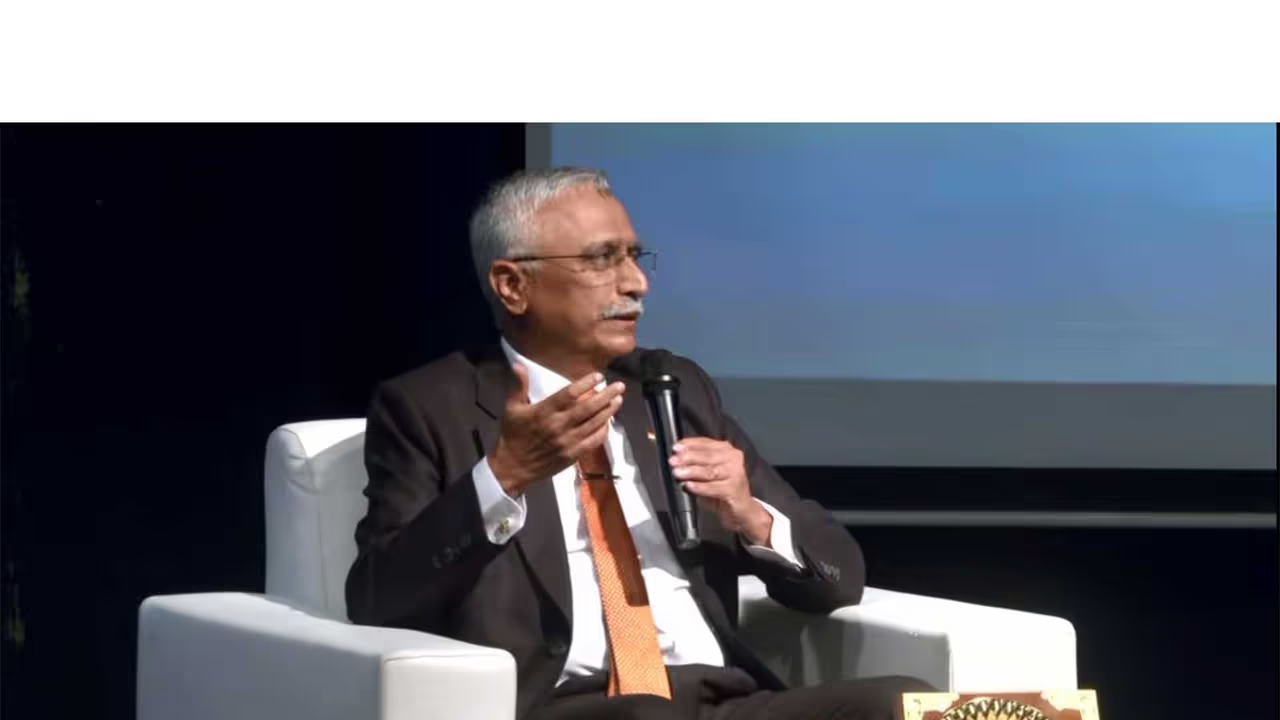
Former Army Chief General Manoj Mukund Naravane (Photo/ANI)
Former Army Chief Gen MM Naravane said China will be India's main competitor, not enemy, across all spheres in the future, while Pakistan remains a key security challenge due to its support for terrorism, urging dialogue alongside deterrence.
China will be India's "main competitor" in the years to come across political, economic, trade and military spheres, while Pakistan will continue to remain a key security challenge due to its support for terrorism, former Army Chief General Manoj Mukund Naravane (Retd) said.Speaking at the launch of his book The Curious and the Classified: Unearthing Myths and Mysteries, published by Rupa Publications, in Pune, Naravane said India must distinguish between a competitor and an enemy, and emphasised the need to resolve differences with China through dialogue while maintaining strong military deterrence.
China the Competitor, Pakistan the Challenge
"Pakistan and China are a totally different ballgame. We have fought wars with both of them. We have unsettled borders. So, they will always remain on our radar as a threat, as a challenge," Naravane said.However, he said the relative importance and priority accorded to the two challenges would keep changing depending on the evolving situation."Because we have fought major wars with Pakistan and because of their continued support to terrorism, our attention is towards our western borders. But that attention towards the western borders is because of the terrorism angle," he said."That's the short-term aim and objective. I think we are very clear that in the long term and in the years to come, China is going to be our main competitor. And I purposely use the word competitor and not enemy," the former Army chief said.Explaining the nature of the competition, Naravane said China would compete with India in multiple domains."Because they are going to be our main competitor in all fields. Political, economic, trade and of course military also. And wherever there is competition, there is always a little bit of conflict," he said.
Dialogue and Deterrence
Naravane stressed that India should seek to resolve such differences through talks and dialogue, with the use of force being the last resort."But it is up to us to try to resolve those conflicts, those differences through the mechanisms of talks, dialogues. And taking recourse to the use of force should always be the last resort. We should try our best to resolve disputes through dialogue," he said.At the same time, he underlined the importance of maintaining a credible military deterrence."And that is why the armed forces have to be ready at all times. You have to have a strong deterrence to stop anybody from resorting to the use of force or any misadventure. And that is why the saying is there that if you want peace, prepare for war," Naravane said.
On Pakistan-Occupied Kashmir (POK)
On Pakistan-occupied Kashmir (POK) and Balochistan, Naravane said India's policy should be not to interfere in the internal affairs of neighbouring countries, just as India does not want other countries to interfere in its internal matters."I think what is happening in Pakistan is for them to look at our policy of not interfering in the internal matters of neighbouring countries. Just as we don't like others interfering in our internal matters, I think we reciprocate by not interfering in the internal affairs of others," he said.On POK, Naravane referred to India's parliamentary position and said the country's claim over the territory remains open-ended."As far as POK is concerned, there is a parliamentary resolution of sometime in the 80s, which says that POK is an integral part of the Union of India," he said.Referring to a statement made by Defence Minister Rajnath Singh a few years ago, Naravane said, "More recently, 2-3 years ago, in one of the interactions, the Defence Minister also stated that it is a part of India and will remain so. However, there is no timeline for that."He said there was also no defined methodology at present on how any future amalgamation would take place."When will it happen? How will it happen? Will the people of PoK themselves declare, through a referendum, that they no longer wish to remain part of Pakistan and instead want to reunite with India? So, the methodology of that amalgamation will have to be decided." Naravane said.He clarified that India's claim did not necessarily imply the use of military force to capture the territory."It's not that it will be done by force of arms or forcefully; we will attack and capture POK. So, it is an open-ended resolution that we don't give up our claim on Pakistan-occupied Kashmir. That is part of the map of India, as we know it," he said.
Winning Over Populations
On the question of the population in POK in the event of any future amalgamation, Naravane cited India's experience in the Northeast and said winning the confidence of people was a long-term process."As far as the populations are concerned, that will be, of course, a matter of concern. But it is up to us, just as we have won over the populations in our border states. Northeast was all insurgency," he said.Naravane recalled the insurgency situation in several northeastern states during the 1980s and said sustained government policies and development in border areas gradually helped integrate the populations more closely with the rest of the country."But over a period of time, because of the policies of the government, because of the way we have carried out development in the border areas, in those days you had to openly tell us that you have come from India. Now they don't say that. Now they consider themselves part of the country, of Bharat," he said."So it is possible. But it takes a generation for that change to come about. So if and when some amalgamation takes place, I am sure we will be able to deal with this question also," the former Army chief said.
Importance of Neighbourhood Stability
Naravane also stressed that India should seek stability in its neighbourhood, saying instability in neighbouring countries can directly affect India's security and development."You can't choose your neighbours in real life also and in geopolitics also. You have to make the best of what you have, and having stable neighbours actually also promotes stability in your own country," he said.He cited the refugee influx from Myanmar as an example of how instability in a neighbouring country can have consequences for India."So, if your neighbouring country is burning, that should not make you happy because, like what happened in Myanmar, you had a refugee influx," Naravane said.He warned that unstable borders and neighbouring countries can also create space for smuggling, drug trafficking, illegal arms and narcotics, with the consequences eventually reaching India."Therefore, we need to help out these countries to be stable," he said.Naravane was speaking at the launch of his book The Curious and the Classified: Unearthing Myths and Mysteries, where Dr Gaurav Pradhan and Praful Sarda interacted with the former Army chief. (ANI)(Except for the headline, this story has not been edited by Asianet Newsable English staff and is published from a syndicated feed.)