
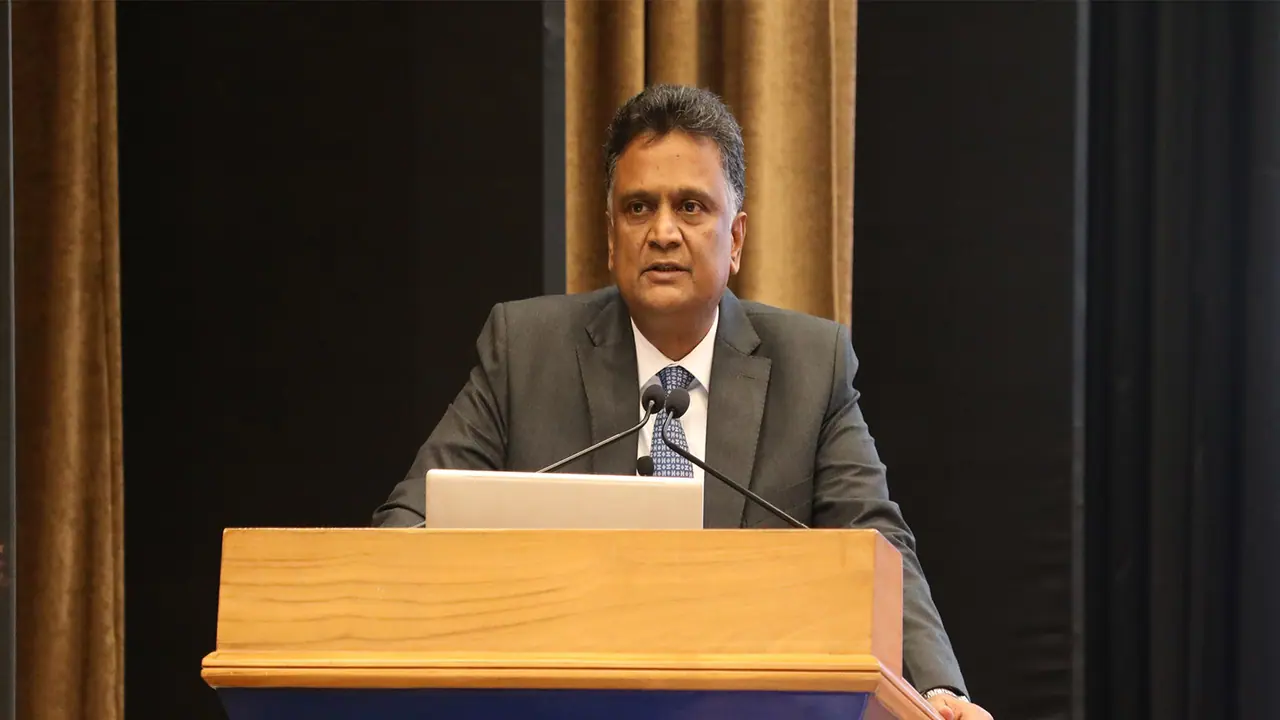
CAG K Sanjay Murthy hosted a national conference on the power sector, signing an MoU with Vasudha Foundation. The conference aims to develop an audit plan to support India's vision for 24x7, reliable, and sustainable power for all by 2047.
CAG Outlines Vision for Power Sector Audit
The Comptroller and Auditor General of India (CAG), K Sanjay Murthy, on Monday hosted a National Conference on the Power Sector, bringing together State Power Secretaries, senior officials from the Union Ministry of Power. A memorandum of understanding (MoU) was signed between the CAG and Vasudha Foundation to support capacity-building initiatives and detailed audits in the power sector. The conference also saw participation from the Chairpersons of the Central Electricity Regulatory Commission (CERC) and the Central Electricity Authority (CEA), along with CMDs of NTPC Limited, NHPC Limited, Solar Energy Corporation of India (SECI), Power Finance Corporation (PFC), Grid Controller of India Limited (Grid-India), Power Grid Corporation of India Limited (PGCIL), heads of selected state generation, transmission and distribution PSUs, and representatives of the Vasudha Foundation--a non-profit think-tank focused on clean-energy solutions.
In his inaugural address, CAG K Sanjay Murthy said the conference aims to harvest innovative ideas, share best practices and shape a comprehensive audit plan for one of the economy's most critical sectors. "At the end of this conference, we will present our audit plan, aligning it with today's deliberations so that it contributes to the national vision for power and to the shared goal of Viksit Bharat @2047," he noted.
Leveraging Technology and Setting Targets
K Sanjay Murthy highlighted the growing role of artificial intelligence and big-data analytics in strengthening sector capacity, citing strategic dashboards from the National Power Portal, CEA and NITI Aayog's India Climate and Energy Dashboard. He urged auditors to align priorities with these tools, creating a three-to-four-year pipeline of audit products that can help both Union and State governments meet their targets. He reminded participants that per-capita electricity consumption must rise from 1,460 kWh today to 2,000 kWh by 2030 and 4,000 kWh by 2047, requiring reliable, 24x7, financially viable and environmentally sustainable power. Generation has already grown from 1,168 BU (2015-16) to 1,824 BU (2025-26), with non-fossil capacity reaching 50 per cent of total capacity five years ahead of schedule.
Stakeholders Call for Action and Reform
CERC Chairperson Shri Jishnu Barua called for concrete, time-bound recommendations on resource adequacy, grid readiness, DISCOM reform, digitalisation, storage and market design. "Sound planning, efficient procurement, timely implementation and transparent reporting are essential so every rupee invested translates into reliable supply and sustainable outcomes for citizens," he said.
Santosh Kumar Sarangi, Secretary, Ministry of New and Renewable Energy, described the "energy trilemma" of affordability, reliability and security, and noted renewable energy's pivotal role in India's transition, with the country now the world's second-largest module manufacturer after China.
New Audits and a Forward-Looking Framework
Additional Deputy CAG Guljari Lal announced that the CAG has launched a horizontal performance audit of DISCOM operational and financial performance and of the Pradhan Mantri Surya Ghar Muft Bijli Yojana. Audits will also cover transmission capacity augmentation, battery-energy-storage systems, the Green Energy Corridor, market development and regulatory challenges over the coming years.
The conference concluded with a commitment to translate today's insights into a robust, forward-looking audit framework that will help power India's growth while ensuring accountability, efficiency and sustainability.
(Except for the headline, this story has not been edited by Asianet Newsable English staff and is published from a syndicated feed.)