
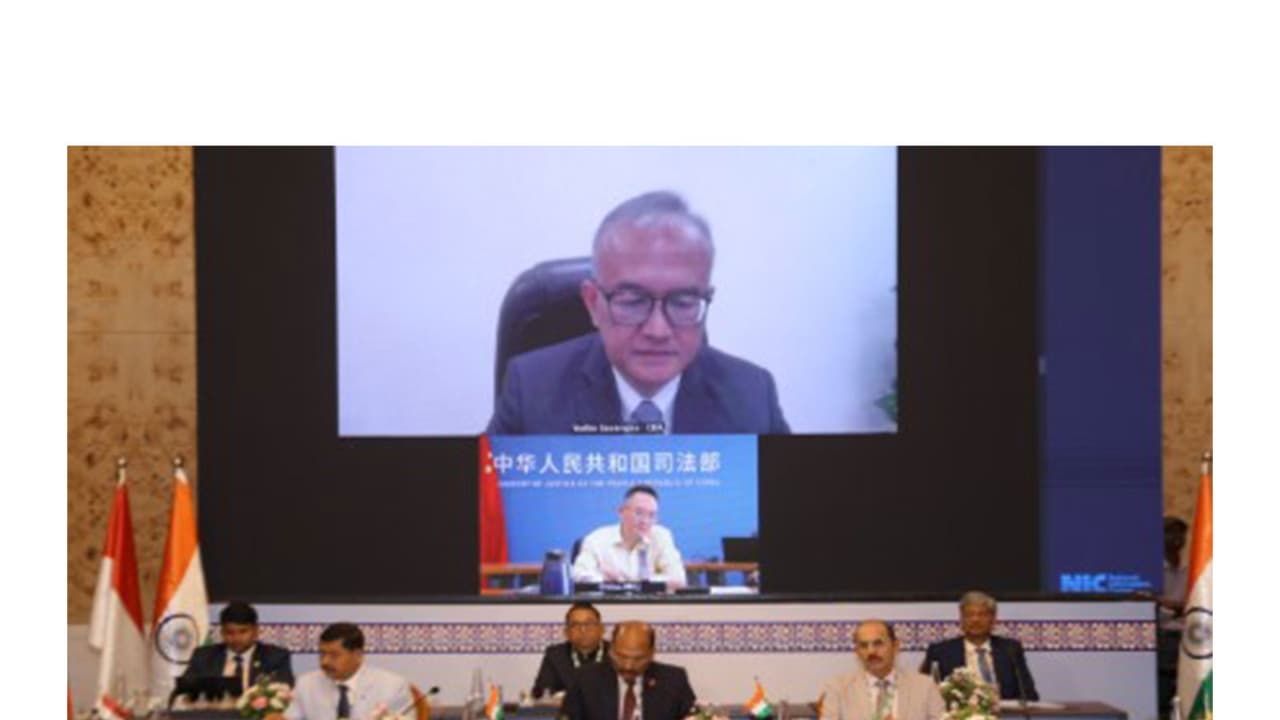
Senior BRICS officials met in Gandhinagar under India's 2026 Chairship, reaching consensus on a Joint Declaration. The focus was on strengthening Alternative Dispute Resolution (ADR) through capacity building in mediation and arbitration.
Senior officials from BRICS countries have reached a consensus on a Joint Declaration aimed at strengthening Alternative Dispute Resolution (ADR) mechanisms through enhanced capacity building in mediation and arbitration, during a two-day meeting in Gujarat's Gandhinagar under India's BRICS 2026 Chairship.
According to the Ministry of Law and Justice, the Department of Legal Affairs, Ministry of Law and Justice, Government of India, concluded a Senior Officials' Meeting from May 19 to May 20 in Gandhinagar, to deepen cooperation on Alternative Dispute Resolution (ADR).
Consensus on Joint Declaration
The meeting was held in hybrid mode, with senior officers from Brazil, China, India, Egypt, Ethiopia, Iran, Indonesia, Russia, South Africa, and the United Arab Emirates. It concluded with a shared consensus on a Joint Declaration titled "Declaration of the Ministers of Justice of the BRICS Countries on Strengthening Alternative Dispute Resolution through Capacity Building in Mediation and Arbitration," which will be presented for formal adoption at the Ministers of Justice Meeting to be held from May 21 to May 22.
The meeting brought together senior justice officials from BRICS countries for comprehensive discussions on ADR-related issues. Delegates deliberated on institutional mediation, arbitration reforms, and the role of ADR in commercial and public-sector disputes, highlighting experiences, challenges, and emerging trends in their respective jurisdictions.
After extensive and constructive dialogue, the Senior Officials finalised the text of the Declaration, which captures the collective commitment of BRICS countries to expand, professionalise, and mainstream mediation and arbitration as accessible and effective means, a release added.
The outcome reflects BRICS members' shared vision of building resilient, innovative, and cooperative legal ecosystems.
BRICS Justice Meetings Framework
The Department of Legal Affairs, Ministry of Law and Justice, under the aegis of India's BRICS Chairship, is hosting the BRICS Senior Officials' Meeting (SOM) on 19-20 May 2026, followed by the BRICS Justice Ministers' Meeting (JMM) on May 21 to May 22 in Gandhinagar.
India will chair the BRICS Justice Ministers' Meeting this year. The SOM will bring together senior officials from BRICS member States--Brazil, Russia, India, China and South Africa to deliberate on priority ADR-related issues, including institutional mediation, arbitration reforms, and the role of ADR in commercial and public-sector disputes.
The discussions will also examine the implementation of ADR-centric reforms, which have been highlighted in BRICS forums as model interventions for reducing case backlogs and enhancing timely, cost-effective dispute resolution.
The JMM will provide a ministerial platform for BRICS Ministers of Justice to adopt a Joint Statement on ADR-led Cooperation in the BRICS Framework, setting out concrete commitments to share best practices, strengthen institutional capacity, and explore collaborative ADR-related initiatives such as training programmes, model rules, and digital dispute-resolution platforms.
The meetings underscore India's leadership in promoting ADR as a core component of modern legal-system reform and as a vital tool for delivering accessible, speedy and affordable justice to citizens.
The choice of Gandhinagar, Gujarat, as the venue reflects the city's emergence as a hub for major international legal and multilateral events under India's 2026 BRICS Chairship.
Key Objectives for ADR Cooperation
The BRICS Justice Ministers will promote dialogue and cooperation on Alternative Dispute Resolution (ADR), particularly mediation and arbitration, by facilitating the exchange of best practices, policy approaches, and institutional experiences; strengthening professional capacity and institutional ecosystems through training, professional exchanges, joint workshops, and knowledge-sharing platforms for mediators, arbitrators, judges, government legal officers, and legal professionals; and enhancing court-referred and pre-litigation mediation. It also fosters institutional cooperation among arbitration centres, mediation institutions, and legal training bodies; leverages digital technologies to improve accessibility and efficiency; supports cooperation on cross-border commercial disputes; advances legal research and comparative study of BRICS jurisprudence to harmonise laws on trade and the environment; and promotes training for government legal officers.
The meetings will include plenary sessions and bilateral exchanges aimed at concrete cooperation initiatives, capacity-building projects, and institutional linkages. Outcomes will be consolidated in a Declaration of the Justice Ministers of the BRICS Countries on "Strengthening Alternative Dispute Resolution through Capacity Building in Mediation and Arbitration". (ANI)
(Except for the headline, this story has not been edited by Asianet Newsable English staff and is published from a syndicated feed.)