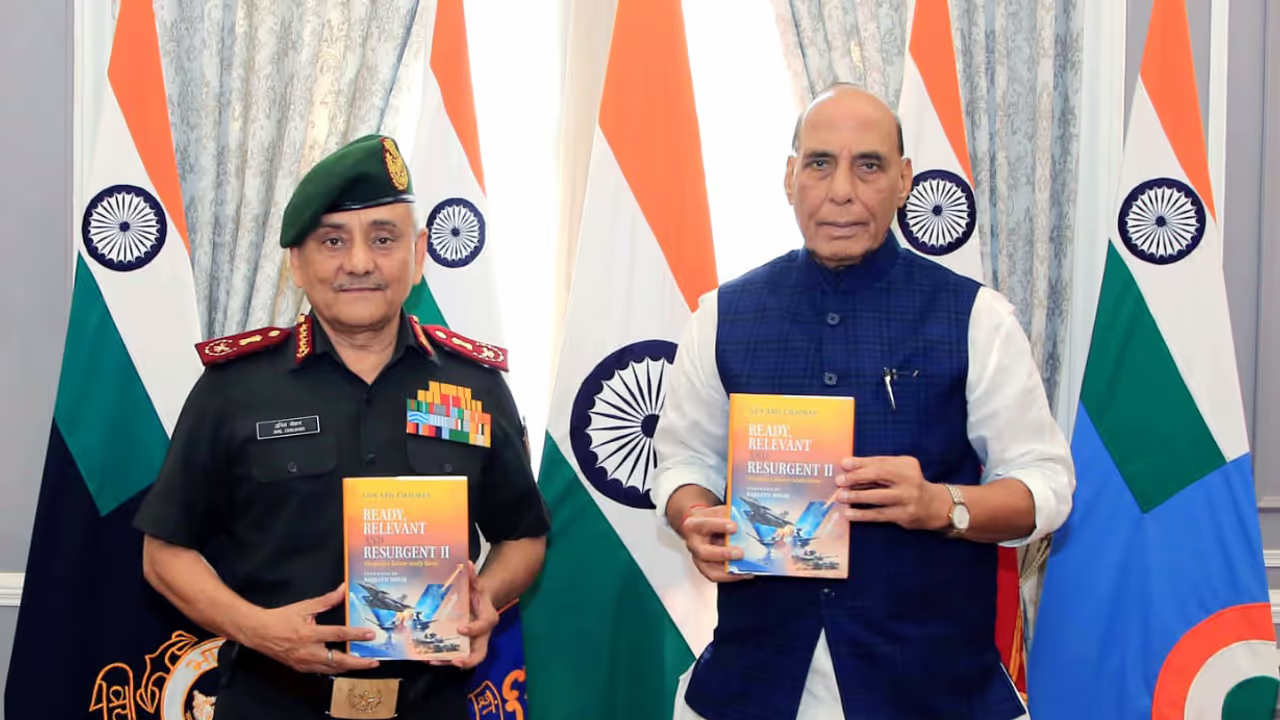
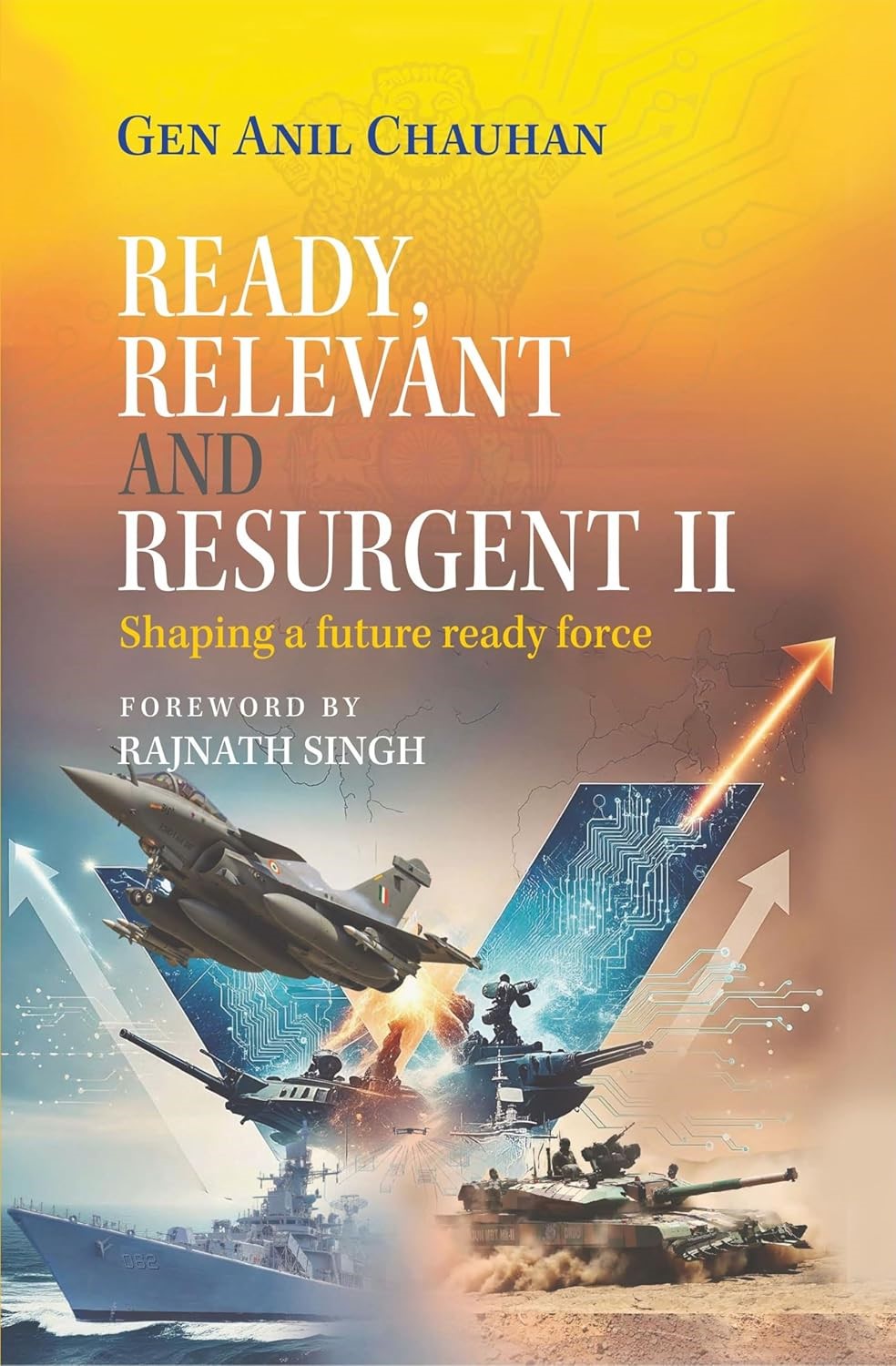
General Anil Chauhan’s Ready, Relevant and Resurgent II is a visionary roadmap for transforming India’s Armed Forces. Blending strategy, technology, and leadership, it charts how India can build a future-ready, agile, and ethically grounded military.
Book Review by Ashika S Prasad, Research Assistant, CENJOWS: General Anil Chauhan’s ‘Ready, Relevant and Resurgent II’ emerges at a decisive moment for India’s defence community- a time when the country’s strategic environment is being reshaped by technology, shifting power equations, and the vanishing boundaries between war and peace. This sequel builds on the foundation of the first volume, ‘Ready, Relevant and Resurgent: A Blueprint for the Transformation of India’s Military’, but feels more than a continuation, as it is a statement of vision for shaping a future-ready force. Unveiled by Defence Minister Rajnath Singh, it captures the urgency of preparing India’s military for an era where the battlefield is as much cognitive and digital as it is physical.
In his foreword, the Defence Minister situates India at a strategic inflection point-surrounded by adversarial challenges but uniquely poised for transformation. The tone is one of resolve, emphasising that incremental adaptation is no longer enough. What the Indian Armed Forces now require is a "decisive and fundamental reimagination of India's national security calculus."
Related Articles

Understanding War: Revisiting Strategy Through a Modern Lens
The opening section, ‘Understanding War: Its Evolution and Future’, forms the intellectual foundation of the book. It explores how the nature and character of conflict have evolved, threading Clausewitz’s classical ideas into the complexity of contemporary warfare. General Chauhan draws a vivid connection between traditional theory and the demands of modern command environments shaped by drones, artificial intelligence, and cyberspace. He calls upon India’s defence establishment to Innovate, Invent, and Integrate- the “3 Is” that define his philosophy for transformation. Modern combat, he writes, has become “more destructive, speedy, and resource-intensive” than ever, demanding agility and foresight from commanders at every level.
One of its strongest aspects of the book is its treatment of emerging domains. Chapters on Air Power, Cyber Space, and Space-Enabled Operations underline how control over these frontiers determines strategic advantage in the 21st century; particularly striking is the chapter on Cognitive Warfare. Gen Chauhan reframes influence operations, information control, and algorithmic perception-shaping as decisive instruments, where power is exercised not only through force but through narratives and neural pathways.
The book does not shy away from confronting uncomfortable truths regarding India's operational and strategic mindset. In his critique of India’s prolonged engagement with counter-insurgency operations, he warns that success at the tactical level can sometimes narrow strategic imagination. He calls for the “Indian Armed Forces to break out of this restrained engagement and take time to pursue strategic issues”.
Building Blocks: From Geography to Innovation
The second section, ‘Building Blocks’, moves from the realm of theory to that of grand strategy and institutional design. Gen Chauhan anchors his analysis in geography, reminding readers that terrain continues to shape national destiny. His examination of India’s borders, the Indian Ocean Region, and the Indo-Pacific power matrix weaves together political geography and maritime strategy.
In the age of contested spaces, the chapters on Military Space Culture and Military Space Diplomacy are particularly significant. They argue for a comprehensive approach to space, not only as a domain of competition but also as a platform for cooperation and deterrence. One of the book’s most compelling proposals is the establishment of a National Defence University, an institution envisioned to nurture a new generation of strategic thinkers. His reflections on defence industrial innovation further tie this argument together. Strategic autonomy, he asserts, depends as much on semiconductors and satellites as it does on soldiers and strategy.
Leadership in the Military Ecosystem: The Human Core of Transformation
The final section, ‘Leadership in the Military Ecosystem’, rightly identifies human capital as the ultimate determinant of success. It identifies people, their judgment, ethics, and adaptability, as the ultimate determinants of military effectiveness. The inclusion of gender diversity and youth entrepreneurship expands the book’s scope, reminding readers that nation-building today extends well beyond the uniform.
The concluding chapters, written in a more reflective tone, are addressed to India’s youth. They urge resilience, innovation, and service, anchored in the reminder that success is not accidental but built through persistent effort and moral conviction.
A Work of Vision and Urgency
What makes ‘Ready, Relevant and Resurgent II’ an important contribution is its ability to blend strategic foresight, institutional critique, and moral imagination. It is both analytical and ethical in its scope- a treatise that situates defence preparedness within a broader narrative of national awakening. The writing itself carries conviction, assertive without being rhetorical, and the arguments are grounded in practical experience as much as intellectual analysis. In balancing technology with tradition, and innovation with introspection, Gen Chauhan offers a vision of the Indian Armed Forces that is adaptable, ethically grounded, and forward-looking.
The book is priced very moderately at Rs 995/- despite being a hardbound as it aims to reach maximum readers. It is a must-have book for one and all. The book has been brought to the readers by the Centre for Joint Warfare Studies (CENJOWS) through Pentagon Press LLP and is available through the publisher as well as on Amazon.