
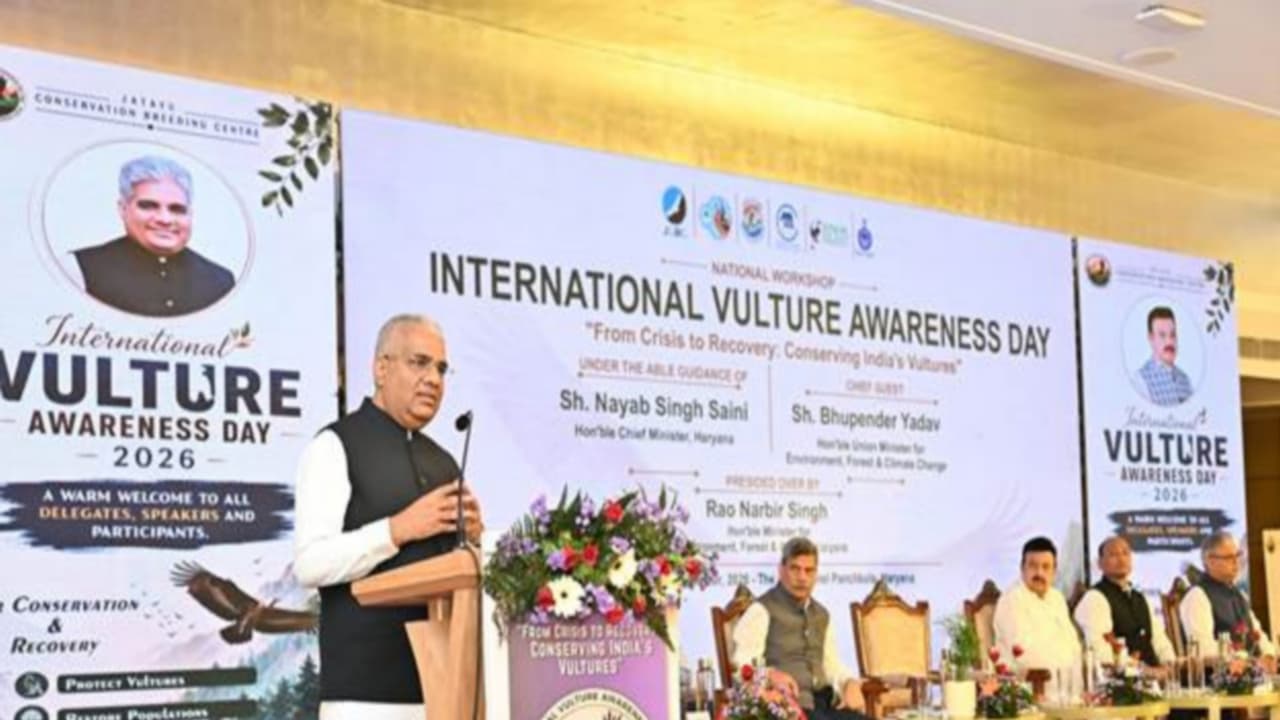
Union Environment Minister Bhupender Yadav inaugurated a national workshop on vulture conservation. He highlighted the need for coordinated efforts to protect the species and restore their population, citing the government's holistic approach.
Union Environment Minister Bhupender Yadav on Sunday inaugurated a national-level workshop on vulture conservation on the occasion of International Vulture Awareness Day 2026, themed ‘From Crisis to Recovery – Conserving India’s Vultures’, highlighting the need for coordinated efforts to protect the declining species and restore their population. The event was also graced by the august presence of Haryana State Minister for Environment, Forest and Wildlife, Rao Narbir Singh, besides senior dignitaries from the Union Ministry of Environment, Forest and Climate Change (MoEFCC), and the Haryana State Government.
According to the Ministry of Environment, Forest and Climate Change, "The programme was organised in collaboration with the MoEFCC, Central Zoo Authority (CZA), Haryana Forest & Wildlife Department, Bombay Natural History Society (BNHS) and the Jatayu Conservation Breeding Centre (JCBC), Pinjore. It brought together senior forest officials, scientists, veterinarians, zoo professionals, conservation practitioners and other stakeholders to strengthen collaborative efforts for vulture conservation in India."
Government's Holistic Conservation Approach
Addressing the gathering, Yadav highlighted that the government's environment conservation approach, under the leadership of Prime Minister Narendra Modi, is based on a holistic ecosystem-oriented conservation model and not limited to a particular species. The Minister stated the approach is evident in various species conservation initiatives, whether it is Big Cats, Sloth Bear, Great Indian Bustard, Dolphins, Gharial, Wild water buffalo or Vultures.
Talking about vultures, he informed that India, which is home to a diverse community of resident and migratory vultures - White-rumped, Long-billed, Slender-billed, Red-headed, Egyptian, Himalayan Griffon, Eurasian Griffon, Cinereous and Bearded Vultures - is making efforts towards their successful conservation. Shri Yadav highlighted the vital ecological role of vultures as highly efficient scavengers and described them as nature’s own cleaning system. By rapidly consuming animal carcasses, vultures facilitate nutrient recycling and help maintain ecological balance.
He stated that the world is facing challenges like climate change and human-animal conflict, and a sharp decline was observed in the Indian Vulture population since the 1990s, mainly due to disruption in their food chain and the use of painkillers for animals that were consumed by the vultures. The Minister emphasised coordinated efforts as a 'Whole of Government' and 'Whole of Society' approach in policymaking for Vulture conservation.
He called for continued efforts to create Vulture Safe Zones through vulture-safe veterinary practices, ensuring safe food availability and technical capacity building to aid species recovery in the wild. The Minister also appealed to veterinary professionals, livestock owners, local administrations and communities to actively contribute to vulture conservation and promote safe carcass-management practices.
JCBC Pinjore: A Hub for Conservation Breeding
Earlier, the Union Minister started the day with a visit to the JCBC Pinjore, where he visited the facility, reviewed a presentation on the Centre and interacted with officials involved in vulture conservation. The Centre, a collaborative initiative of the Haryana Forest Department and BNHS, has emerged as an important centre for conservation breeding of the White-rumped, Long-billed and Slender-billed Vultures.
Key Achievements and Impact
It was informed that the Centre undertakes scientific husbandry, artificial incubation, veterinary care, breeding and genetic management. During 2025–26, JCBC housed 356 vultures and successfully bred 35 chicks. It also released or contributed 87 vultures for reintroduction, transferred 90 birds to other conservation-breeding institutions, and trained 1,222 participants from 22 institutions, thereby strengthening technical capacity for vulture conservation.
Addressing the gathering on the occasion, Rao Narbir Singh talked about the important contribution and successful vulture conservation programme being carried out at the Jatayu Conservation Breeding Centre (JCBC), Pinjore. He emphasised that the success of conservation breeding should not be measured merely by the number of animals born, but by the establishment of healthy and genetically managed populations, generation of scientific knowledge, development of technical capacity and contribution towards species recovery in the wild.
Workshop Highlights and Renewed Commitment
During the inaugural session, a Coffee table book - 'Story of Jatayu: Saving India's Vulture' - was released on the occasion. It chronicles India's remarkable vulture conservation story from a declining Vulture population to the successful breeding conservation programme through the establishment of JCBC Pinjore.
Further, a prize distribution ceremony was held for the online drawing competition and digital photography competition held on Vulture Conservation.
The International Vulture Awareness Day 2026 National Workshop was organised with a renewed commitment to ensuring that vultures continue to thrive in India’s landscapes and perform their vital ecological role. The journey ‘From Crisis to Recovery’ reflects India’s collective commitment to vulture conservation through science, policy, conservation breeding, safe landscapes and community participation.
(Except for the headline, this story has not been edited by Asianet Newsable English staff and is published from a syndicated feed.)