
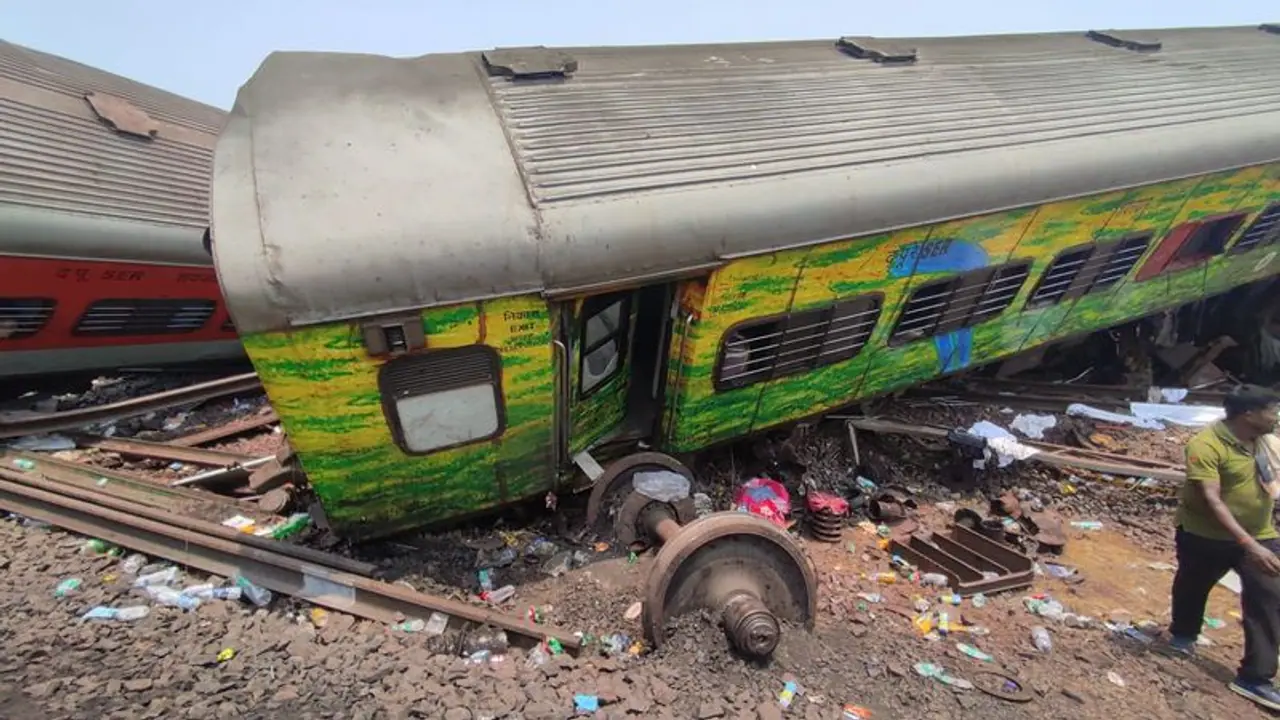
The Commission of Railway Safety (CRS) report on the Balasore train tragedy has been submitted, shedding light on the collision involving the Coromandel Express. The report highlights lapses in the Signal & Telecommunication Department and emphasizes the need for accident prevention measures.
The Balasore train tragedy, which resulted in 290 deaths and over 1,000 injuries, was caused by a sudden drop in the speedometer reading of the Coromandel Express, resulting in the train colliding with a goods train stationed on the up-loop line near the Bahanaga Bazar railway station, the long-awaited report by the Commission of Railway Safety (CRS) has said. The collision led to the derailment of the Coromandel Express and impacted the last few coaches of the Bengaluru-Howrah Superfast Express on a separate track.
The report, submitted to the Railway Board, includes testimonies from staff members and investigates various aspects related to the incident and railway infrastructure. The report places responsibility on multiple lapses within the Signal & Telecommunication (S&T) Department for the accident.
Odisha Train Accident: The two possibilities on tracks
Railway sources suggest that issues with the point/crossover before the signal caused the Coromandel Express to enter the loop line instead of the main line, which has been confirmed by the CRS. The accounts of the loco-pilot and assistant loco-pilot, as well as the joint report of supervisors after the accident, were taken into consideration, revealing that the point was set in reverse while the signal indicated green for the main line.
Initially, the investigation into the accident, one of the deadliest in the history of Indian Railways, was assigned to the CRS and later transferred to the Central Bureau of Investigation. The CRS report has reportedly clarified the cause of the accident and suggests that appropriate action will be taken.
The conclusion of the CRS report highlights the deficiencies in the signalling circuit alteration and the replacement of the Electric Lifting Barrier (ELB) for a level crossing gate, which ultimately resulted in the train being displayed a wrong signal.
The report mentions lapses in circuit shifting work without adhering to standard practices and incorrect lettering on terminals. Additionally, the circuit for the ELB of a level crossing was not suitable, and there was no approved circuit diagram for the replacement work, which could have prevented the mistake.
While the report addresses the non-supply of the circuit diagram and assigns responsibility to the Signal and Telecommunication Department, it also emphasizes that the accident could have been averted if the Station Master had alerted the S&T staff about the unusual behaviour of the Crossover 17A/B. This could have prompted them to investigate the wiring issue connecting to the electronic logic of the crossover.
Furthermore, abnormal events logged in the data logger on the day of the accident, such as extended point operation and a change in status, were noted but possibly overlooked.
Indian Railways orders double-locking of all signalling assets
