
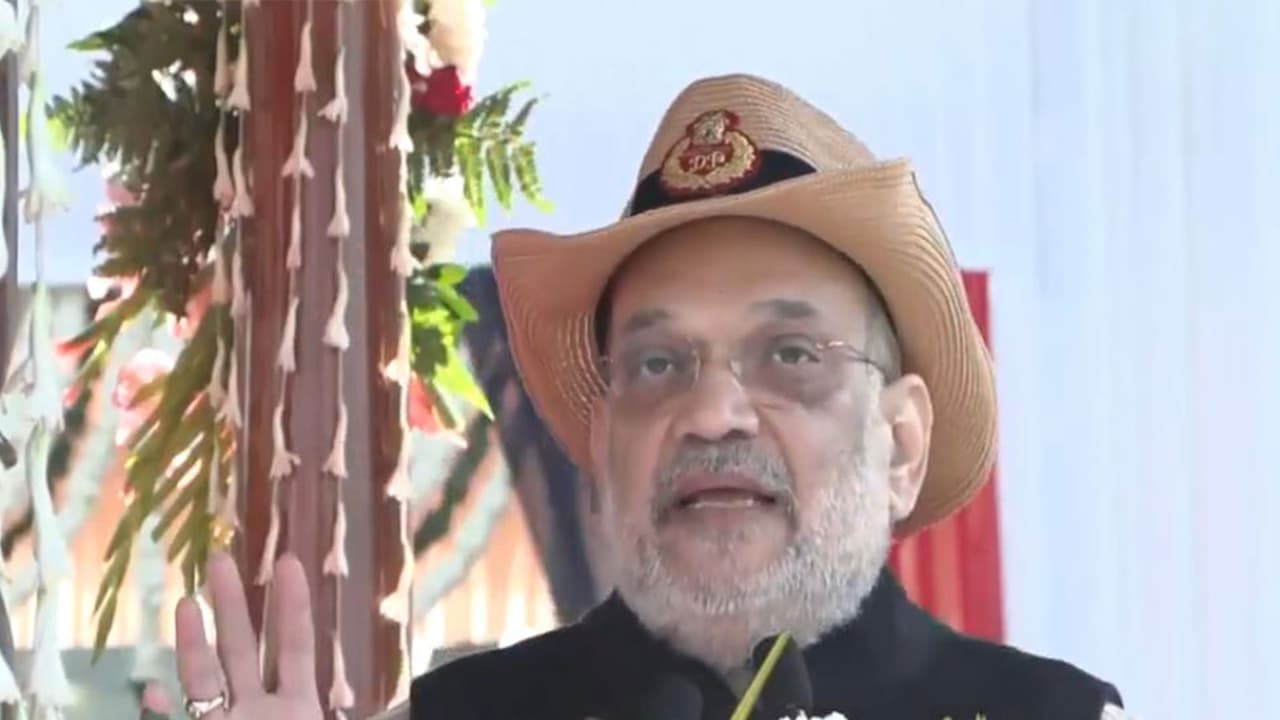
Amit Shah laid the e-foundation for the Delhi Police Special Cell's Rs 400 cr HQ to tackle narcotics and terrorism. He also launched the Safe City Project, highlighted security gains in Kashmir and Naxal areas, and praised new criminal laws.
Union Home Minister Amit Shah on Monday laid the e-foundation stone for the integrated headquarters of the Delhi Police Special Cell, describing it as the country's "most modern centre" for tackling narcotics and terrorism.
Addressing the 79th Delhi Police Raising Day programme here, Amit Shah said, "Today, the e-foundation stone was laid here for the integrated headquarters of the Special Cell to further strengthen the Delhi Police. The integrated headquarters of the Special Cell is being constructed at an estimated cost of around Rs 400 crore."
A 'Modern Centre' for Counter-Terrorism
Shah said the facility would be equipped with a state-of-the-art indoor firing range, a war room, cyber lab, training hall and advanced equipment. "It will, in a way, become the country's most modern centre for tackling narcotics and terrorism. Equipped with a state-of-the-art indoor firing range, war room, cyber lab, training hall, and various advanced equipment, this headquarters will be fully modernised. I am confident that it will emerge as an ideal Special Cell headquarters for police forces across the country," Shah said.
Safe City Project and Surveillance Network
The Union Home Minister also laid the foundation stone for 10 new projects of the Delhi Police and inaugurated the first phase of the Safe City Project. "An advanced Integrated Command, Control, Communication and Computer Centre (C4I), built at a cost of approximately Rs 857 crore, is being dedicated to the people of Delhi. Along with this, 11 district-level C3I centres and 75 police station-level C2I units will also be integrated into the system," Shah added.
Shah said that under the first phase of a programme to connect the capital through 10,000 cameras, 2,100 cameras have already gone live. The process of integrating over 15,000 existing cameras across Delhi into the centralised system has also been completed.
Centre's Record on Internal Security
Highlighting the Centre's record on internal security, Shah said the period from 2014 to 2026 would be remembered as a "golden era" for the country's internal security.
He said that before 2014, three major challenges had persisted for decades: the situation in Kashmir, unrest in the North-East, and Maoist insurgency across several states. Referring to the abrogation of Article 370, he claimed that incidents of violence in Kashmir, the North-East and Maoist-affected areas had been reduced by up to 80%. "The day is not far when these three regions will become completely free from violence," he said.
Eradicating Left-wing Extremism
On Left-wing extremism, Shah stated that the Maoist insurgency, once spread across 11 states, was close to being eradicated. "Maoist insurgency, which had spread across 11 states, had long been considered a major challenge to the country's internal security. However, I am glad to convey to the nation, through the people of Delhi, that we are very close to permanently freeing the affected regions from Naxalism," he said.
"I would like to once again assure the people that by March 31, 2026, we will succeed in freeing the entire country from Maoist violence. This will be a major achievement for our security forces," Shah further said.
Reforms in Criminal Justice System
Furthermore, the Union Home Minister also highlighted the government's recent legal reforms, saying that in the last 11 years under PM Modi, India has achieved significant milestones in criminal justice. He pointed out that three new criminal laws were passed in Parliament, which, once fully implemented, will ensure that any FIR filed anywhere in the country reaches the Supreme Court, providing justice not only to victims but also to punish offenders.
"In the last 11 years, under the leadership of PM Modi, the country has achieved many milestones. In the coming days, when justice will be discussed in the country, history will surely recall these three new criminal laws. These three new criminal laws were passed in the Parliament elected by the people of our country. In the next two years, after the full implementation of these laws...within three years, we will ensure that any FIR filed in any corner of the country, not only punishing the criminal but also providing justice to the victim, reaches the Supreme Court," Shah said.
"A separate chapter has been added to these laws for crimes against children and women. E-FIRs and Zero FIRs have been given legal backing. For the first time, community service has been legalised as a punishment for minor offences. Provision has also been made for the confiscation and seizure of properties of proclaimed offenders located outside India," he added. (ANI)
(Except for the headline, this story has not been edited by Asianet Newsable English staff and is published from a syndicated feed.)