
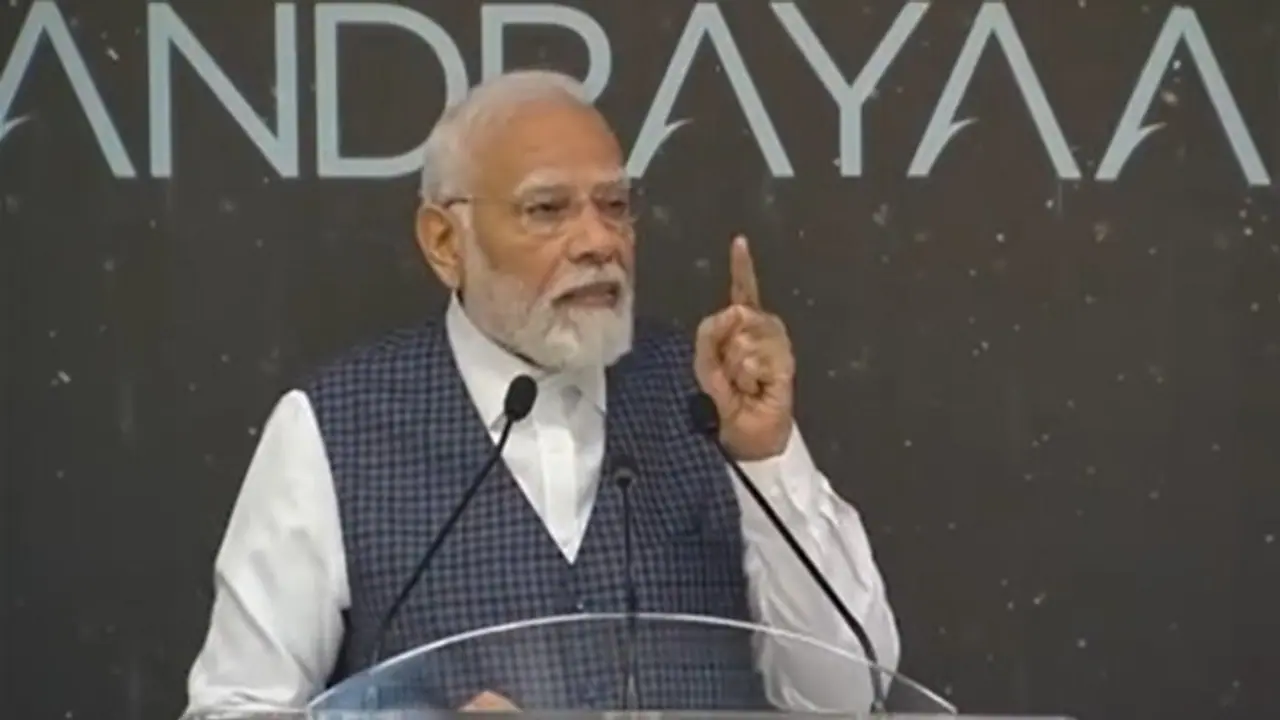
This triumphant launch garnered widespread praise and accolades from leaders and political parties, transcending partisan boundaries. The remarkable feat came hot on the heels of another remarkable achievement – the successful lunar landing of India's Chandrayaan-3 mission.
The Indian Space Research Organisation (ISRO) on Saturday (September 2) celebrated a remarkable triumph as the PSLV-C57.1 rocket elegantly lifted off from the Satish Dhawan Space Centre in Sriharikota, Andhra Pradesh, carrying India's groundbreaking solar mission, Aditya-L1. This triumphant launch garnered widespread praise and accolades from leaders and political parties, transcending partisan boundaries. The remarkable feat came hot on the heels of another remarkable achievement – the successful lunar landing of India's Chandrayaan-3 mission.
In praise of the dedicated scientists who accomplished this remarkable feat in India's space exploration journey, Prime Minister Narendra Modi expressed his optimism that India's endeavors would persist in fostering a "deeper comprehension of the cosmos."
"After the success of Chandrayaan-3, India continues its space journey. Congratulations to our scientists and engineers at Isro for the successful launch of India’s first Solar Mission, Aditya -L1. Our tireless scientific efforts will continue in order to develop a better understanding of the Universe for the welfare of entire humanity," PM Modi said.
Aditya-L1 successfully separated from PSLV after solar mission launch: ISRO chief S Somanath
President Droupadi Murmu hailed the momentous occasion as a "landmark achievement," emphasizing its role in advancing our comprehension of space. She extended her heartfelt congratulations to the diligent ISRO scientists and engineers for their exceptional accomplishment, expressing her best wishes for the mission's success.
"The launch of Aditya-L1, India's first solar mission, is a landmark achievement that takes India’s indigenous space programme to a new trajectory. It will help us better understand space and celestial phenomena. I congratulate the scientists and engineers at Isro for this exceptional feat. My best wishes for the success of the mission," President Murumu said.
Union Minister Nitin Gadkari, echoing the sentiments of many, lauded this extraordinary endeavor, foreseeing it as a key to unlocking the mysteries shrouding our closest celestial neighbor, the Sun.
Aditya-L1 takes off: India's first solar mission commences journey towards the Sun
Taking to X, Gadkari said, "Congratulations, ISRO! 🌞🚀 A historic achievement in the pursuit of scientific knowledge! ISRO has triumphantly launched its first-ever space mission to study the Sun, #AdityaL1🛰 This remarkable endeavor promises to unlock the secrets of our nearest star, shedding light on its mysteries and enhancing our understanding of space weather. Kudos to the brilliant minds at ISRO who have made this mission possible. Your dedication and expertise continue to inspire us all. Here's to a bright future of solar exploration and groundbreaking discoveries! 🌌⚡."
Congress President Mallikarjun Kharge expressed his admiration for the achievement, emphasizing that science serves as a vital tool for progress, well-being, and constructive transformation, representing our guiding principle.
"We are indebted and grateful to our scientists, space engineers, researchers and our hard-working personnel at @ISRO for the successful launch of #AdityaL1 - Solar Observation Mission. Our tribute to the vision, ingenuity and the vigorous dedication of our legendary scientists and countless researchers for this historic accomplishment," Kharge said.
Explained: How close to the Sun will India's Aditya-L1 get?
On Saturday, ISRO successfully launched Aditya-L1 solar probe from Sriharikota spaceport, Andhra Pradesh. This comes less than ten days after creating history with the first-ever soft landing near the Moon's south pole.
Aditya-L1 is primed to be positioned in a strategic halo orbit around the Sun-Earth Lagrange point L1, located approximately 1.5 million kilometers from Earth. The journey to this Lagrange point is estimated to span about four months.
The distinctive advantage of this orbit lies in its uninterrupted view of the Sun, free from potential disruptions like eclipses, making it ideal for the detailed study of solar activities.
