India's first National Household Travel Survey reveals that walking and two-wheelers dominate daily commutes for students and workers. While urban workers face higher travel expenses, the majority of Indians still manage to reach their schools and workplaces within 30 minutes.
India’s first-ever National Household Travel Survey (NHTS) has shed light on how students and workers across the country travel every day, revealing a significant dependence on walking, buses, bicycles and two-wheelers.
According to the survey, 66.4% of students aged six years and above travel more than 1 km daily to reach their educational institutions, while two-wheelers are the most commonly used mode of transport among workers commuting to their workplaces.
The survey was conducted by the National Statistics Office (NSO) under the Ministry of Statistics and Programme Implementation (MoSPI) between July 2025 and June 2026.
Related Articles

Students Travel More Than 1 km For Education
The NHTS found that nearly two-thirds of students aged six and above undertake daily trips of more than 1 km to attend their educational institutions. The figure stood at 65.6% in rural areas and 68.1% in urban areas. The survey did not record journeys shorter than 1 km. Students aged between 15 and 29 recorded the highest participation in regular educational travel. Daily travel participation among this group stood at 79.1% in rural India and 73.3% in urban areas.
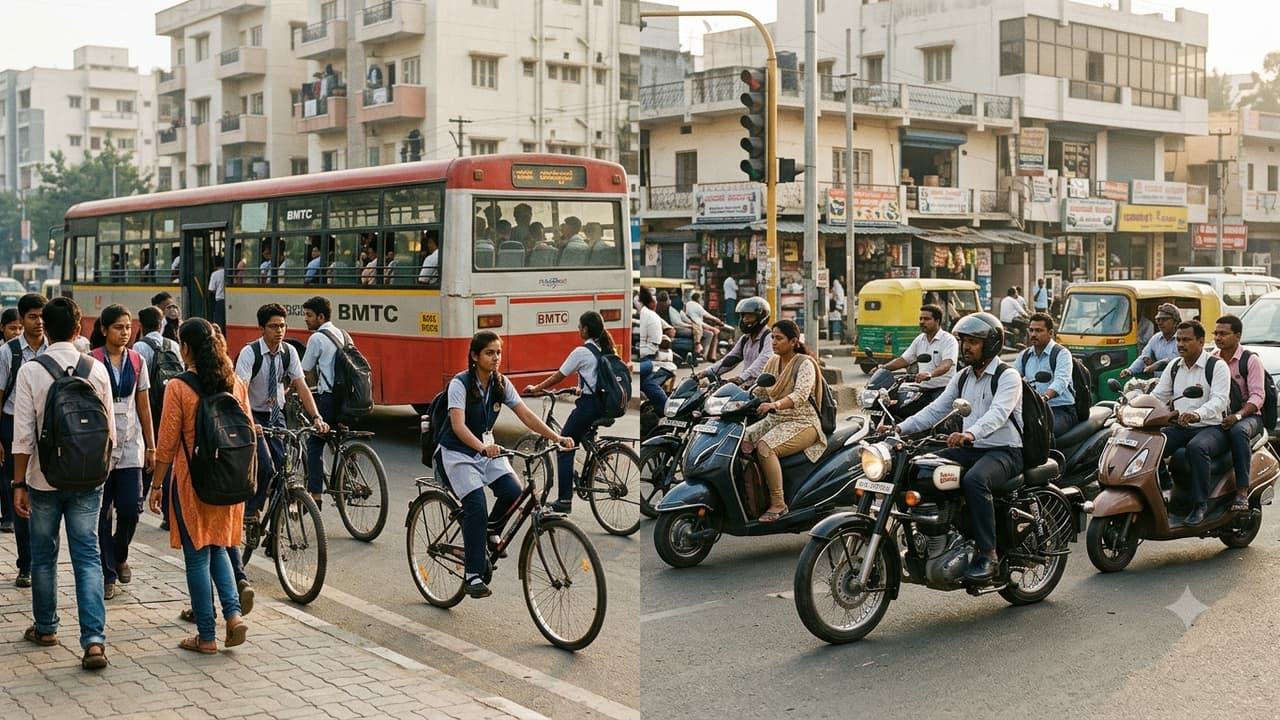
Walking emerged as the most popular way for students to reach educational institutions, accounting for 37% of student commutes. Buses followed at 29.5%, while bicycles accounted for 15.8%.
Auto-rickshaws made up 10.5% of student journeys, with their share rising to 14.4% in urban areas. Two-wheelers accounted for 6.7% of student travel nationally and 11.5% in urban areas.
Two-Wheelers Dominate Workplace Travel
The survey also highlighted the country's strong dependence on two-wheelers for daily work travel. Among workers aged 15 years and above, 57.6% travelled more than 1 km to fixed or non-fixed workplaces. The proportion was higher in urban areas at 64.1%, compared with 54.5% in rural India.
There was also a notable gender difference. About 61.9% of male workers travelled more than 1 km for work, compared with 41.9% of female workers.
Two-wheelers emerged as the leading mode of workplace transport, accounting for 42.6% of worker commutes. Their share was 37.1% in rural areas and increased to 52.3% in urban areas. Walking was the second most common mode at 28.3%. Public transport accounted for a considerably smaller share of daily workplace travel.
Metro And Rail Usage Varies Across States
The NHTS also highlighted differences in urban public transport use across states. Monorail, metro, suburban rail and trams together accounted for 5% of urban worker commutes nationally. However, their usage was considerably higher in some states and regions.
Maharashtra recorded the highest share at 20.7%, followed by West Bengal at 16.5% and Delhi at 14.4%.
Urban Workers Spend More On Commuting
Travel expenses also showed a clear urban-rural divide.
Workers across India spent an average of Rs 785 per month commuting to fixed workplaces. Urban workers spent considerably more, with an average monthly expenditure of Rs 1,044, compared with Rs 612 among rural workers.
Students spent an average of Rs 443 per month on commuting to educational institutions. The monthly average was Rs 617 for urban students and Rs 361 for rural students.
The survey also found a gender gap in workplace travel expenditure. Male workers spent an average of Rs 835 per month, compared with Rs 533 for female workers. Most students and workers reach their destination within 30 minutes
Despite the distances involved, the survey found that most daily journeys were completed within half an hour.
Around 87.6% of students reached their educational institutions within 30 minutes, while 83.4% of workers travelling to fixed workplaces reached their destinations within the same time frame.
The NHTS covered 4,92,023 households and 20,34,371 people across 14,274 villages and 10,377 urban blocks, making it the country's first comprehensive all-India household travel survey.
The findings are expected to provide useful data for transport planning, infrastructure development, route optimisation and improving the availability and frequency of public transport services.