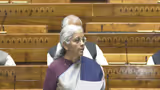
A political debate over the patriotic song Vande Mataram has erupted in India’s Parliament between the BJP and Congress. The BJP accuses Congress of weakening national unity by removing stanzas in 1937.
As Parliament gears up for a special discussion on the 150th anniversary of Vande Mataram, one of India's most emotionally charged patriotic songs is once again at the centre of a political storm. What began as a hymn in a Bengali novel is today fuelling a fierce battle of narratives between the BJP and the Congress, over history, identity and nationalism.
On Monday, Prime Minister Narendra Modi will open the debate in the Lok Sabha, followed by Defence Minister Rajnath Singh. The BJP has been allotted three hours in a session that will run nearly 10 hours. The Rajya Sabha will take it up the next day, with Home Minister Amit Shah leading the discussion.
But behind this nearly 150-year-old song lies a complex story, one shaped by literature, freedom struggle, religious imagery and political compromise. Here’s the journey and why it is sparking fresh controversy.
Related Articles

Why It's Making Headlines Now
The latest flashpoint emerged last month during a commemorative event when PM Modi accused the Congress of "removing important stanzas" of Vande Mataram during its 1937 Faizabad session. He said this "tampering" weakened national unity and planted seeds of partition.
The Congress responded sharply, calling the claim a distortion of history. It argued that the 1937 decision was taken after detailed deliberations by a Working Committee that included Mahatma Gandhi, Nehru, Patel, Subhas Bose, Rajendra Prasad and other stalwarts.
Their reason: only the first two stanzas were widely sung and free from religious imagery that could alienate some communities. The rest invoked Hindu goddess symbolism, which leaders feared could limit the song's unifying appeal.
The party also pointed to Rabindranath Tagore's advice, he believed that any national symbol must be inclusive and never force religious imagery upon all citizens.
This back-and-forth has now set the stage for a charged discussion inside Parliament.
Where Did Vande Mataram Come From?
Born in a novel, adopted by a nation
Vande Mataram was composed by Bankimchandra Chattopadhyay around 1875 and later appeared in his novel Anandamath (1881). The story revolves around ascetic revolutionaries who worship the motherland—depicted through symbolic images of the past, present and future.
While some stanzas carried Hindu goddess metaphors, the central idea celebrated the homeland as a shared mother.
How the Song Became a Freedom Movement Slogan
By the early 1900s, Vande Mataram had travelled far beyond literature. It became the electric slogan of the anti-partition agitation in Bengal:
- Students shouted it during protests
- Marchers sang it in unison
- Newspapers adopted it as their title
In 1906, over 10,000 Hindus and Muslims marched together in Barisal shouting Vande Mataram, reflecting its early cross-community appeal.
The British, alarmed by its power, tried suppressing it, banning its recitation in schools and lathi-charging crowds.
In 1907, when Madam Bhikaji Cama unfurled the first tricolour abroad in Stuttgart, Vande Mataram was written on it.
The Congress's Relationship With the Song
- 1896: Tagore sings it at the Congress session in Calcutta
- 1905: Congress makes it the song for all-India events
- 1937: Congress Working Committee decides only the first two stanzas should be used officially
Why the 1937 Decision Was Made
It wasn't an attempt to "break" the song.
Documents show the Working Committee explicitly noted that:
- Only the first two stanzas were already popular and commonly sung
- The remaining verses contained religious references not acceptable to many
- The national movement needed symbols that united, not excluded
This was one of the last major cultural decisions taken jointly by Gandhi, Nehru, Patel, Bose and others before independence.
What the Constituent Assembly Decided in 1950
On 24 January 1950, Dr Rajendra Prasad made a crucial announcement:
- Jana Gana Mana would be India's national anthem
- Vande Mataram would receive equal honour and status
His statement was applauded. No member objected.
This dual recognition was meant to preserve both inclusivity and respect for history.
Why the BJP and Congress Are Fighting Today
BJP's View
The BJP argues that the Congress diluted a symbol of civilizational pride. It claims the 1937 decision was an early example of "appeasement," and that the full song reflects India's cultural roots.
Congress's Counter
The Congress says:
- It popularised the song long before the BJP existed
- The 1937 decision reflected sensitivity, not division
- Tagore and other icons supported limiting the song to inclusive stanzas
- The BJP is weaponising history to distract from real issues
What Muslim Groups Like Jamiat Ulama-i-Hind Say
The Jamiat accepts the first two stanzas but firmly rejects the remaining verses, arguing they contain goddess imagery that is incompatible with Islamic theology.
Maulana Mahmood Madani stated that reciting verses depicting the motherland as goddess Durga amounts to worship beyond Allah, which Muslims cannot do.
This position has remained unchanged for decades.
So, What's the Debate Really About?
At its heart, the fight is about:
- Competing interpretations of historical choices
- The meaning of nationalism
- The balance between cultural heritage and religious diversity
- Political messaging in an election-year climate