- Home
- World
- Who Was Khamenei? A Ruthless Revolutionary and Iron‑Fisted Ruler at the Helm of Iran’s Theocracy
Who Was Khamenei? A Ruthless Revolutionary and Iron‑Fisted Ruler at the Helm of Iran’s Theocracy
Iran's Supreme Leader Ali Khamenei, a ruthless revolutionary who survived wars, protests, and assassination attempts, has died at 86, ending decades of unchallenged rule over the Islamic Republic.
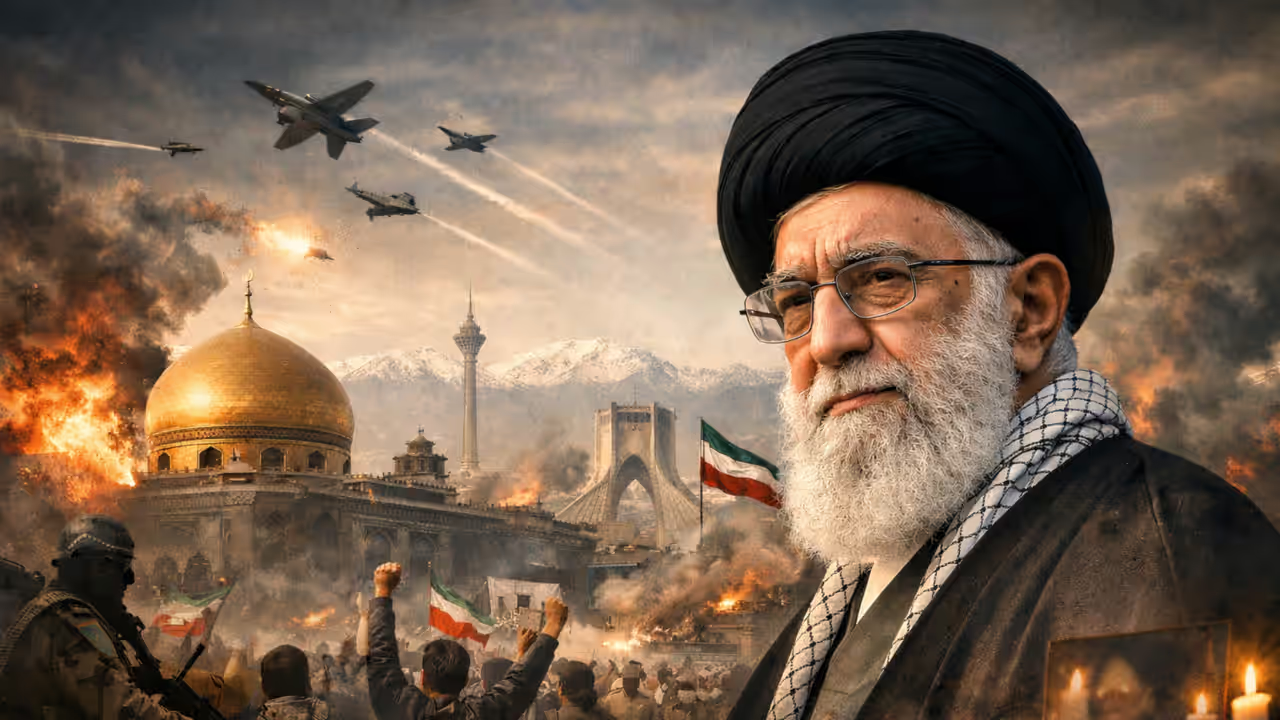
Khamenei: The Man Who Ruled for Decades
The Islamic Republic woke up to a defining moment as the death of Ali Khamenei was confirmed by Iranian state media on Sunday. For nearly four decades, he stood at the centre of Iran’s political and ideological machinery — a figure who outlasted protests, wars, and internal dissent, and who remained deeply influential until the very end.
In the hours following reports of massive US‑Israeli strikes across Iran, including an attack on the supreme leader’s compound in Tehran, global reactions poured in. Among the most blunt responses came from Donald Trump, who wrote on Truth Social: “Khamenei, one of the most evil people in history, is dead.”
Iranian state television later confirmed the death but notably avoided linking it directly to the strikes.
Khamenei was 86.


From Revolutionary Firebrand to Supreme Authority
Khamenei’s rise was tied closely to the birth of the Islamic Republic itself. When Ayatollah Ruhollah Khomeini — the architect of the 1979 Islamic Revolution — died in 1989, Iran’s powerful Assembly of Experts selected Khamenei as his successor. That moment reshaped the trajectory of the country.
Yet the decision was not without drama. When clerics proposed his name, Khamenei reportedly reacted with visible hesitation, placing his head in his hands and declaring: “I am opposed”.
Despite his resistance, the clerical establishment rallied behind him unanimously. From that point onward, his hold on power rarely wavered.
A Leader Defined by Crises
Over the decades, Khamenei governed through some of the Islamic Republic’s most turbulent periods. The system he led faced repeated waves of unrest that tested both its legitimacy and endurance.
He remained in control during the 1999 student protests and again in 2009 when millions took to the streets following disputed presidential elections. The demonstrations of 2019, sparked by economic anger, were suppressed with force.
Another major challenge arrived with the nationwide “Woman, Life, Freedom” protests of 2022‑2023, triggered by the death in custody of Mahsa Amini, a Kurdish Iranian woman detained over alleged violations of Iran’s strict dress code for women.
Even earlier this year, fresh protests rattled the country — yet Khamenei once again appeared defiant, reinforcing the image of a leader who rarely yielded under pressure.
Living Under Constant Threat
Security around Khamenei was among the tightest for any world leader. His public appearances were rare and typically announced only after they occurred. Unlike many heads of state, he never travelled abroad during his decades as supreme leader.
That precedent dated back to Khomeini’s era.
In fact, Khamenei’s last known trip outside Iran took place in 1989 when he was still president. During that visit to Pyongyang, he met North Korea’s founding leader Kim Il Sung.
Long before he rose to the top post, his life had already been shaped by violence. In 1981, he survived an assassination attempt that left his right arm partially paralysed. Iranian authorities blamed the attack on the opposition group People's Mujahedin of Iran — once allies of the revolution but later outlawed.
Early Years in the Revolution and War
Before becoming supreme leader, Khamenei was deeply embedded in the revolutionary establishment. Under the rule of the shah, he was arrested multiple times for his anti‑imperial activism.
Following the revolution, he became Tehran’s Friday prayer leader and served on the front lines during the Iran‑Iraq war — an experience that helped cement his credentials among Iran’s ruling clerical and military elite.
In 1981, after the assassination of Iranian president Mohammad Ali Rajai, Khamenei himself was elected president, a role he held throughout much of the turbulent 1980s.
The Succession Drama Before 1989
Interestingly, Khamenei was not widely expected to inherit the supreme leadership. For years, the cleric considered most likely to succeed Khomeini was Hossein Ali Montazeri.
But shortly before his death, Khomeini changed course. Montazeri had criticised the mass executions of opposition figures, including members of the MEK and other dissidents. That disagreement proved decisive.
When the Assembly of Experts convened after Khomeini’s death, the balance shifted — and Khamenei emerged as the new leader of the Islamic Republic.
Balancing Reformists and Hardliners
During his tenure, Khamenei worked with six presidents, each elected but ultimately subordinate to the authority of the supreme leader. Among them were relatively moderate figures such as Mohammad Khatami, who attempted cautious reforms and explored limited engagement with the West.
Still, when political fault lines sharpened, Khamenei consistently aligned himself with the hardline factions within Iran’s power structure.
His role as the ultimate arbiter of policy ensured that major shifts — especially those affecting ideology, security, or relations with the United States — remained tightly controlled.
A Powerful Family, Quiet but Influential
Khamenei was believed to have six children, though most stayed away from the public eye. One exception was Mojtaba Khamenei, widely viewed as a powerful behind‑the‑scenes figure in Iran’s political establishment. The United States placed him under sanctions in 2019.
The family’s internal tensions occasionally surfaced publicly. His sister, Badri, broke with the family during the 1980s and moved to Iraq amid the Iran‑Iraq war alongside her dissident cleric husband. Some of their children — including a nephew now living in France — later became outspoken critics of the Iranian leadership.
The End of a Long Era
Khamenei’s death closes a chapter that began soon after the Islamic Republic itself was born. Few leaders in modern Middle Eastern history remained in power for so long while presiding over such a complex web of ideological rule, internal dissent, and geopolitical confrontation.
From surviving assassination attempts and protests to navigating wars and global pressure, he remained — until the final days — one of the most consequential and controversial figures shaping Iran’s modern history.
Check the Breaking News Today and Latest News from across India and around the world. Stay updated with the latest World News and global developments from politics to economy and current affairs. Get in-depth coverage of China News, Europe News, Pakistan News, and South Asia News, along with top headlines from the UK and US. Follow expert analysis, international trends, and breaking updates from around the globe. Download the Asianet News Official App from the Android Play Store and iPhone App Store for accurate and timely news updates anytime, anywhere.