Why Japan Is On Edge Again After 7.7 Earthquake And Tsunami Warning
A powerful 7.7-magnitude earthquake struck Japan, triggering tsunami waves and mass evacuations of over 182,000 people. Waves hit coastal areas, though no major damage or injuries were reported. Authorities warned of possible aftershocks.
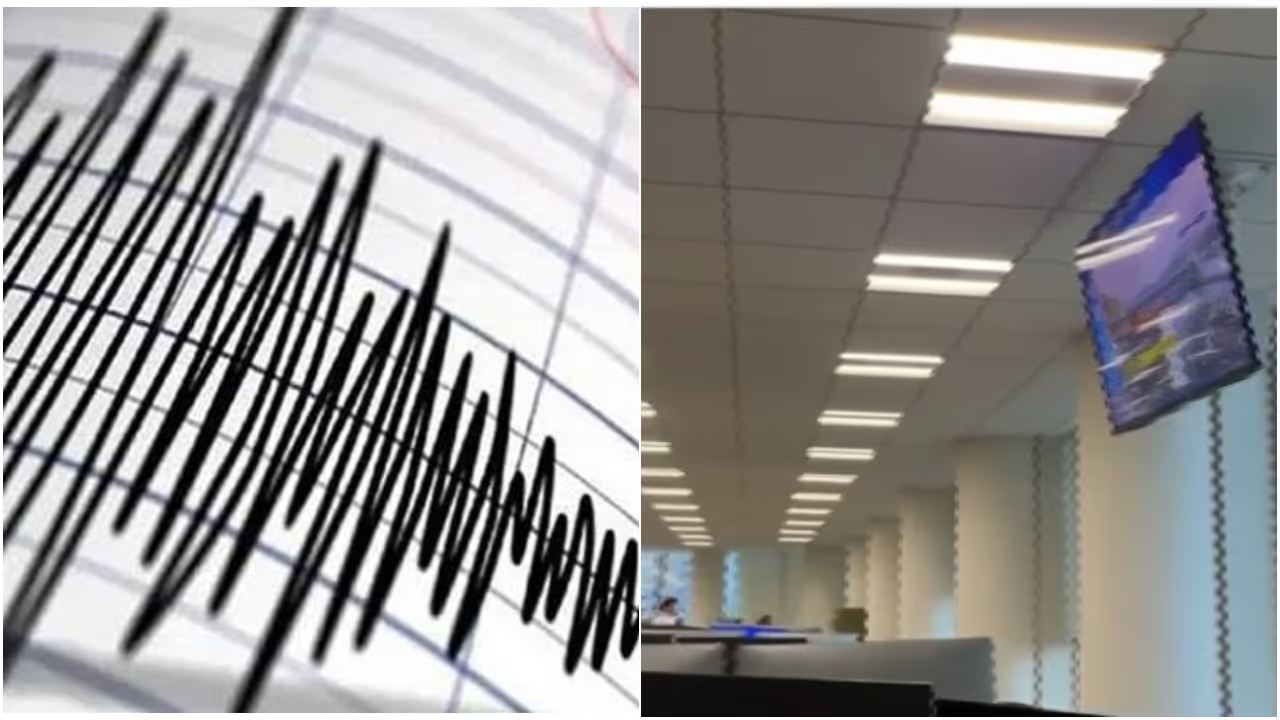
A powerful earthquake shakes Japan
A strong earthquake struck Japan on Monday, April 20, causing panic along its northeastern coast. The quake measured 7.7 in magnitude and hit off the coast of Iwate Prefecture.
The tremor occurred at a shallow depth of about 19 kilometres, making it more dangerous. It was powerful enough to shake buildings even in Tokyo, which is hundreds of kilometres away from the epicentre.
Soon after the quake, authorities issued a tsunami warning, raising fears across coastal areas.


Tsunami waves reach the coast
After the earthquake, tsunami waves began hitting parts of the northeastern coastline. Around 40 minutes after the quake, a wave of about 80 centimetres reached a port in Kuji.
Later, waves measuring over 2.6 feet were recorded at Kuji Port.
🇯🇵 First footage of tsunami waves hitting Japan's coastline following today's 7.4 magnitude earthquake.
Waves measuring around half a meter are now threatening coastal areas.pic.twitter.com/REx8wFQ7vO https://t.co/f1MrP9Db0N— Mario Nawfal (@MarioNawfal) April 20, 2026
🚨A tsunami hits Japan after a powerful 7.4 magnitude earthquake.
The first waves are already hitting the Port of Hachinohe.... #Tsunami #Earthquake #Japan pic.twitter.com/Ct8eCIDz08— Kashan Khan (@Kashansardar119) April 20, 2026
A tsunami is now striking north-eastern Japan after a 7.4 magnitude earthquake. pic.twitter.com/766pVViYIU
— Osint World (@OsiOsint1) April 20, 2026
#WATCH : Security camera footage has captured the moment a 7.5-magnitude earthquake struck the northern coast of Japan.#TsunamiWarning #Japan #Earthquake #Tsunami #JapanQuake #TsunamiAlert pic.twitter.com/KQnEMkCQhf
— upuknews (@upuknews1) April 20, 2026
The Japan Meteorological Agency (JMA) had initially warned of waves up to 3 metres. By evening, the warning was slightly lowered, but an advisory remained in place for waves up to 1 metre.
So far, there have been no reports of serious injuries or major damage. However, officials are still checking the situation carefully.
Large-scale evacuations ordered
Authorities moved quickly to protect people living near the coast. More than 182,000 residents were asked to evacuate to safer, higher areas.
The Fire and Disaster Management Agency also confirmed that evacuation advisories were issued across several regions.
Prime Minister Sanae Takaichi urged people to leave low-lying areas and move to safety without delay.
Emergency teams were set up, and the government formed a crisis management group to monitor the situation.
Risk of another major earthquake
After the initial quake, the JMA issued a special advisory warning that the risk of another strong earthquake is now higher than usual.
Officials said that while the chances remain low, there is still a possibility of another major quake, possibly even stronger.
People in affected areas have been advised to stay alert, review safety plans and be ready for aftershocks.
Experts say aftershocks are most likely within the next two to three days but could continue for up to a week.
Why Japan is so vulnerable
Japan is one of the most earthquake-prone countries in the world. It lies along the Pacific “Ring of Fire”, where several tectonic plates meet.
These plates constantly move, which leads to frequent earthquakes. Japan experiences around 1,500 earthquakes every year.
It accounts for nearly 18 percent of all earthquakes worldwide.
This constant activity means Japan is always prepared, but also always at risk.
How tsunamis actually work
Many people imagine a tsunami as a single giant wave. But that is not correct.
A tsunami is more like a series of powerful water surges. It carries a huge amount of water and energy.
Tsunamis start deep under the ocean. When an earthquake shakes the seabed, it can push the ground up or down suddenly. This movement displaces a large amount of water above it.
That energy spreads out across the ocean in all directions.
In deep water, these waves may be very small, sometimes only 30 centimetres high, and can travel as fast as a jet plane.
But as they reach shallow coastal areas, they slow down and grow taller, becoming very dangerous.
Why even small waves are dangerous
Officials warned that even a wave as small as 30 centimetres can knock a person off their feet.
Tsunamis can carry debris like cars, trees and other objects, which can cause serious injury.
Another danger is the retreating water. When the wave pulls back into the sea, it can drag people and objects with it.
This makes tsunamis extremely risky, even if they do not look very large.
Geography makes the impact worse
Japan’s coastline adds to the danger. Many parts of the coast have narrow bays and inlets.
These shapes can trap and focus the incoming water, making waves higher and stronger.
This effect can turn a moderate tsunami into a much more dangerous one.
It is one of the reasons why past disasters in Japan have been so severe.
Memories of the 2011 disaster
The current situation has brought back memories of the devastating 2011 Japan earthquake and tsunami.
That disaster was caused by a massive 9.0-magnitude earthquake under the sea. It triggered a huge tsunami that killed or left missing around 18,500 people.
It also caused a major nuclear accident at Fukushima.
Because of this history, even smaller earthquakes and tsunamis create fear among people in Japan.
Megaquake concerns grow
Experts have also raised concerns about a possible 'megaquake' in the future.
One area of concern is the Nankai Trough, a long trench where tectonic plates meet.
In the past, large earthquakes in this region have caused major damage.
The government has warned that a megaquake here could kill up to 298,000 people and cause massive economic losses.
In recent years, special advisories have been issued warning about this risk, including one in 2024 and another in late 2025.
Current situation and safety measures
As of now, around 200 power outages have been reported in affected areas. Authorities are continuing to monitor the situation closely.
Officials have asked people to stay away from coastal areas until all warnings are lifted.
Emergency services remain on high alert, and residents have been told to follow official instructions carefully.
What people should do during such events
Experts advise simple but important steps during earthquakes and tsunamis:
- Move to higher ground immediately if near the coast
- Stay away from the sea even after the first wave
- Follow official alerts and warnings
- Prepare emergency kits in advance
These steps can save lives during sudden disasters.
A tense wait ahead
For now, Japan remains on alert. While the worst fears have not come true, the risk is not over.
Aftershocks and possible new quakes mean people must stay cautious.
The situation is a reminder of how powerful nature can be and why preparation is so important in earthquake-prone regions.
Check the Breaking News Today and Latest News from across India and around the world. Stay updated with the latest World News and global developments from politics to economy and current affairs. Get in-depth coverage of China News, Europe News, Pakistan News, and South Asia News, along with top headlines from the UK and US. Follow expert analysis, international trends, and breaking updates from around the globe. Download the Asianet News Official App from the Android Play Store and iPhone App Store for accurate and timely news updates anytime, anywhere.