- Home
- India
- Why Your Favourite Packaged Snack May Carry Red Hexagons? Top Court Tightens Food Labelling Rules
Why Your Favourite Packaged Snack May Carry Red Hexagons? Top Court Tightens Food Labelling Rules
Supreme Court has directed FSSAI to mandate separate red hexagonal front-of-pack warning labels for excessive sugar, salt and fat rather than a single combined mark.
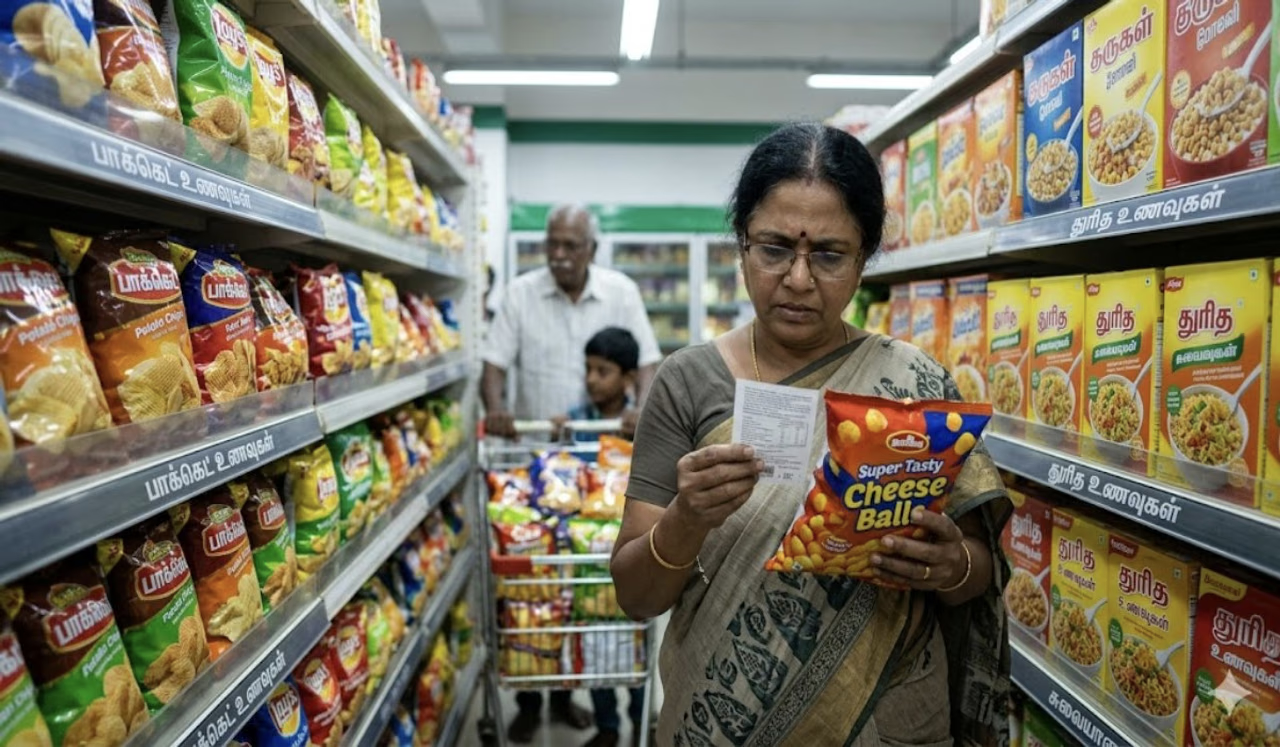
Supreme Court Orders Separate Red Warning Labels For High Sugar, Salt And Fat Foods
Packaged food products that contain excessive amounts of sugar, salt or fat will have to carry prominent warning labels on the front of their packets, with the Supreme Court directing the food safety regulator to make these warnings separate for each nutrient.
In a significant order on Thursday, November 26, the Supreme Court directed the Food Safety and Standards Authority of India (FSSAI) to introduce separate red, hexagon-shaped warnings for products that exceed the prescribed limits for sugar, salt or fat, Bar and Bench reported.
This means a product high in sugar, for instance, will have to carry a 'HIGH SUGAR' warning. Similarly, products with excessive salt or fat will have to display 'HIGH SALT' or 'HIGH FAT' warnings, respectively.
The direction is important because FSSAI's earlier proposal envisaged a single combined warning label. The Supreme Court has now made it clear that each nutrient of concern must have its own warning, making it easier for consumers to understand what a packaged food product contains.
Supreme Court pronounces verdict in case relating to FSSAI’s implementation of front-of-pack warning labels on packaged food products containing high levels of sugar, salt and saturated fat.
Bench: Justices JB Pardiwala and K Vinod Chandran https://t.co/3LRX9vkmK8
— Bar and Bench (@barandbench) November 26, 2026
The matter was heard by a bench of Justices JB Pardiwala and K Vinod Chandran.


What Will The New Warning Labels Look Like?
Under the proposed front-of-pack nutrition labelling system, packaged food products will carry red hexagonal warning symbols on the front of their packaging.
Each symbol will identify the nutrient that exceeds the prescribed limit. The labels will carry clear words such as 'HIGH SUGAR', 'HIGH SALT' and 'HIGH FAT', along with a standardised pictorial representation of the nutrient concerned.
The warnings are expected to be placed prominently on the upper left side of the front of the packet, against a white background. Their font size will be at least one point larger than the font used in the nutrition information table printed on the back.
The idea is to ensure that consumers can identify products containing excessive amounts of these nutrients without having to turn the packet around and study the nutritional information in small print.
For example, a packet of snacks that exceeds the prescribed limits for both salt and fat would need separate warnings for both nutrients, rather than one combined symbol.
The requirement will apply when a product crosses the prescribed threshold for even one of the specified nutrients. It will not be necessary for a food product to be high in all three.
Why Has The Supreme Court Intervened?
The case concerns the implementation of Front-of-Pack Nutrition Labelling (FoPNL), a system designed to help consumers identify packaged foods that are high in nutrients linked to health risks.
The Supreme Court has been examining the issue in a case filed by 3S And Our Health Society, a non-profit organisation seeking stronger warning labels on packaged food products.
The issue gained importance because of growing concerns over obesity, diabetes, high blood pressure and other non-communicable diseases in India. Excessive consumption of foods high in sugar, salt and unhealthy fats can increase the risk of several such conditions.
Children are also a major concern, as they are frequently exposed to packaged snacks, sugary drinks and heavily processed foods. Attractive packaging and advertising can influence their food choices, while nutritional information printed on the back may not always be easy to understand.
Front-of-pack warnings are intended to make this information more accessible at the point of purchase.
Supreme Court Questions Delay In Implementation
The Supreme Court has expressed concern over the time taken to develop the warning-label framework, a process that has been under discussion for several years.
FSSAI had proposed a phased approach earlier, under which products high in two or more specified nutrients would receive warnings in the first phase. The second phase would extend the requirement to products high in even one nutrient.
The regulator subsequently moved towards covering products that exceed the prescribed limit for any one of the nutrients.
The proposed framework draws on the Dietary Guidelines for Indians, 2024, issued by the Indian Council of Medical Research's National Institute of Nutrition (ICMR-NIN), for identifying high levels of nutrients of concern.
The food regulator had also proposed giving food businesses 365 days for voluntary compliance after the regulations were notified.
The Supreme Court, while acknowledging that the proposed timeline for bringing the regulations into force was consistent with the statutory process and reasonable, stressed that FSSAI must make every effort to avoid unnecessary delays.
It said the regulator should anticipate possible obstacles and take active steps to address them. The Court also cautioned against allowing the process to get stuck because of attempts to secure complete agreement among all stakeholders.
It emphasised that public health and consumer interests must take priority.
What Does The Decision Mean For Food Companies?
The ruling is expected to have a significant impact on India's food and beverage industry, estimated to be worth around $100 billion, according to a report by Reuters.
Food manufacturers may have to review their packaging designs and ensure that products exceeding the prescribed nutrient limits carry the required individual warnings.
The labels could also encourage companies to reduce the sugar, salt and fat content of their products to avoid warning symbols on their packaging.
Health advocates have supported stronger front-of-pack warnings, arguing that consumers should not have to rely only on detailed nutritional tables to understand what they are buying.
The Supreme Court has also highlighted the importance of nutritional awareness, particularly among children. It has called attention to the need for better nutritional education and effective implementation of existing food safety regulations.
The Registry has been directed to list the matter after ten weeks. FSSAI will have to place an affidavit before the Court detailing the progress made on the draft regulations.
The latest directions mark an important step towards clearer food labelling in India. However, consumers will have to wait for the regulatory process to be completed before the new warning labels become mandatory on packaged food products.
(With inputs from agencies)
Stay updated with the Breaking News Today and Latest News from across India and around the world. Get real-time updates, in-depth analysis, and comprehensive coverage of India News, World News, Indian Defence News, Kerala News, and Karnataka News. From politics to current affairs, follow every major story as it unfolds. Get real-time updates from IMD on major cities weather forecasts, including Rain alerts, Cyclone warnings, and temperature trends. Download the Asianet News Official App from the Android Play Store and iPhone App Store for accurate and timely news updates anytime, anywhere.