
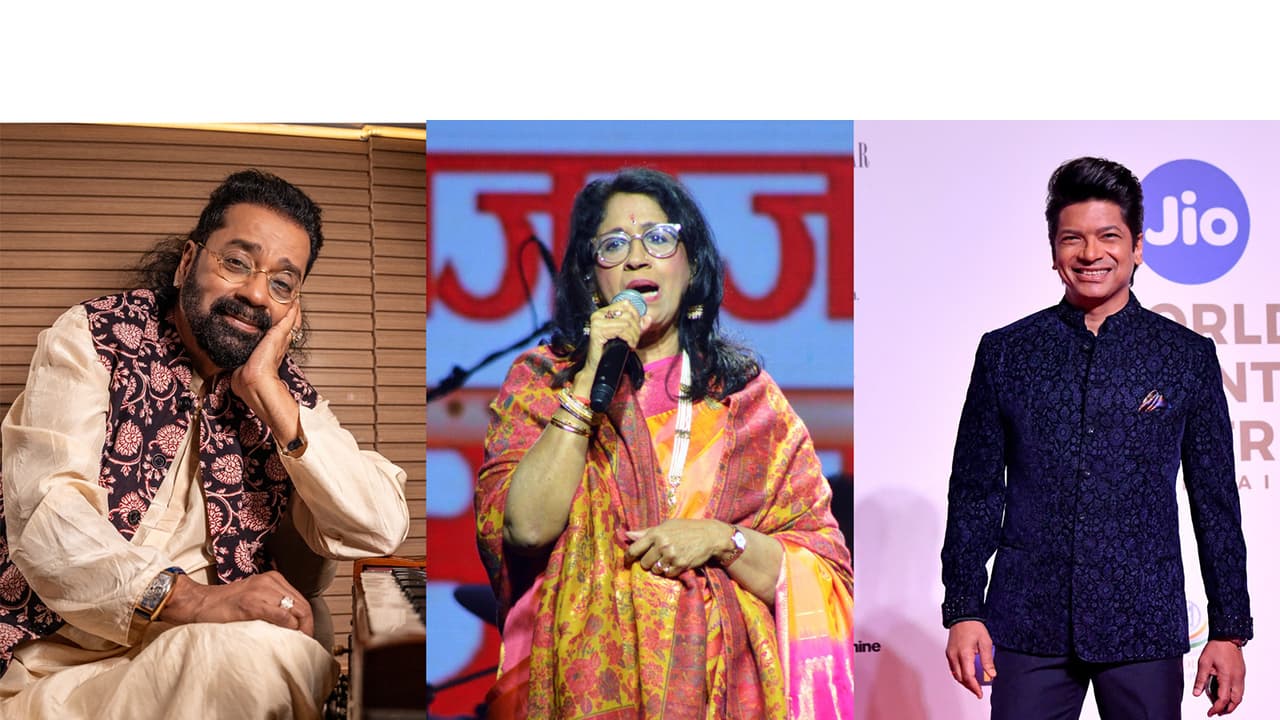
On Valentine's Day, renowned musicians like Kavita Krishnamurti, Hariharan, and Shaan reflect on the enduring magic of 90s love songs, praising their soulful lyrics, emotional depth, and timeless appeal compared to modern, digital-heavy tracks.
As Valentine's Day rekindles the spirit of romance, the melodies of the 1990s continue to echo across generations, reminding listeners of an era when love songs were defined by soulful lyrics, lingering compositions and unmatched emotional depth.
Even though modern music has embraced rapid beats and digital production amid changing listener preferences, the 90s music has always felt personal and poetic - with the songs that didn't just bring love stories but became timeless love stories themselves. This Valentine's Day, renowned musicians such as Kavita Krishnamurti, Hariharan, Anuradha Paudwal, Lalit Pandit and Shaan offered a heartwarming look back at the golden age of music romance, sharing why the love songs of that decade remain irreplaceable.
Kavita Krishnamurti on the Timeless Language of Love
Singer Kavita Krishnamurti, whose voice became synonymous with romance in the 90s, reflected on the timeless language of love songs back in the day. Speaking to ANI, the 'Aankhon Ki Gustakhiyan' hitmaker shared, "There were a lot of films at that time where music played a very important role. They were like musical films. Every emotion was conveyed through music, whether it was a love story, a tragedy, or any other emotion. This is something that made the songs timeless."
Krishnamurthy highlighted that the actors and actresses also played a key role in bringing the music alive through their own performances, adding that contributions by legends like Laxmikant-Pyarelal, RD Burman, and music directors of the age accentuated the musical stories. https://www.instagram.com/p/C9_8MwYNdg-/?hl=en
Speaking on the evolution of romantic songs over the years, Kavita Krishnamurthy reflected on the generational change and shared how the modern love songs don't touch her heart. "I grew up with songs of the 60s and 70s, surrounded by the music of Dilip Kumar, Madhubala, Mohammad Rafi, and Kishore Kumar. It was a completely different era, and then slowly our era was somewhere in between this. I believe our generation acts as a bridge between that generation and the current one. Today's romantic songs don't touch my heart as much as they did previously. It could be that the lyrical value has changed a lot," she added.
Kavita Krishnamurti listed singers such as Arijit Singh, Shreya Ghoshal, Shaan, Sunidhi Chauhan, and the late KK among her favourites, acknowledging that the essence of heartfelt romance lives on through their work.
Anuradha Paudwal: Songs that Grew with Audiences
Likewise, veteran singer Anuradha Paudwal, one of the defining voices of the 90s, explained that those songs were given time to grow with audiences, gradually weaving themselves into everyday life. "The songs in the 70s and 80s were eternal. After 'Hero' came out, a lot of action-oriented films were made. There were situational songs, but all were fresh and new. The songs were made for television, to be shown in films. A lot of good songs have arrived, and we got an advantage to grow on people through singing," Paudwal said.
Hariharan: 90s Songs 'Born Out of a Dream'
Echoing similar sentiments, veteran singer Hariharan described the 90s songs as "born out of a dream." "Those songs were born out of a dream. In that era, music was the hero. We had the luxury of time to let a melody breathe, to let the poetry decide the tune. It wasn't manufactured; it was slow-cooked. Built with patience. That's why those songs feel like a fragrance that just stays with you," Hariharan told ANI. https://www.instagram.com/p/CwiApEPBKeW/?hl=en
In a stark reference to the changing music scenario, he added, "The 90s were a beautiful dream lived through a melody, while today is more of a talkie conversation captured in a digital flash." He explained that modern compositions have become tighter and more technical, in contrast to the "poetic fantasy" that formed the foundation of 90s music.
Known for his timeless romantic numbers like 'Tu Hi Re', 'Roja Jaaneman', and 'Baahon Ke Darmiyan', Hariharan looks back on his journey spanning five decades as he described it as a "journey of staying original, avoiding imitations, experimenting and remembering that the art is always bigger than the artist."
Lalit Pandit on an Era of Youthful Romance
Renowned music director Lalit Pandit of the iconic Jatin-Lalit duo, who significantly dominated the 90s with hits like DDLJ and Jo Jeeta Wohi Sikandar, emphasised that the strength of their music remained through love songs, which he believes excelled at that time. "Romance and the love songs that you make depend on the era of the films being made in. Our strength in music was in the love songs. In the 90s, a lot of youthful and romantic films were made, marking the arrival of good songs. The audience received a fresh wave of emotions through the songs. It was a particular era when music had boosted its value and movies," Lalit Pandit told ANI. https://www.instagram.com/p/DPyHo4akjuI/?hl=en
Referring to his iconic composition of 'Pehla Nasha' from 'Jo Jeeta Wohi Sikandar', Lalit Pandit said, "There is no other song like 'Pehla Nasha'. It is the epitome of love songs. Even the newer generations love it and have made it timeless. However, the songs that come out today fade out after a while.
The Impact of AI on Musical Emotion
Lalit Pandit also addressed how the rise of AI has affected the music industry, even altering the real expressions and emotions that were felt in the 90s. "AI is doing wonders. But when it comes to bringing out the emotions from the heart, it can't be done. AI can now create new voices, but it cannot create the expression of the singer. You have to work very hard for the song to touch your heart," he added.
Shaan: A Shift from Pedestal to Realistic Love
Adding a perspective shaped by the transition into a new musical era, Shaan, who significantly rose to prominence in the early 2000s, believes the romantic tracks, regardless of decade, prioritised melody and emotions, allowing listeners to connect. He told ANI, "It's the kind of cinematic liberties that were taken back in the day that allowed those love songs to connect with audiences, and the audience with the music, far after the movie left the theatre," adding that the modern love songs are unable to make a visual connection.
He highlighted that 90s music placed the poetic element at the forefront, where "love was put on a pedestal and worshipped." "Over the years, it has become more realistic and relatable. The language got simplified, and the emotions were not as heightened. Today love songs are more realistic, simplistic and less aspirational," he added. https://www.instagram.com/p/DUaKXKwDDZO/?hl=en
Comparing love tracks from the 90s to the current music, Shaan said, "Today there is more intensity but no romance in love."
A Legacy of Melody and Emotion
As the world prepares to celebrate Valentine's Day, the reflections of these music stalwarts clearly serve as a reminder that romance is not merely about changing trends but about emotions that endure.
From the poetic storytelling of the 60s and 70s to the melodic magic of the 90s, artists like Kavita Krishnamurthy, Hariharan, Anuradha Paudwal, Lalit Pandit and Shaan collectively echo the belief that timeless love songs were crafted with patience, poetry, and passion - something that gave them a soul beyond sound.
Today, the golden era of the 90s stands as a testament to a time when melody was the 'true hero' and love was elevated to art. This Valentine's Day, as people continue to express affection in countless ways, these evergreen tunes are once again finding their way into playlists - proving that love, much like those unforgettable songs, never fades with time. (ANI)
(Except for the headline, this story has not been edited by Asianet Newsable English staff and is published from a syndicated feed.)