
The Corbett Literature Festival focused on India's natural landscapes, debating human-wildlife coexistence, river conservation, and the role of communities. Experts and artists, including singer Jubin Nautiyal, called for holistic conservation.
From shrinking habitats and land-use change to human-wildlife coexistence, river conservation and the role of local communities, the future of India’s natural landscapes emerged as a key concern during discussions that brought together conservationists, writers, photographers, researchers and storytellers in Jim Corbett.
The conversations explored how forests, rivers and wildlife are closely linked to the lives of communities, while also underlining the need to look beyond individual species and understand the larger ecosystems that sustain them. These issues came into focus on the third day of the Corbett Literature Festival.
Jubin Nautiyal Lends Support to Conservation Cause
The concluding day also saw a special appearance by popular Bollywood singer Jubin Nautiyal, who extended his support to the festival and its focus on wildlife and forest conservation. "We being a mountain state, it's very important for us to realise it and work towards it. And these literature festivals and these kind of activities is what truly penetrates in your heart and creates a resonance and love for nature," he told ANI.
Nautiyal also praised the forest staff for creating imagery showcasing Corbett and said he was encouraged by the public response to the initiative. "I love how so many good, classy, well-read people are coming forward to kind of stand with things that really matter, which will actually matter in the long run," he said.
Exploring Corbett Through Different Lenses
The day opened with the Wildlife Photography Exhibition at Jungle Grill, curated by Sriroopa Raheja Bajaj. Bringing together photographs of Corbett's wildlife and landscapes, the exhibition offered a visual entry point into the day's larger conversations about beauty, behaviour and the fragility of the natural world.
The Visual Language of Wildlife
The session, 'Corbett: Seen & the Unseen', saw environment journalist, documentary filmmaker and photographer Ajay Suri in conversation with filmmaker Vikramjit Singh Bal. The discussion explored the visual language of wildlife and the role of observation in documenting landscapes where patience and understanding can be as important as the camera itself.
Wild Histories and Cultural Connections
The conversation then moved from what the camera sees to what history remembers in 'Wild Histories, Living Landscapes', bringing together conservationist and wildlife historian Raza Kazmi, Uttarakhand State Council for Science and Technology Director General Dr Durgesh Pant and Additional Secretary in the Ministry of Law and Justice Manoj Kumar.
Kumar, who is also a Member of the National Tiger Conservation Authority, has combined his work in public administration with his interest in wildlife photography and natural history. His book Sacred Tiger Tales explores India's cultural and conservation relationship with the tiger.
Speaking about India's long cultural relationship with the tiger, Kumar said the animal has been part of the journey of human civilisation in the country, with references to it appearing in ancient scriptures and community traditions. "The story that Sacred Tiger Tales conveys is how tiger has been a part of the journey of human race in India. From our ancient times, in the old scriptures, we find references of tiger with a lot of respect, at times with fear," Kumar said.
He said the relationship between communities and tigers needs to evolve towards coexistence, with greater emphasis on respect rather than fear. "Human-animal coexistence has to absolutely come back and reach a point where we respect each other rather than we fear," he said, adding that ‘Sacred Tiger Tales’ seeks to create "a bridge for the future."
The Conservation Imperative
In the session titled 'The Conservation Imperative', where conservation biologist Dipankar Ghose was in conversation with Praveen Singh Pardeshi and former Principal Chief Conservator of Forests and Head of Forest Force, Uttarakhand, Dr Samir Sinha. The discussion raised a fundamental question, how can wildlife protection work in a landscape where forests, development and communities are closely connected.
Writer and Conservationist Prerna Singh Bindra, speaking on the sidelines of the festival, identified land-use change as one of the most urgent challenges facing wildlife and natural habitats. "I think the biggest challenge before us is land-use change, the destruction and diversion of our habitats, forests, forest areas, rivers, wetlands and whatever natural habitats we have, for different purposes," she said.
Bindra also rejected the idea of treating development and environmental protection as opposing goals, arguing that ecological systems form the foundation of human welfare and sustainable development. "I don't think there is any conflict in this. The ecology we have, the conservation, the wildlife and the forests we have are the foundation on which the welfare and development of people rests," she said.
For Bindra, the conservation conversation also needs to extend beyond the tiger. While acknowledging that the tiger naturally attracts greater attention, she said other species and their habitats also require equal consideration. "Other animals should not ride on the tiger. Our wolves, bears, otters, we need to conserve them. We need all of them. They are all part of the ecosystem and they all play an important role in conserving the habitat," she said.
Rivers, Faith, and the Role of Local Communities
The festival's focus on the wider landscape continued with 'Rivers of Faith and Forest: The Ganga and Ramganga', a session that explored the cultural, spiritual and ecological significance of the two rivers. Journalist Ramesh Bhatt, academic and community resource researcher Dr Anjali Capila, and mountain development professional Chinmaya Shah joined moderator Sumantha Ghosh to examine the relationship between rivers, forests and communities.
Shah drew on his field research and an approximately 250-kilometre journey through the Western Ramganga catchment to underline the deep dependence of Himalayan communities, particularly women, on local biodiversity and natural resources. He said communities' lives remain closely connected to biological resources ranging from medicinal plants to agricultural produce, adding that some underutilised resources could become sources of livelihood if they receive greater value addition and are used sustainably.
But he stressed that conservation cannot remain a concept discussed only in policy rooms. "It is 100 per cent necessary because if you do not involve local communities, then wherever we talk about conservation and sustainability, these remain just jargon, just big words," Shah said.
He argued that traditional knowledge and the experience of communities living within the landscape need to be incorporated into planning and decision-making. "Their traditional knowledge and their understanding of nature and the landscape, if we do not integrate these into our decision-making and planning, we will not be able to talk about sustainability," he said.
His observations also reflected one of the festival's recurring themes, that understanding a landscape requires going beyond assumptions and spending time on the ground. He said the Ramganga journey made him realise how limited conventional understanding of a landscape can be and stressed the need for conservation practitioners and others working on rivers and natural resources to engage more closely with communities and field realities.
The Wild Word: The Power of Storytelling
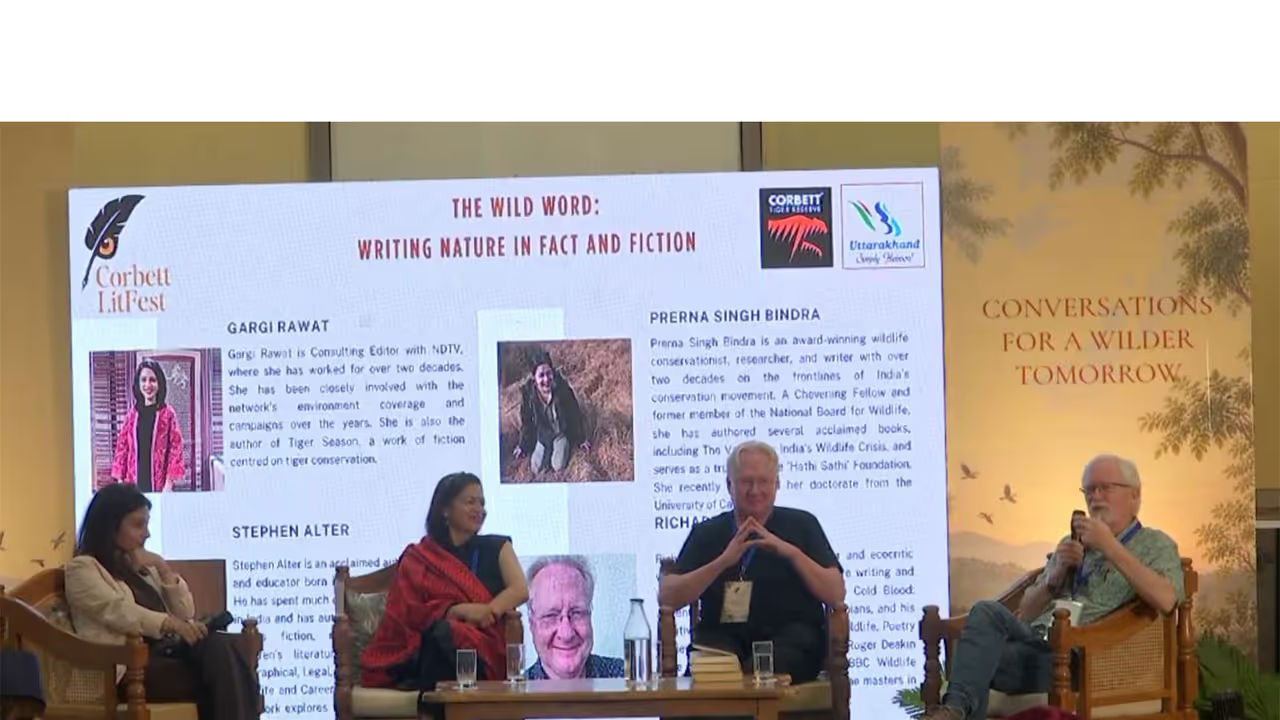
The conversation of the festival, 'The Wild Word: Writing Nature in Fact and Fiction', brought together Consulting Editor Gargi Rawat, author and naturalist Stephen Alter, nature writer and ecocritic Richard Kerridge and conservationist and author Prerna Singh Bindra. The session returned the festival to one of its founding questions,what role can stories play in changing the way people see nature?
Kerridge, whose work combines nature writing, memoir and literary criticism, said nature writing brings together personal experience, scientific information, natural history, cultural meanings and politics. "The important thing about nature writing is the way it brings together different perspectives," Kerridge said, explaining that personal experiences of joy, fear, grief and wonder can exist alongside science, ecology, cultural history and questions about protecting the global ecosystem.
He also argued that nature writing today cannot ignore the biodiversity and climate crises. "Nature writing does have to bring everything back to that, and it does have to connect that with the experience of individuals," he said.
Kerridge pointed to a growing interest in conservation and responsible behaviour, including the relationship between ecotourism and local communities. He said tourism can put pressure on protected areas but can also support local communities and conservation when visitors respect wildlife and park rules. He also highlighted Indian nature writing, mentioning Prerna Singh Bindra's The Vanishing: India's Wildlife Crisis' and Yuvan Aves' 'Intertidal: A Coast and Marsh Diary' as examples of writing that connects personal experience with larger environmental questions.
For Kerridge, the attraction of Corbett itself lies in the richness of its landscape. "I love coming here. I love the landscape. I love the abundance. I love to see hornbills and, of course, the tigers, the elephants, the wild boar, the sambar, all these creatures, the glorious birds," he said, also noting his particular interest in snakes.
A Continuing Conversation: The Future of the Festival
The concluding day also saw a special appearance by Uttarakhand-born playback singer Jubin Nautiyal, who spoke about his association with the festival and the importance of an initiative rooted in the state's natural and cultural landscape. As the three-day festival drew to a close, its organisers indicated that the event was intended not as a one-off gathering but as the beginning of a continuing conversation.
Anirudh Lakhotia, Director of Ivory Destinations, which owns The Golden Tusk, said the three days had unfolded as envisioned, with speakers from diverse fields, a photography exhibition and films showcasing the landscape and the work of those documenting it. "I really hope it's the beginning of new stories and something better to come out of it in the future," Lakhotia said.
He added that the aim was to make the festival a recurring platform and organise smaller events through the year under the Corbett Literature Festival banner so that the conversation around the landscape did not remain limited to one annual gathering.
Field Director of Corbett Tiger Reserve Saket Badola described the first edition as an initiative that demonstrated how a literary perspective could present a destination in a different light. "The success of this first-of-its-kind initiative has demonstrated how a literary perspective can present a destination in an entirely different light," Badola said, adding that stories of Corbett and the wild were inherently captivating and that he looked forward to more editions.
The festival concluded at The Golden Tusk with a gala dinner, music and live painting. ( ANI)
(Except for the headline, this story has not been edited by Asianet Newsable English staff and is published from a syndicated feed.)