
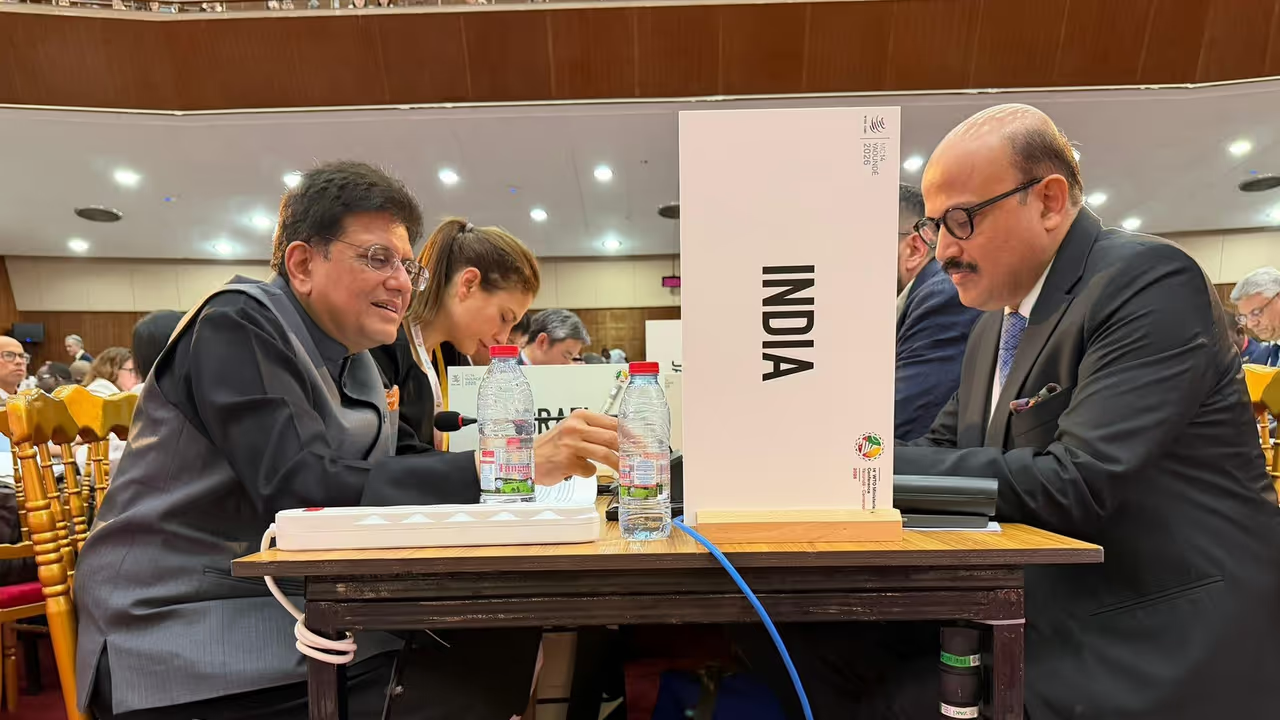
Union Minister Piyush Goyal said India took a firm stand at the 14th WTO Ministerial Conference, rejecting the inclusion of the Investment Facilitation for Development (IFD) Agreement over concerns it would undermine the WTO's core principles.
Union Commerce and Industry Minister Piyush Goyal said India took a firm stand at the 14th WTO Ministerial Conference, refusing to support the inclusion of the Investment Facilitation for Development (IFD) Agreement into the World Trade Organization framework, citing concerns that it could undermine the institution's foundational principles.
India Rejects IFD Agreement at WTO
"At #WTOMC14, drawing inspiration from Mahatma Gandhi ji's philosophy of Truth prevailing over conformity, India showed the courage to stand alone on the contentious issue of the Investment Facilitation for Development (IFD) Agreement and did not agree to its incorporation into the WTO framework as an Annex 4 Agreement," Goyal said in a post on social media.
"Incorporation of the IFD Agreement risks eroding the functional limits of the WTO and undermining its foundational principles," the post added.
Discussions on WTO Reform
Goyal further noted that WTO members are discussing safeguards as part of reforms. "As part of WTO reform discussions, Members are discussing guardrails and legal safeguards for plurilaterals before the integration of any specific plurilateral outcome," he said.
"In view of the systemic issue at hand, India showed openness to have good faith, comprehensive discussions and constructive engagement under the WTO Reform Agenda," he added.
Minister Addresses Fisheries Subsidies
The minister also addressed a ministerial session on fisheries subsidies, where he highlighted India's people-centric approach to fisheries governance.
"Fisheries in India are a vital source of livelihood and food security, supporting more than 9 million fishermen, largely comprising small, traditional, and artisanal fishermen practising sustainable methods," Goyal said.
He said India has long taken steps to protect marine resources. "India's proactive and historical conservation efforts, including the annual fishing ban, demonstrate our long-standing commitment to sustainability well before it became a global priority," he added.
Protecting Small-Scale Fishermen
Goyal stressed that the problem of overfishing is largely linked to industrial fleets rather than small fishermen in developing countries. "The challenge of overcapacity and overfishing arises from heavily subsidised industrial fleets, and not from small-scale fishermen in India and other developing countries," he said.
He also reiterated India's support for a balanced outcome in negotiations. "India supports the adoption of the draft decision, while emphasising that further decisions must deliver an equitable and development-oriented outcome that protects both marine resources and livelihoods," he added.
Engagement with Indian Diaspora in Cameroon
During his visit, Goyal also interacted with members of the Indian community in Cameroon, highlighting the role of the diaspora in strengthening ties between the two countries.
"Our diaspora in Cameroon is a vital bridge strengthening bonds, fostering goodwill, and bringing our nations closer together," he said.
"Delighted to address the Indian Community Reception in Cameroon and highlight the immense potential to further deepen our bilateral relations." (ANI)
(Except for the headline, this story has not been edited by Asianet Newsable English staff and is published from a syndicated feed.)