
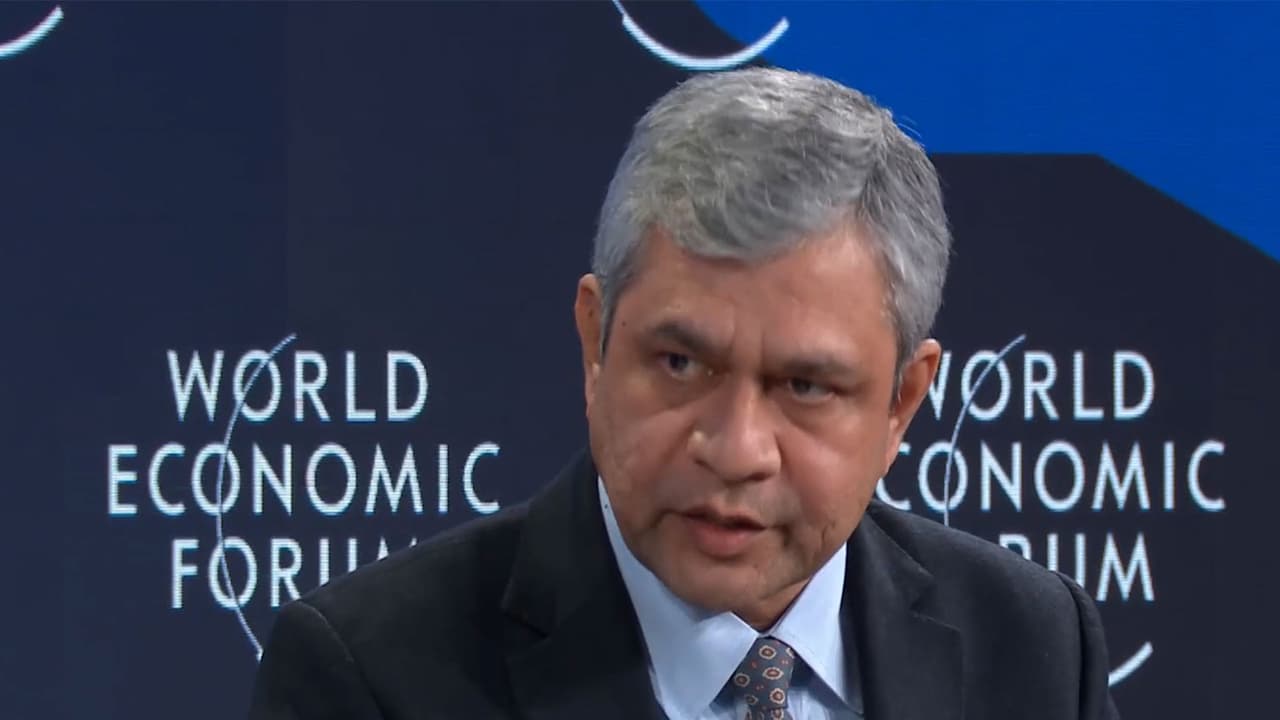
Union Minister Ashwini Vaishnaw rejected the IMF's classification of India as a second-tier AI economy at the WEF. He asserted India's position in the 'first group,' citing Stanford rankings and the country's comprehensive AI strategy.
Union Minister for Electronics and IT Ashwini Vaishnaw on Wednesday rejected the International Monetary Fund's (IMF) Managing Director Kristalina Georgieva's suggestion that India belongs to a second tier of AI economies, saying that India is clearly in the first group globally.
Addressing a World Economic Forum (WEF) panel in Davos, Vaishnaw said, "I don't know what the IMF criteria has been, but Stanford places India as third in terms of AI penetration, in terms of AI preparedness, and in terms of AI talent." Addressing the IMF chief directly regarding the classification, he stated, "I don't think your classification in the second book is right. It's actually in the first."
India's Comprehensive AI Strategy
The Union Minister detailed India's comprehensive strategy across the five layers of AI architecture, which include the application, model, chip, infrastructure, and energy layers. He noted that India is making significant progress in all these sectors to ensure its independence in the global tech landscape. Vaishnaw emphasised that India is charting its own course rather than strictly aligning with the paradigms set by the United States or China.
Focus on Application Layer and ROI
On the application layer, Vaishnaw projected that India will become the largest supplier of AI services to the world. He explained that success in AI deployment depends on understanding enterprise business needs to provide specific services, which is where the return on investment (ROI) is generated. He argued that ROI does not come from creating very large models, noting that "95% of the work can happen with models which are 20 billion or 50 billion parameters."
The Minister confirmed that India already possesses a "bouquet" of such models, which are currently being deployed across multiple sectors to increase productivity and efficiency. He stated that the government's focus remains on ensuring that "AI diffusion happens in a very big way" across the domestic economy.
The panel, which focused on AI and the economy, included Saudi Arabian Minister of Investment Khalid Al-Falih and Microsoft President Brad Smith. Throughout the session, Vaishnaw maintained that India's status as the fastest-growing major economy is supported by its talent pool, which he noted is ranked highly globally by Stanford. He reiterated that the country's integrated approach across the AI stack secures its position as a primary player in the global technology evolution.
(Except for the headline, this story has not been edited by Asianet Newsable English staff and is published from a syndicated feed.)