
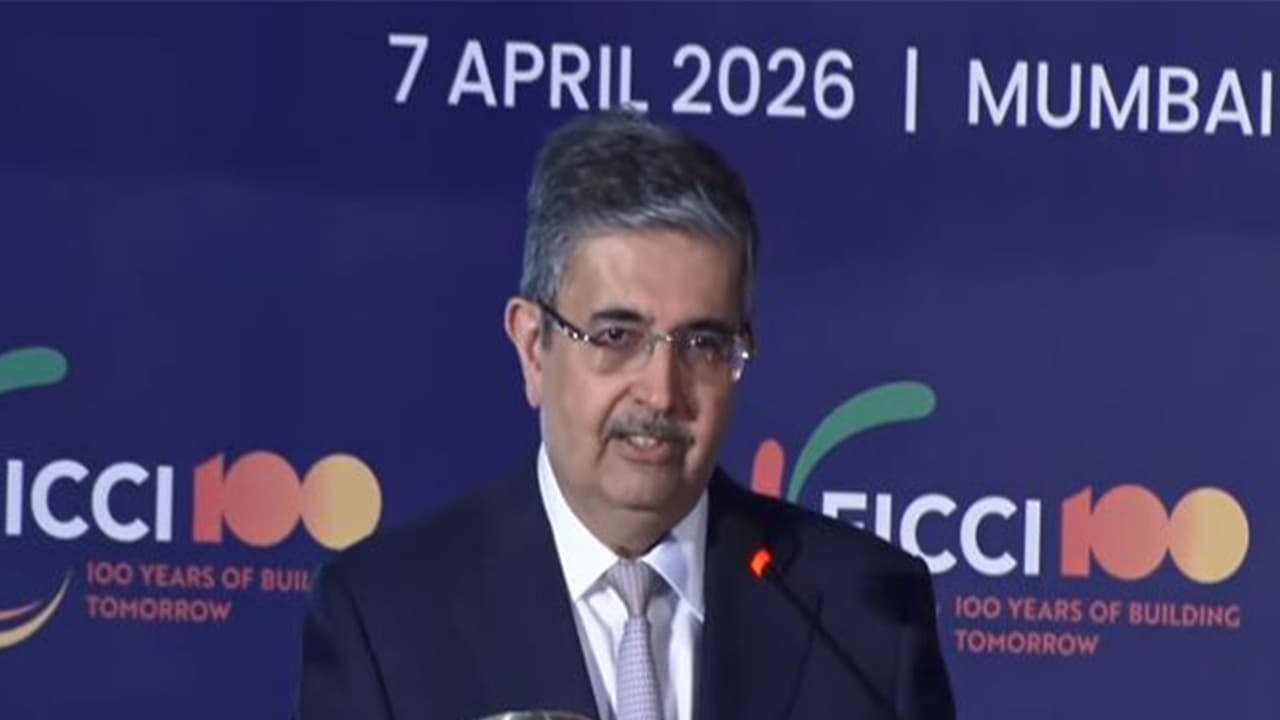
Uday Kotak warns of a 'return of global colonialism' amid geopolitical shifts. He urged India to focus on research, innovation, and manufacturing to achieve true self-reliance and reduce its trade deficit, especially with China.
Uday Kotak, Founder and Non-Executive Director of Kotak Mahindra Bank, on Tuesday warned that the world may be entering a phase of structural geopolitical change and said India must invest more in research, innovation and manufacturing to truly achieve self-reliance. Speaking at the FICCI Foundation Day - Celebrating the Spirit of Entrepreneurship organised by the Federation of Indian Chambers of Commerce and Industry, Kotak said the current global situation -- particularly rising conflicts and shifting geopolitical power -- raises an important question about whether the world will return to normal or undergo deeper structural changes.
A 'Return of Global Colonialism'?
"We are at an important cusp of what I call the return of global colonialism," Kotak said, referring to recent geopolitical developments and comments by Donald Trump. "He (Trump) made two points that clearly identified that we are in a very different world. One... 'whoever wins the war keeps the spoils.' And two... 'if we get control of the Strait of Hormuz, we the United States of America will charge a rent'," Kotak said.
Kotak said such developments echo historical patterns of colonial expansion, drawing a parallel with the rise of the East India Company in India. "In the early stages, East India Company was a pure trading company. It traded and made money. Then they had superior technology -- guns and gun powder -- which gave them leverage," he said.
"Soon the trader figured out that why not I start acquiring territory as well. And through that you saw the trading company become the British Empire in India," Kotak added.
Two Potential Global Scenarios
According to him, the world currently faces two possible economic scenarios. The first is a continuation of the global order that emerged after World War II, where economies typically recover after crises. "For the last 80 years, whenever there has been a crisis, we have seen a reversion to mean," he said.
However, Kotak said the second scenario could be a return to the kind of structural shifts that defined global history before 1945. "In this scenario, whenever there is a crisis, there is structural change happening in the world -- lands conquered, rulers changed and the rule of might," he said.
Kotak said while the first scenario may remain the base case for businesses, even a small probability of deeper structural change cannot be ignored. "Even if it is a low probability event, it's a very high impact event," he said. "Whatever low probability you put to scenario two, do not assume that to be zero."
India's Path to Self-Reliance
Turning to India's growth strategy, Kotak said the country must focus on innovation, product development and manufacturing if it wants to build true economic strength. "Research and innovation has to be at the core of Atma Nirbhar Bharat," he said.
Kotak noted that Indian companies often rely on imported technologies rather than building their own capabilities. "We believe we can buy technology. We can buy rare earths from China. We can get Microsoft and other technologies from the US. But where is the Atma Nirbhar Bharat truly?" he asked.
Focus on Productisation
He also highlighted the need for Indian firms to move beyond services and focus on building products, especially in the age of artificial intelligence. "As AI comes at our doorstep, hardly any company has moved to productise themselves," Kotak said.
Learning from China's Progress
Drawing comparisons with China, Kotak said the country has made rapid progress in electric mobility and manufacturing capabilities. "I went to China last week. In China, 60 per cent of domestic car production is electric. India is 3 per cent," he said.
Strengthening Middle Manufacturing
Kotak added that India must strengthen domestic manufacturing capabilities, particularly in mid-scale industries. "The biggest area where we need to build is middle manufacturing," he said, referring to companies investing between ₹100 crores and ₹1,000 crores.
Reflections and The Way Forward
Reflecting on India's economic journey since the 1991 Indian economic reforms, Kotak said Indian businesses initially resisted liberalisation but eventually adapted. "Soon Indian businesses figured out that let's get our act together and Indian manufacturing got back and created world-class manufacturing," he said.
However, he said India must now take the next leap to strengthen industrial capacity and reduce dependence on imports, especially from China. "The reality is a $116 billion trade deficit with China," Kotak said.
He concluded by urging the business community to prepare for an uncertain global environment while strengthening India's long-term economic resilience. (ANI)
(Except for the headline, this story has not been edited by Asianet Newsable English staff and is published from a syndicated feed.)