
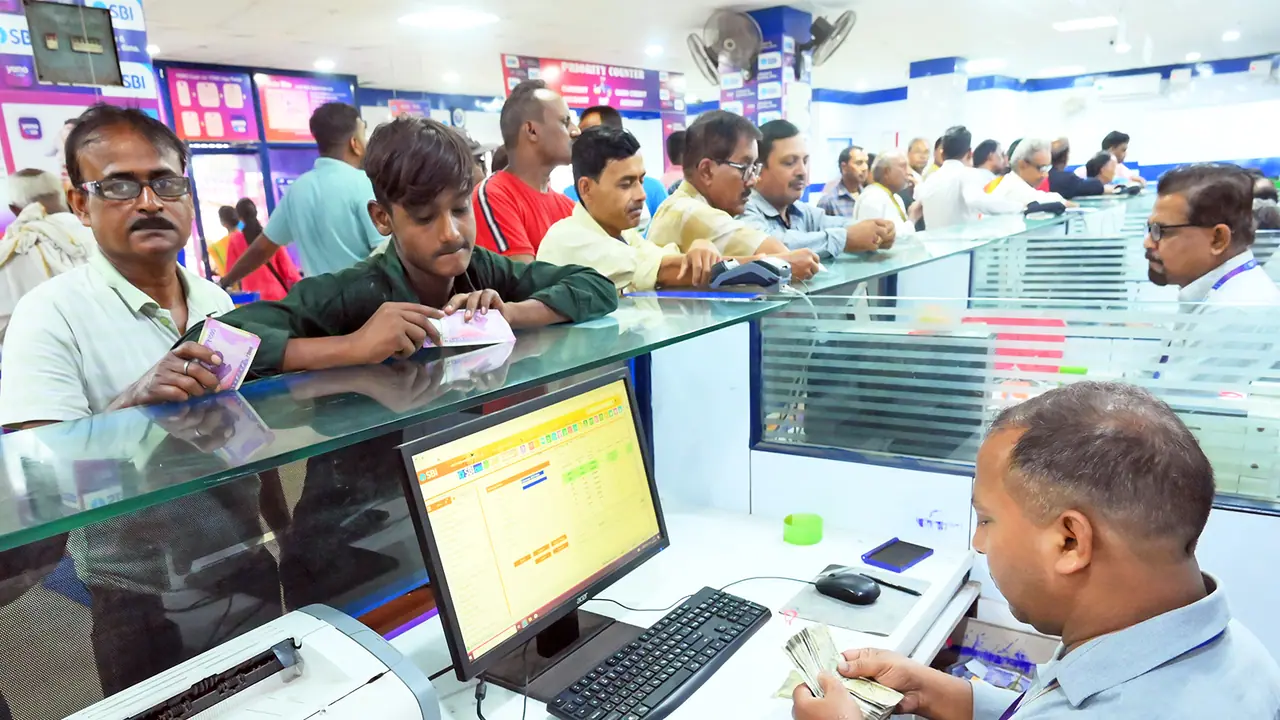
A McKinsey report says India's banking sector is entering a complex phase with emerging pressures like margin compression and rising costs, despite recent strong profitability. Headwinds could test the sustainability of recent gains.
India's banking sector, after a period of strong profitability and balance sheet improvement, is entering a more complex phase marked by emerging structural pressures, according to a report by McKinsey & Company.
The report, titled "Indian Banks: Navigating through the turbulence," highlights that while banks have benefited from robust macroeconomic growth and improved asset quality, headwinds such as margin compression, rising costs, and evolving credit risks are beginning to surface. "Indian banks have been outperforming global peers, but they are still facing headwinds," the report noted, pointing to growing challenges that could test the sustainability of recent gains.
Profitability Under Pressure
It added that profitability has reached a peak, with return on assets (ROA) touching 1.4 per cent in FY2025, but further upside may be limited due to declining net interest margins (NIMs) and rising operating expenses. The findings indicate that banks are navigating a "structural profitability squeeze" as credit growth continues to outpace deposit growth, leading to tighter liquidity and higher funding costs. At the same time, fee income has remained under pressure amid increasing competition from fintech players and the shift towards low-cost digital transactions.
Emerging Asset Quality Concerns
The report also flagged emerging stress in asset quality, particularly in unsecured retail lending. While gross non-performing assets (GNPAs) have declined to a 13-year low, rising write-offs and higher slippages suggest underlying vulnerabilities that could impact future earnings.
Shifting Credit Dynamics
The sector is witnessing shifts in credit dynamics, with non-banking financial companies (NBFCs) outpacing banks in credit growth and retail lending gaining a larger share of overall portfolios. Additionally, the credit-deposit ratio has reached a decade high, forcing banks to rely more on higher-cost deposits.
A Holistic Performance Scorecard
Beyond financial metrics, the report underscores the importance of a broader approach to evaluating bank performance. It introduces a holistic impact scorecard that assesses banks across five dimensions financial performance, industry health, customer experience, societal impact, and operational resilience. "To stay ahead, banks would need to strengthen their financial and operational foundations, embrace innovation to enhance customer value, and align their growth with broader social and environmental goals," the report said.
Technology, Risk, and Customer Experience
Technology and digital transformation are emerging as key priorities, with banks accelerating investments in artificial intelligence and data-driven capabilities. However, legacy infrastructure and uneven adoption remain significant challenges.
The report also warns of rising cybersecurity risks as digital adoption increases, necessitating stronger risk management frameworks.
In addition, the sector faces evolving customer expectations, with a shift toward hyper-personalised services and digital engagement models. While public sector banks are closing the gap in digital capabilities, private lenders continue to lead in customer experience and technology investments.
An Inflection Point for Indian Banks
Overall, the report concludes that Indian banks stand at an inflection point, balancing strong growth momentum with increasing operational and financial pressures. Sustained success, it suggests, will depend on the sector's ability to adapt quickly, manage risks effectively, and build resilience in an increasingly competitive and technology-driven landscape.
(Except for the headline, this story has not been edited by Asianet Newsable English staff and is published from a syndicated feed.)