
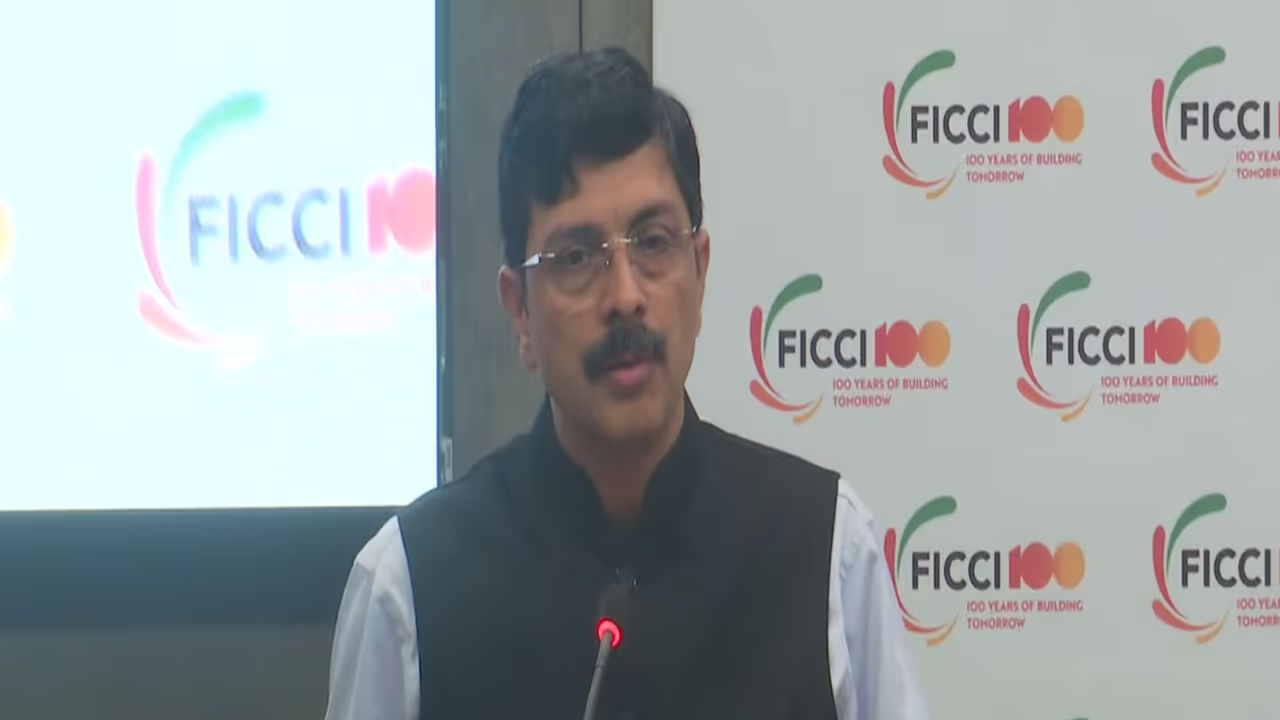
Power Secretary Pankaj Agarwal said India must cut its dependence on oil and gas and accelerate its shift towards renewable energy for energy security, citing recent global developments like the situation around the Strait of Hormuz as a key driver.
India needs to reduce its dependence on oil and gas and accelerate the shift towards renewable energy as energy security assumes greater importance amid changing global circumstances, said.Pankaj Agarwal, Secretary-Ministry of Power.
Speaking at the FICCI Indian Power Sector Conference on “Building A Reliable, Flexible And Market-Ready” power system, Agarwal said recent developments around the Strait of Hormuz had reinforced the need to move away from oil and gas wherever possible, making renewable energy a key component of India’s energy security. “Today's outlook after Hormuz, we have to accept that we need to move away from oil and gas wherever we can. There is a limit to it. Sun, wind, biomass, maybe nuclear and coal. So, whether we like it or not, renewable energy is a reality and is a key to our energy security,” he said.
Tackling Variability and Building Flexibility
Agarwal said the growing share of renewable energy also meant India would have to address variability and build greater flexibility on both the supply and demand sides of the power system.
Future Roadmap and Falling Costs
He noted that the economics and assumptions around the power sector had changed significantly in the last three years, citing a decline in battery storage costs from around Rs 10 per unit in 2023 to Rs 4 per unit currently. He also said India was now working on a roadmap for 100 GW of nuclear capacity by 2047, while around 16,000 MW of pumped storage projects were already under implementation.
Geographical Challenges and Grid Stability
Agarwal highlighted geographical concentration of renewable energy as a major challenge for grid stability, particularly as large volumes of solar and wind capacity are concentrated in states such as Rajasthan and Gujarat. He said the government was working on solutions including storage, transmission expansion, time-of-day tariffs and market-based mechanisms to manage fluctuations in renewable generation.
Policy, Investment, and 'Design in India'
The Power Secretary said the upcoming National Electricity Policy would incorporate flexibility mandates for large consumers such as data centres and green hydrogen projects, which could place significant and fluctuating loads on the grid.
He also pointed to opportunities for investment in battery storage and pumped storage projects, particularly in renewable-rich states, saying storage could help address curtailment, provide grid support and enable energy arbitrage.
Agarwal said India should also use the evolving grid-stability challenge as an opportunity to develop and manufacture power-electronics and other solutions domestically, with a focus on “design in India” products. (ANI)
(Except for the headline, this story has not been edited by Asianetnews Editorial staff and is published from a syndicated feed.)