
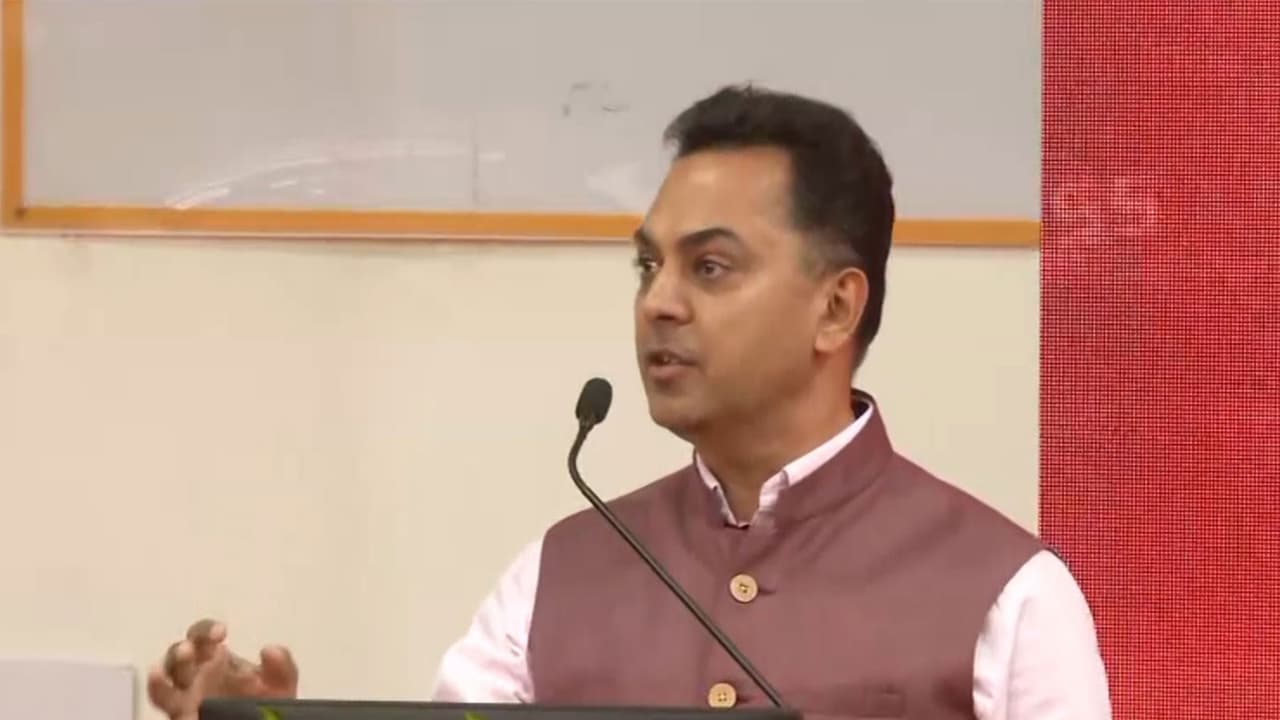
Former CEA Krishnamurthy Subramanian stated India can sustain an 8% growth rate for two decades, urging policymakers to target this. He identified formalisation, catch-up growth, and rising female labour participation as key structural drivers.
India's 8% Growth Imperative
Former Chief Economic Advisor Krishnamurthy Subramanian has expressed confidence that India can sustain an average economic growth rate of around 8 per cent over the next two decades, arguing that policymakers must aim for such expansion if the country is to fully realise its long-term economic potential.
Speaking about India's growth prospects and the evolving role of finance leaders, Subramanian said the broader macroeconomic environment would shape the "top line" outlook that chief financial officers (CFOs) and finance professionals must track closely. "For a CFO, the top line matters the most," he said, adding that economic growth ultimately determines the scale of opportunities available to businesses. He emphasised the link between finance and long-term planning, noting, "finance without strategy is blind and strategy without finance is lame."
Subramanian said India now has a historic opportunity to emerge as one of the world's largest economies over the coming decades. "For the first time in possibly four or five centuries, India has the opportunity to become one of the top two economies in the world. This was not the case ever since the 15th or 16th century," he said, speaking at the FICCI CFO Summit 2026 over the weekend.
According to Subramanian, policymakers must target sustained high growth if India is to capitalise on its demographic and economic advantages. "I believe that our policymakers will not be delivering India's potential if they do not deliver 8 per cent growth in real terms on average over the next two decades," he said. He acknowledged that some critics consider such projections overly optimistic, noting that when he puts such projections on social media, people often say that it seems too optimistic.
Past Predictions and the Role of Optimism
Subramanian referred to earlier predictions he had made about the economy's trajectory. At the height of the COVID-19 pandemic, he had predicted a V-shaped recovery after the sharp contraction during the first lockdown quarter. "At the height of the COVID pandemic, after a (sharp) decline in GDP in the first lockdown quarter, I predicted a V-shaped recovery for the Indian economy," he said.
He also recalled forecasting a stronger economic expansion when India was growing at around 6 per cent. Subramanian argued that optimism is a necessary ingredient for economic progress. "The difference between an economic commentator and an economic leader is in this fundamental belief that for anything good to happen, positive thinking is necessary. For anything bad to happen, negative thinking is sufficient," he said.
Subramanian said that even if India grows at an average rate of 8 per cent over the next two decades, the country's per capita income would still remain well below levels where growth typically begins to slow significantly. He explained that at such growth rates, India would reach around $30,000 in real per capita income over time, which still leaves substantial room for continued economic expansion before the law of diminishing returns begins to kick in.
Structural Drivers for Sustained Growth
Subramanian outlined several structural drivers that could help India achieve the projected 8 per cent growth trajectory.
Continued Formalisation of the Economy
The first is the continued formalisation of the economy. He noted that a large share of economic activity in India still takes place in the informal sector. "Even today, and estimates vary, about half of the Indian economy is informal," he said.
He explained that productivity tends to be lower in the informal sector and that the gradual shift toward formalisation over the next two decades could significantly boost efficiency and output.
Catch-Up Growth Potential
The second driver is catch-up growth. Subramanian said that while advanced economies grow by pushing the productivity frontier through innovation, emerging economies like India can grow faster by adopting existing technologies and development models. "In India, on the other hand, an emerging economy like India, we will be having catch-up growth," he said.
Increasing Female Labour Force Participation
The third factor is increasing female labour force participation, which he said has already shown significant improvement in recent years. "Over the last six years, the labour force participation ratio... has increased from 23 per cent to 42 per cent," he said, citing data from the Periodic Labour Force Survey.
Despite the progress, he noted that there is still significant potential for further improvement in women's participation in the workforce. Together, these structural changes, formalisation of the economy, catch-up productivity gains, and rising female labour force participation, and credit growth could support sustained high growth and help India realise its economic potential over the next two decades, he summed up. (ANI)
(Except for the headline, this story has not been edited by Asianet Newsable English staff and is published from a syndicated feed.)