
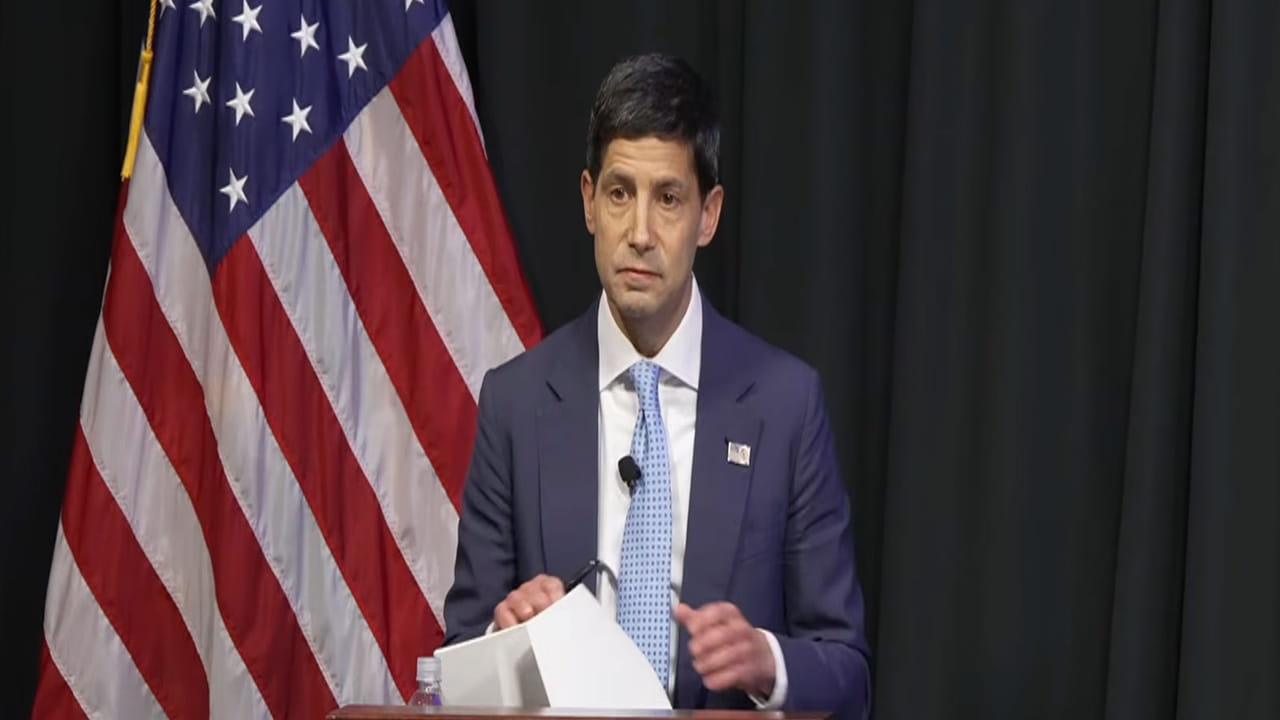
Fed Chairman Kevin Warsh suggests super intelligence could radically transform the US economy by accelerating idea generation and productivity, while stressing that human judgment remains crucial in navigating potential labor market disruptions.
Fed's Warsh Says Super Intelligence Could Transform the US Economy
Federal Reserve Chairman Kevin Warsh on Monday said the emergence of artificial intelligence and what he described as "super intelligence" could fundamentally transform the US economy, potentially driving productivity growth, generating new ideas and reshaping the labour market. Addressing the Productivity and Jobs Task Force Conference, hosted by the Federal Reserve Board and the Federal Reserve Bank of San Francisco in San Francisco, Warsh said the current period could be "the most transformational period in my adult lifetime."
Highlighting the rapid advancement of super intelligence (SI), Warsh said access to advanced intelligence tools was becoming increasingly widespread, with the cost of satisfying human curiosity falling rapidly. "Today, with the advances of SI, it's happening. The marginal cost of satisfying limitless curiosity—on questions large and small—is falling fast, perhaps even trending toward zero," he said.
Warsh emphasised that ideas remain the ultimate resource for economic growth, arguing that societies capable of generating and developing new ideas are more likely to prosper. "In the tradition of endogenous growth theory in economics, ideas are the ultimate resource. If living standards are to advance, conditions must be favorable to the generation of new ideas," he said. He noted that despite a substantial increase in research efforts over recent decades, breakthrough innovations had become harder to achieve, with research productivity declining.
According to Warsh, super intelligence could distinguish itself from earlier general-purpose technologies such as electricity and the internal combustion engine by directly accelerating the process of idea generation. "What might set SI apart, as an economic influence, is that it could supercharge idea generation. It appears to be changing the method—and the speed—of innovation," he said. He added that broader idea generation could sustain economic growth at levels substantially higher than historical averages.
However, Warsh cautioned against assuming that machines could replace human judgment and responsibility. "Machines that can amass or even exceed human knowledge are still machines. They do not take the place of human judgment, morality, or responsibility. Humans are the designers and the builders, and humans must be the deciders," he said. Raising questions about the strategic importance of the technology, Warsh asked, "Can you be a superpower without super intelligence?"
He said the Federal Reserve was examining the economic implications of the technology rather than advocating for or opposing its adoption. "At the Fed, our role in all this is neither advocacy nor opposition. Our responsibility is to recognize that the widespread adoption of this technology will have significant impact on the economy, with important implications for monetary policy down the road," he said. Warsh identified the magnitude, scope and timing of productivity gains as key questions for policymakers, adding that the technology's impact on employment and living standards would require close examination.
He also cautioned that the rapid adoption of super intelligence could create risks, particularly in critical infrastructure. "SI empowers all, including bad actors, so we are thinking especially of critical infrastructures and their potential vulnerabilities," he said. The Federal Reserve's staff has begun evaluating different economic scenarios associated with the technology through model-based frameworks, Warsh said, stressing that these were illustrative scenarios rather than forecasts. He outlined three broad possibilities.
In the first scenario, productivity gains translate into broadly shared economic benefits for workers and capital owners, supporting sustained growth in real GDP while keeping the US economy close to full employment. In another scenario, technological adoption generates higher economic growth but causes substantial labour market disruption as automation displaces jobs. Labour market frictions could push unemployment above levels consistent with full employment. A third possibility involves disappointing productivity gains following significant capital investment and stock market appreciation. In such a situation, falling expected returns and declining equity valuations could trigger an economic slowdown and higher unemployment.
Warsh said the Federal Reserve was preparing for different possible outcomes as the technology evolves, rather than attempting to predict its precise trajectory. "Our job is to prepare for whatever comes next. That means contingency planning, which becomes only more important when the world is changing this fast. Our aim today is a humble one: to ask the right questions," he said. He also highlighted the importance of American leadership in the emerging technological landscape, expressing optimism about the country's long-term economic prospects.
Warsh described his participation in the conference as an opportunity to engage with experts and policymakers on the challenges and opportunities associated with super intelligence. "It's a privilege to be a policymaker at a time of such consequence—and it's an encouraging sign to be in the company of so many serious and capable men and women," he said. The conference brought together Federal Reserve officials and other stakeholders to examine the relationship between productivity, employment and technological transformation. (ANI)








