
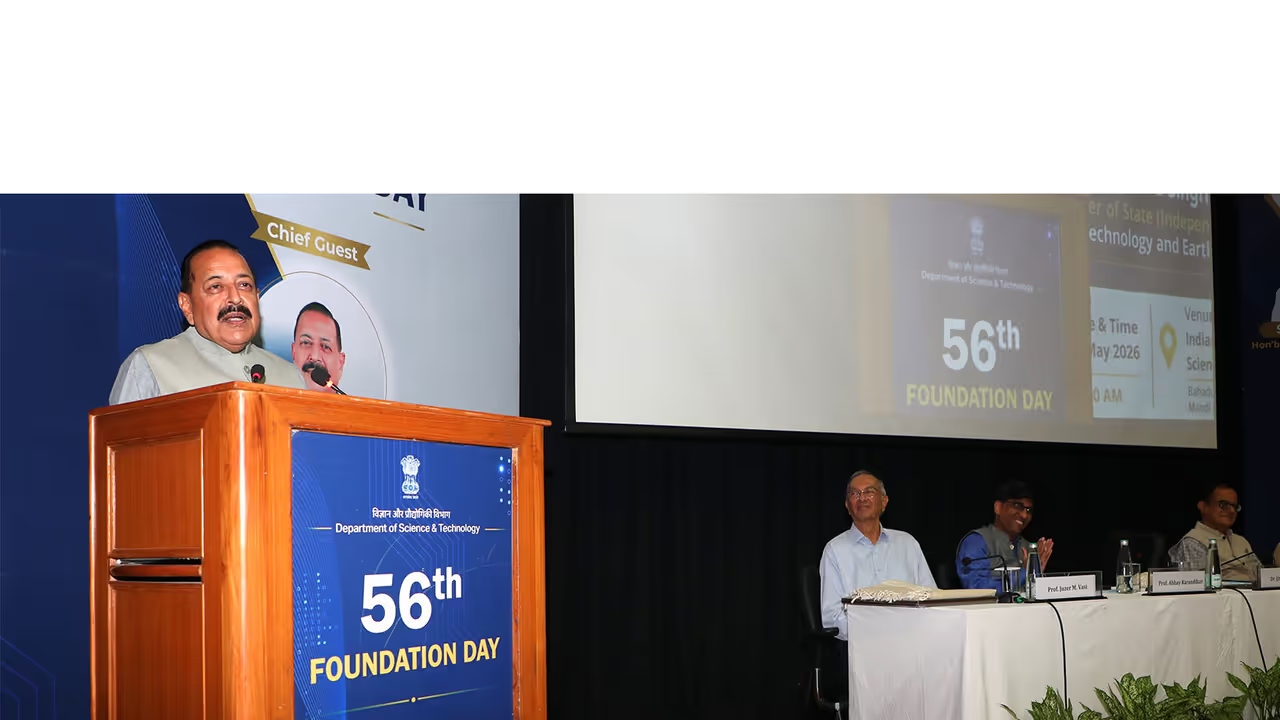
Union Minister Jitendra Singh said technology innovation led by the DST is driving India's economic growth. He emphasised moving science from 'labs to markets' and noted a surge in startups due to policy reforms like opening the space sector.
Union Minister Jitendra Singh on Monday said technology-driven innovation led by the Department of Science and Technology (DST) over the past decade is playing a key role in driving India's economic growth, with its contribution expanding from research to industry, startups and national development.
A Transformative Decade for Indian Science
Addressing the 56th Foundation Day of DST at the Indian National Science Academy (INSA) Auditorium in New Delhi, the Minister said science must now move "from laboratories to markets and from ideas to impact," reflecting a policy direction that integrates research with economic outcomes.
He said, "India's science and technology landscape has undergone a decisive transformation over the past decade, supported by policy decisions that opened sectors such as space and nuclear energy to private participation," creating new opportunities for startups and industry.
Startup-Driven Innovation in Key Sectors
Referring to developments in the space sector, Singh said that opening it to private players has led to a surge in startup-driven innovation, with capabilities emerging in areas such as satellite technologies, contributing to both economic growth and national preparedness.
The Minister stressed that no country can advance in science without collaboration between government, academia and industry, calling for deeper partnerships to strengthen the innovation ecosystem.
He also highlighted the importance of indigenous research, noting that India is increasingly developing its own technologies across sectors, including pharmaceuticals.
Rising Global Standing and Startup Boom
Singh said, "India's global scientific standing has also strengthened significantly, with a growing share of highly cited research publications, reflecting both quality and impact. He pointed to the expansion of India's startup ecosystem, from a few hundred a decade ago to over two lakhs today, as evidence of a rapidly maturing innovation landscape."
He also underlined the need for scientific institutions to communicate their achievements effectively and engage with stakeholders to ensure wider societal impact.
The Path Forward: Reforms and Future Initiatives
Highlighting administrative reforms, the Minister referred to efforts aimed at improving efficiency, including restructuring legacy systems and promoting decentralised decision-making.
Earlier, Principal Scientific Adviser Ajay Kumar Sood emphasised aligning research with technology development and commercialisation, while DST Secretary Abhay Karandikar highlighted initiatives such as the Anusandhan National Research Foundation, RDI Fund and National Quantum Mission to strengthen India's science ecosystem.
Singh expressed confidence that sustained reforms and stakeholder participation will enable India's science and technology ecosystem to play a defining role in the country's economic growth and global leadership.
(Except for the headline, this story has not been edited by Asianet Newsable English staff and is published from a syndicated feed.)