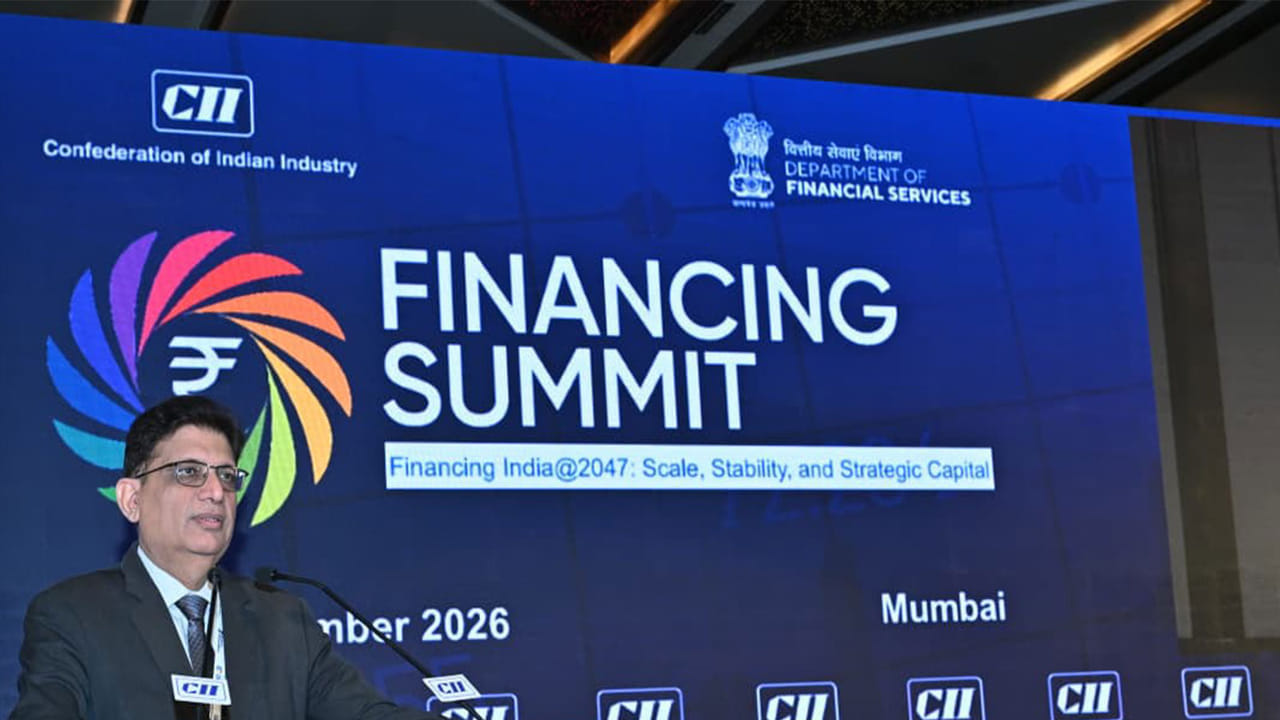
DIPAM Secretary Arunish Chawla highlights the importance of mobilising domestic savings and deepening capital markets to drive India's growth towards Viksit Bharat, urging for efficient deployment of household funds into productive assets.
DIPAM Secretary Urges Mobilising Domestic Savings For Viksit Bharat
Mumbai (Maharashtra) [India], November 19 (ANI): Mobilising domestic savings and deepening capital markets remain critical to financing India's journey towards Viksit Bharat, Department of Investment and Public Asset Management (DIPAM) Secretary Arunish Chawla stated during his address at the CII-DFS Financing Summit 2026 held in Mumbai on Thursday. Speaking at the inaugural session titled "Finance for Prosperity: Mobilising India's Capital for Viksit Bharat," Chawla noted that the country requires a more productive deployment of household funds alongside a diversified financial system that serves micro, small and medium enterprises (MSMEs), infrastructure, and households equally.
He pointed out that Indian households participate widely in capital markets and digital finance, which represents a democratisation of the financial ecosystem. He added that the next step involves channelling these savings into productive financial assets through supportive policy and regulatory frameworks. Calling for a better balance between equity and fixed-income markets, the DIPAM Secretary emphasized developing the domestic bond market.
He also outlined four distinct stages in a company's financing lifecycle, start-up, growth, harvest, and reinvention, and urged stronger domestic participation in alternative investment funds, venture capital, and private equity to support entrepreneurs across each phase. On the infrastructure front, Chawla advocated for self-financing models and public-private partnerships across central, state, and city levels. He noted that Infrastructure Investment Trusts and Real Estate Investment Trusts connect physical assets with capital markets, enabling capital recycling and the deployment of underutilised properties to generate employment and growth.
Addressing the same session, Economic Advisory Council to the Prime Minister Chairman Prof S Mahendra Dev stated that sustaining an economic growth rate of around 8 per cent over the next two decades requires an investment rate of roughly 34 to 35 per cent of GDP. Alongside the volume of investment, its efficiency would be crucial, with project implementation, technology adoption and capacity utilisation determining how effectively capital translates into economic output, Dev remarked. He explained that public infrastructure improves connectivity and aids enterprise activity, while manufacturing and services must expand together alongside research and innovation. Because households contribute nearly two-thirds of domestic savings, directing these funds effectively impacts capital formation. To resolve working-capital and collateral hurdles for MSMEs, Dev pointed to invoice financing via TReDS, credit guarantees, and digital public infrastructure such as the Account Aggregator framework and Unified Lending Interface.
In his welcome address, R Mukundan, President, Confederation of Indian Industry, stressed that MSMEs continue to face challenges relating to the availability, ease and cost of credit. Financial market development must therefore translate into better financing access for smaller enterprises, rather than serving only larger businesses. Mukundan outlined three priorities for financial sector reform: operational and regulatory improvements; structural changes to the financial architecture required by 2047; and stronger institutions supported by deeper pools of long-term, strategic capital. (ANI)