
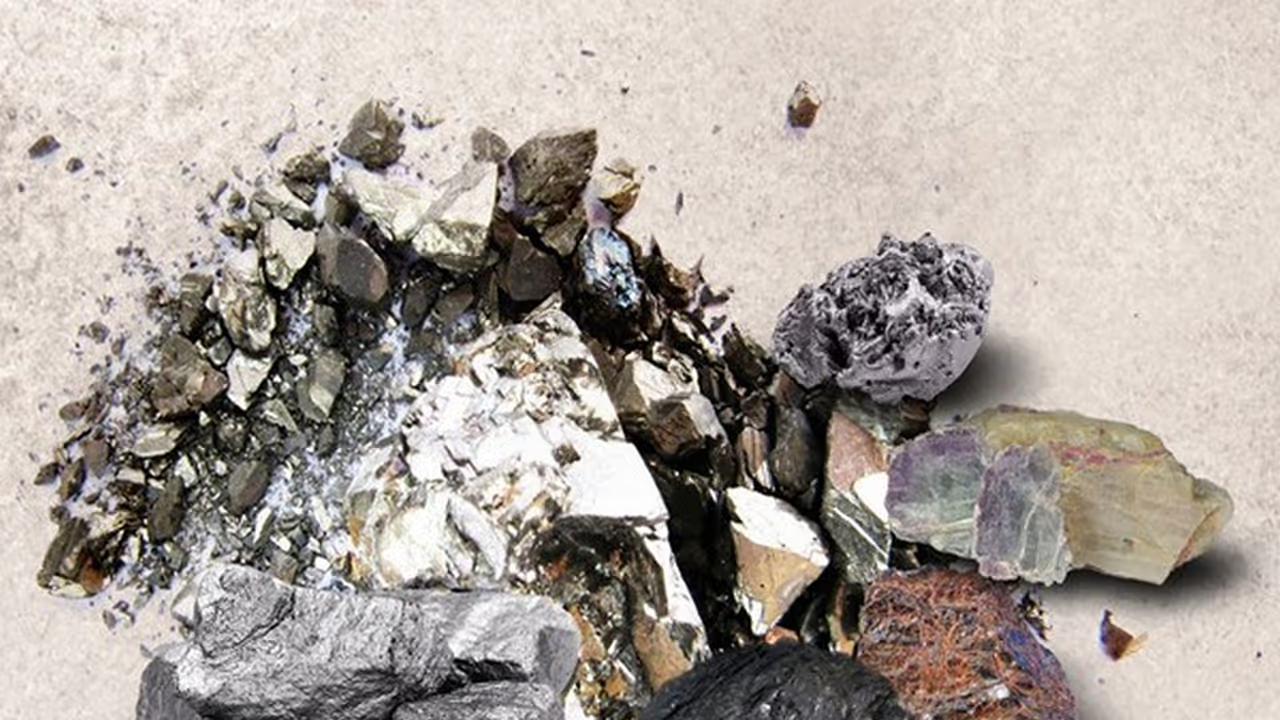
Global investment in critical minerals fell by 9% in 2025, ending years of growth, according to the IEA. The decline, driven by geopolitical tensions and price volatility, saw sharp pullbacks in battery metals while copper investment rose.
Global investment in critical minerals declined by 9 per cent in 2025, ending several years of growth despite strong long-term demand for minerals essential to clean energy technologies, electric vehicles and advanced industries, according to the International Energy Agency's (IEA) Global Critical Minerals Outlook 2026.
The report attributed the slowdown to rising geopolitical tensions, price volatility and a more cautious investment environment, even as demand fundamentals remained strong. "Critical mineral investment declined by 9% in 2025, ending several years of growth. Amid rising geopolitical tensions and price volatility, investors became more cautious despite strong underlying demand," the report said.
Investment Pullback in Specific Sectors
Battery metals witnessed the steepest pullback in investment. According to the report, capital spending in the segment fell by more than 20 per cent, marking the sharpest decline in over a decade, while lithium companies cut investment by around 40 per cent.
In contrast, copper continued to attract capital, with spending by copper-focused companies increasing 8 per cent, reflecting confidence in the metal's long-term demand outlook, the report added.
Exploration Spending Weakens
The IEA said exploration spending also weakened, declining by more than 10 per cent in 2025. Spending on lithium and nickel exploration dropped by around 45 per cent, outweighing steady investment in copper and modest growth in uranium exploration.
Most regions recorded lower exploration budgets, although Asia Pacific stood out with a 20 per cent increase.
Government Support Rises Amid Private Sector Caution
Despite weaker private investment, governments stepped up financial support for critical mineral projects. "Public finance commitments in advanced economies reached around USD 65 billion in 2025, over four times higher than in 2023," the report said, adding that a significant gap still remains between announced commitments and actual disbursements, which will determine how much these measures help diversify supply chains.
Uneven Investment Across Value Chain
The report also found that investment across the critical minerals value chain remains uneven. While mining projects continue to move ahead, refining and downstream processing capacity are not keeping pace. "Analysis of project pipelines reveals a structural imbalance in efforts to promote supply chain diversification, with refining and downstream capacity lagging behind mining," the IEA said.
It noted that in battery materials, planned cathode production capacity amounts to only about one-third of projected lithium mining capacity, highlighting the need for more balanced investment across the supply chain.
The agency said governments are increasingly deploying policy support, including grants, concessional loans and equity participation, to reduce investment risks and mobilise private capital for strategically important mineral projects as countries seek to build more resilient and diversified supply chains. (ANI)
(Except for the headline, this story has not been edited by Asianet Newsable English staff and is published from a syndicated feed.)