
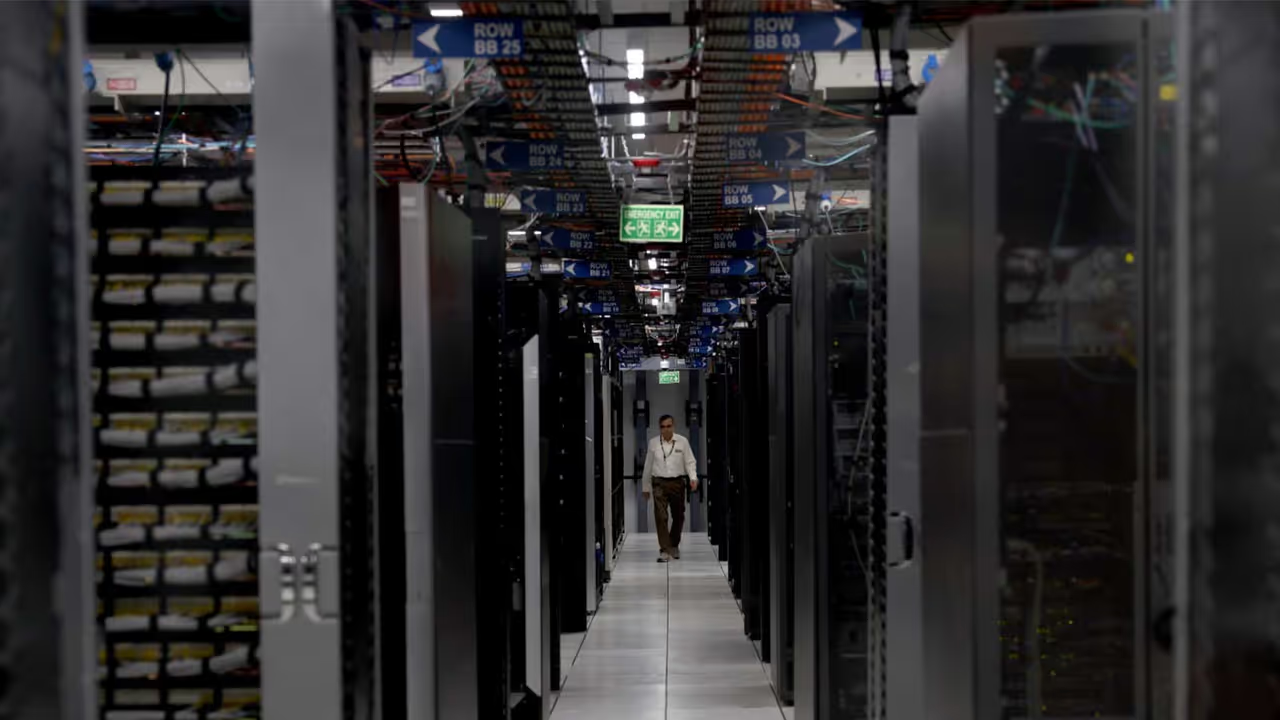
A Goldman Sachs report highlights a shift in China's AI data centre sector, where rising financing costs are pushing investors to prioritise profitable returns on investment and capital efficiency over mere capacity expansion.
China's rapidly expanding artificial intelligence (AI) data centre sector is facing growing pressure to demonstrate profitable returns on investment as rising financing costs and investor concerns shift attention from capacity expansion to capital efficiency, according to a Goldman Sachs research report.
The report said stronger-than-expected demand for AI infrastructure has improved the medium-term growth outlook for Chinese data centre operators. However, as new orders translate into long-term contracted capacity, the sector is increasingly being judged on its ability to generate returns that exceed the cost of capital.
Examining Business Models
Highlighting the changing investment environment, Goldman Sachs said, "the next stage of China data centre investing is less about securing MW capacity or contracts, but more about generating favourable capital returns." This shift comes as investors assess whether the substantial capital required for AI infrastructure can generate sufficient returns, particularly amid rising financing costs. Goldman Sachs examined three business models in China's data centre sector: traditional powered-shell facilities, integrated AI data centres that provide graphics processing unit (GPU) computing services under long-term contracts, and AI token factories that generate revenue by processing AI workloads.
Traditional Powered-Shell Facilities
Traditional powered-shell data centres offer relatively stable infrastructure revenues but may generate limited returns without favourable financing or asset-sale opportunities. The report estimated gross return on invested capital (ROIC) at around 5 per cent under its base-case assumptions.
Integrated AI Data Centres
Integrated AI data centres could generate higher returns by providing GPU-as-a-service under three-to-five-year contracts. However, profitability depends on GPU procurement costs, rental prices, financing and the risk of hardware becoming obsolete. Goldman Sachs estimated that certain configurations involving Nvidia B300-equivalent servers could support a 15 per cent annual ROIC under specific pricing and capital-cost assumptions.
AI Token Factories
AI token factories could offer still higher returns by monetising computing capacity through AI inference and token production. The report modelled an ROIC of around 21 per cent for an asset-light token factory and around 43 per cent for one owning its GPU infrastructure. These are model-based estimates, not actual returns achieved by companies.
Opportunities for Capital Efficiency
The report also highlighted potential opportunities for operators to improve capital efficiency through asset recycling, lower-cost debt and overseas expansion.
Overall, Goldman Sachs' analysis suggests that China's AI data centre sector is entering a phase in which investment returns, financing costs and the ability to monetise computing capacity will become increasingly important in determining the long-term value of businesses. (ANI)
(Except for the headline, this story has not been edited by Asianetnews Editorial staff and is published from a syndicated feed.)